
NASA's Juno Measured the Temperature Below Io's Surface for the First Time. The Most Volcanic World in the Solar System Got Stranger.
For more than four decades, everything scientists knew about the heat inside Io came from infrared readings of the moon's surface. Now Juno's Microwave Radiometer has measured the temperature below the crust for the first time, during two close flybys. The results, published in JGR: Planets in July 2026, show heat rising more than 40 degrees Fahrenheit just a few feet down, a surface as smooth and light as volcanic ash, and a technique that could one day help study volcanoes on Earth.
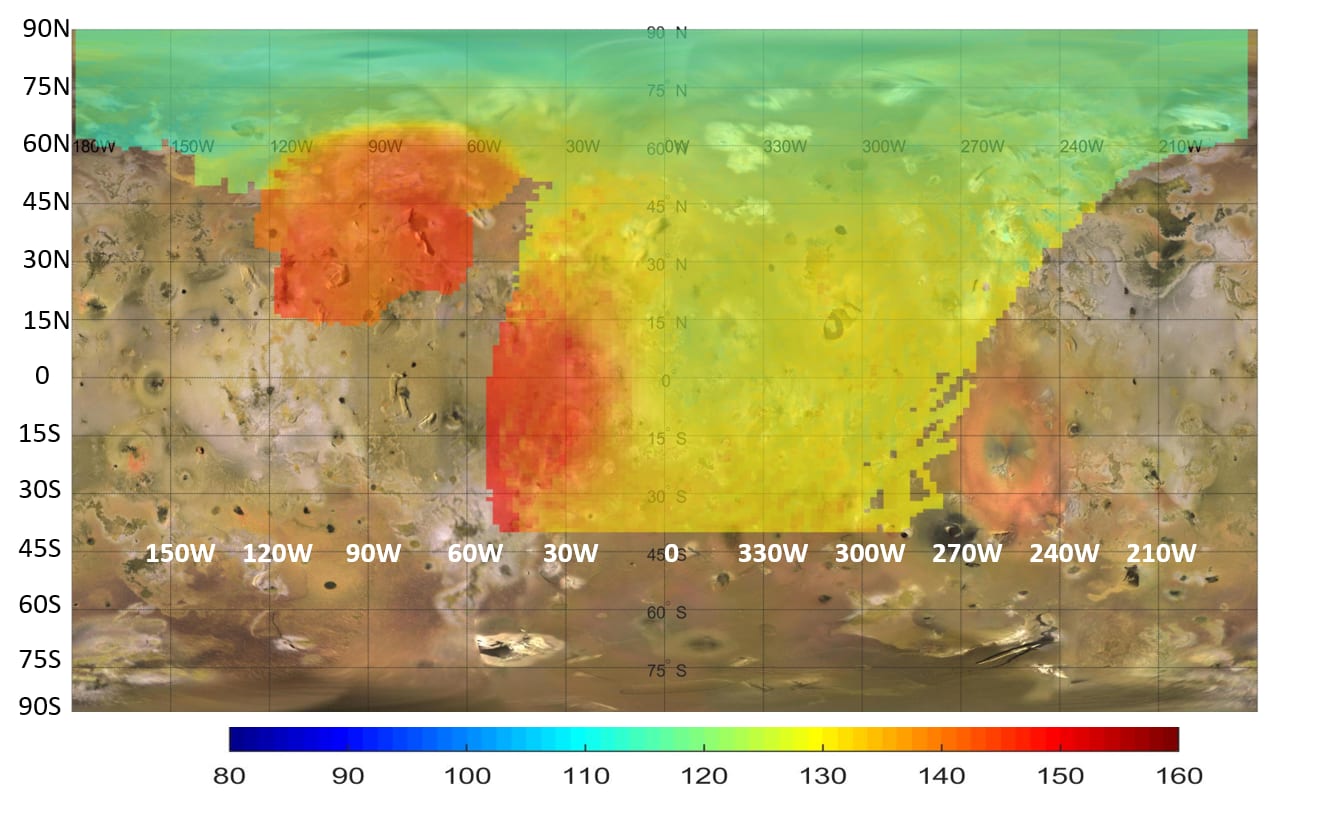
For more than four decades, everything scientists knew about the heat inside Io came from one place: infrared readings of the moon's skin. Infrared sees only the top of a surface. If the heat that powers Io's hundreds of volcanoes was stored deeper, no instrument had ever been able to check.
Now NASA's Juno spacecraft has done exactly that. Using its Microwave Radiometer, or MWR, Juno measured the temperature below Io's surface for the first time, during two close flybys in December 2023 and February 2024. The results, published July 22, 2026, in the Journal of Geophysical Research: Planets, show heat rising more than 40 degrees Fahrenheit (22 degrees Celsius) just a few feet into the ground, everywhere the spacecraft looked. They also reveal that most of Io's surface is surprisingly smooth and made of very low density material, more like volcanic ash or pumice than solid rock.
The most volcanic world in the solar system
Io is the most volcanically active body in the solar system, home to an estimated 400 volcanoes that blast lava and plumes in what look like continuous eruptions. It is a small world, about the size of Earth's Moon, squeezed by the gravity of the largest planet in the solar system.
The moon was discovered by Galileo Galilei on January 8, 1610, but its volcanic nature stayed hidden for centuries. It was not until 1979 that imaging scientist Linda Morabito of NASA's Jet Propulsion Laboratory spotted a volcanic plume in an image from the Voyager 1 spacecraft, the first active volcanism ever seen on a world beyond Earth.
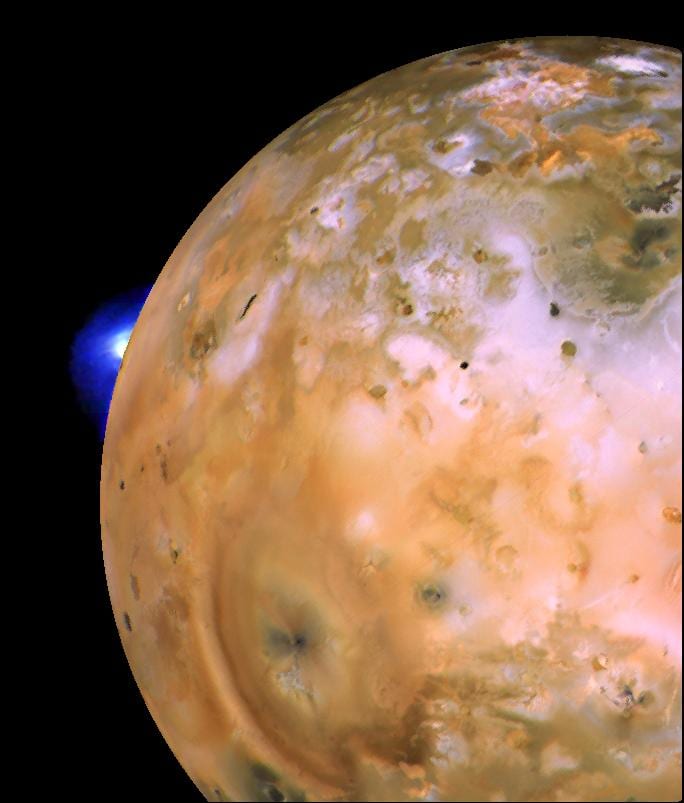
Since Morabito's discovery, the question has been how the volcanoes are fed. Io's extreme volcanism is powered by tidal heating. The moon orbits Jupiter once every 42.5 hours on a slightly elliptical path, so the planet's immense gravity stretches and squeezes it with every lap. That constant flexing creates friction inside the moon, generating internal heat many times greater than Earth's own heat output. Io, Europa, and Ganymede are also locked in an orbital resonance that keeps Io's orbit from ever becoming circular, so the squeezing never stops.
How microwaves see below a surface
Until Juno, nearly everything known about that heat came from infrared observations, which sense only the temperature of the top surface. Infrared cannot see through rock. Microwaves can, which is why the MWR, an instrument originally designed to peer beneath Jupiter's cloud tops, turned out to be the right tool for a moon.
The MWR's six microwave antennas work as a single instrument, detecting microwaves across a wide range of wavelengths, from about half an inch to 20 inches (1.3 to 51 centimeters). The key trick: each wavelength explores a different depth. Longer wavelengths see deeper, so a single pass can build a temperature profile of the ground beneath the spacecraft. During the mission's extended phase, the instrument has observed three of Jupiter's Galilean moons: Ganymede, Europa, and Io. At Ganymede and Europa, it probed tens of miles below ice shells assumed to be mostly pure water. That it could also see into the volcanic rock of Io was, in the words of Juno principal investigator Scott Bolton of the Southwest Research Institute, an unexpected discovery.
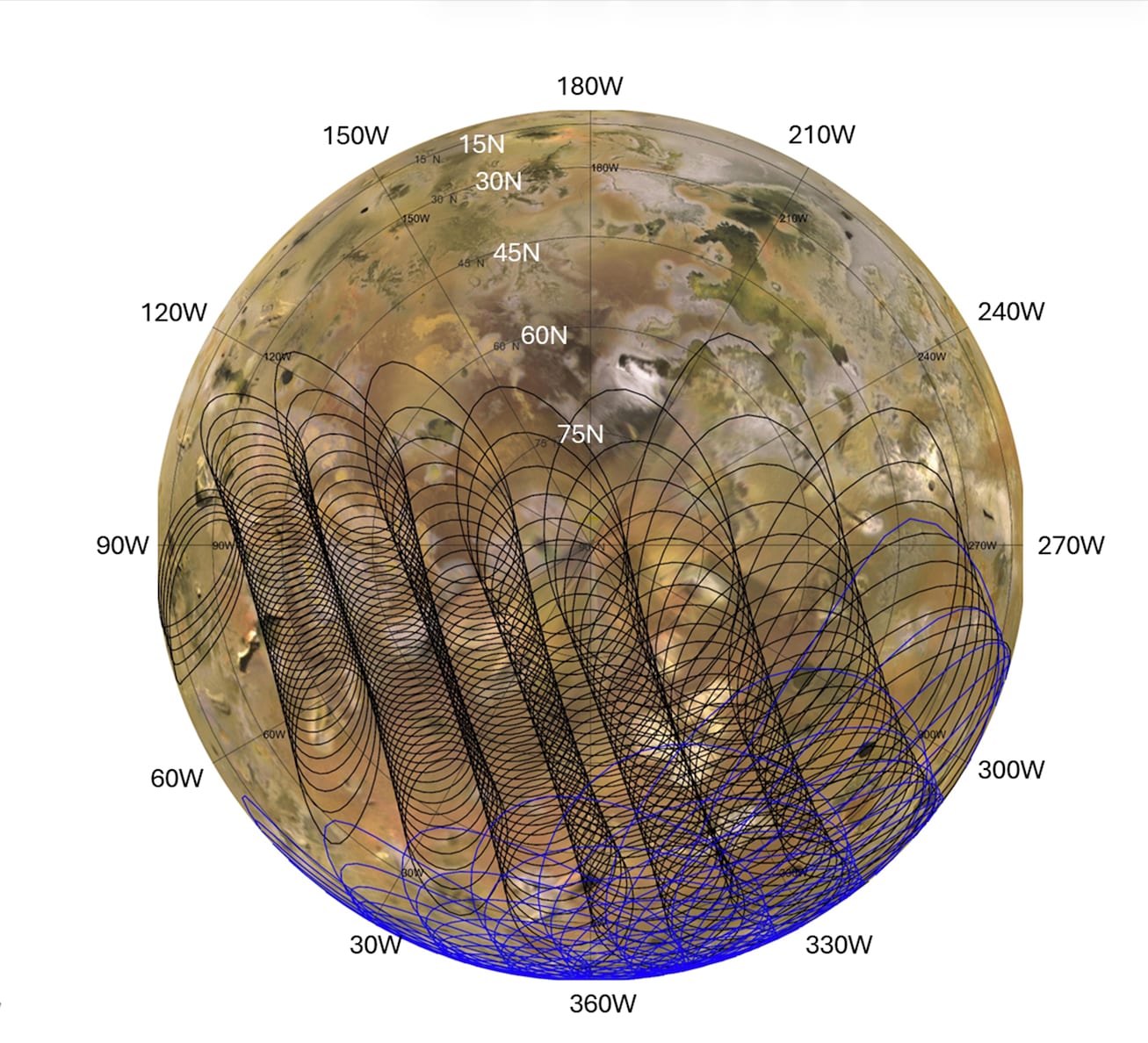
During those two flybys, Juno came within about 930 miles (1,500 kilometers) of Io's surface, close enough for the instrument to measure the moon's thermal emission from depths of a few inches down to tens of feet. "Everywhere we looked, we found the temperature rising by more than 40 degrees Fahrenheit just several feet into the surface, a gradient far steeper than solar heating alone can explain," said Shannon Brown, the paper's lead author at NASA's Jet Propulsion Laboratory.
Two ways to explain the hidden heat
The data suggests two possible explanations. First, heat could be rising steadily through a conductive crust. That background heat flow, measured at 1 to 3 watts per square meter, is gentle on a local scale, roughly equivalent to a small nightlight glowing under every square yard of ground. But across the entire moon, it adds up to a release of energy up to 30 times Earth's average heat flow.
Alternatively, the signal could come from cooling lava flows, capped by roughly 30 to 35 feet (9 to 11 meters) of solidified crust, covering about 10 percent of the moon's surface at any given time. Both explanations are consistent with the data so far, and both point to the same conclusion: Io is leaking its internal heat through its entire crust, not just at volcanic vents.
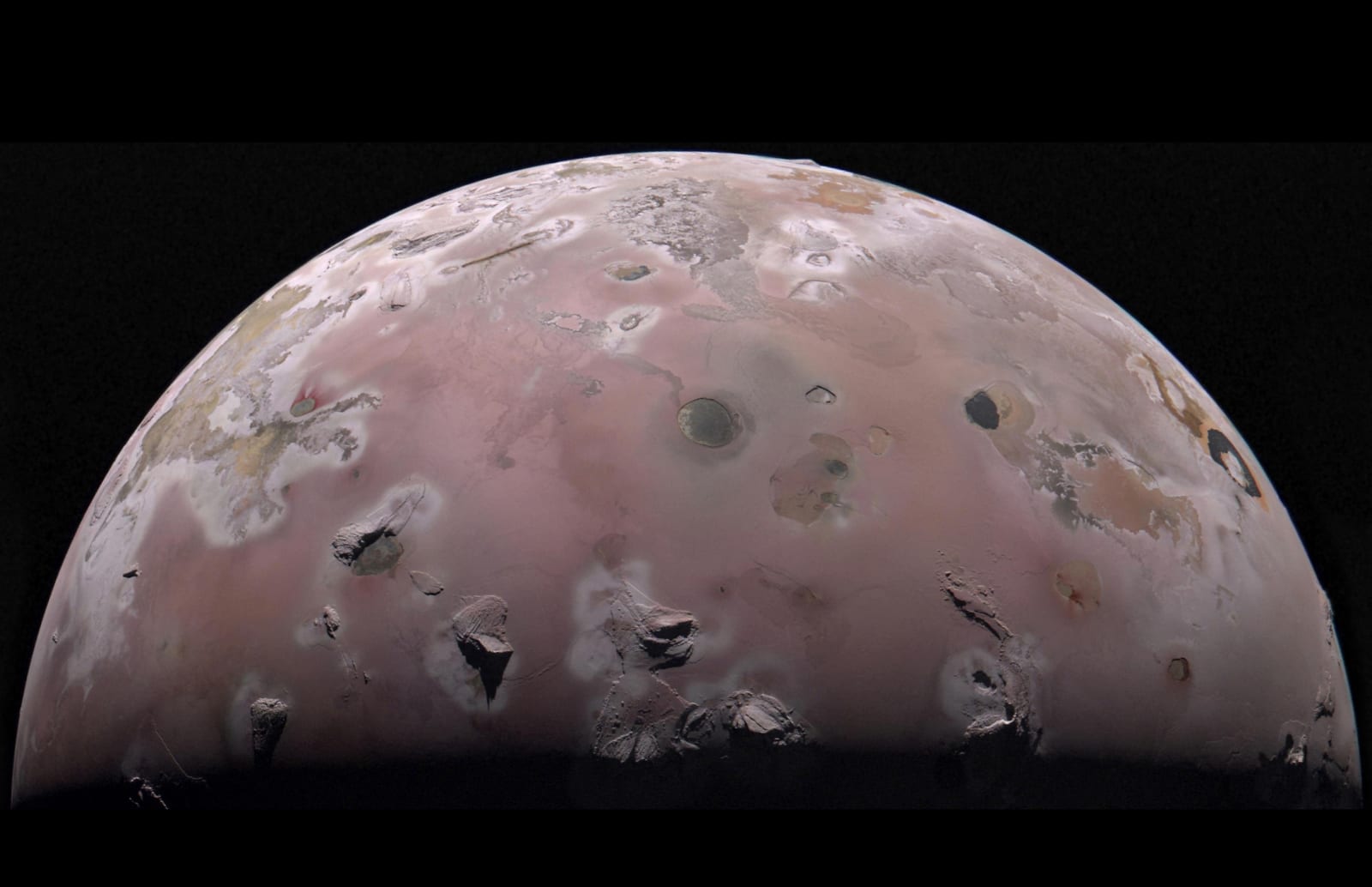
The microwave readings also settled a smaller question about what the surface itself is like. "Away from its mountains, the surface is more like the Great Plains of North America, and even though Io is a rocky body, the surface material has a very low density, more like pumice or a fluffy volcanic ash than solid rock," Brown said. At microwave wavelengths, most of Io looks smooth, a sign that the surface is being continuously resurfaced by lava and sulfurous fallout.
No global magma ocean
The new measurements land a year and a half after a companion result from the same two flybys. In December 2024, a team led by Ryan Park of JPL published a study in Nature based on high-precision Doppler tracking of Juno during the close approaches. The gravity data showed that Io's tidal deformation is consistent with a mostly solid interior, ruling out the shallow global magma ocean that scientists had debated since 1979, a 44-year-old mystery about how the volcanoes are fed.
Instead, each of Io's roughly 400 volcanoes is likely powered by its own chamber of roiling magma, rather than one ocean of melt beneath the whole crust. "Juno's discovery that tidal forces do not always create global magma oceans does more than prompt us to rethink what we know about Io's interior," Park said. "It has implications for our understanding of other moons, such as Enceladus and Europa, and even exoplanets and super-Earths."
Keep the two results distinct: the December 2024 gravity analysis constrains the deep interior, while the new microwave measurements describe the shallow subsurface. Together they sketch a moon that is solid and rigid at depth, with pockets of magma feeding individual volcanoes, and a porous, fluffy surface layer warmed from below.
Why looking below a rocky surface matters
The technique has implications well beyond Io. Bolton pointed out that a Microwave Radiometer-style instrument flown near a volcano on Earth might pick up a similar subsurface temperature signature, giving volcanologists a new way to study how terrestrial volcanoes work. That idea is worth testing, not yet proven, but it follows directly from what Juno measured.
The same physics that heats Io also operates across the cosmos. Tidal heating is what fuels the subsurface oceans on icy moons such as Europa and Ganymede, and it can keep worlds warm far from their parent stars. "Up until this point we could only observe the heat escaping at the surface or through eruptions," Bolton said. "Now we can characterize how the heat is moving from the interior toward the surface."
What the measurements do and do not show
A few caveats matter. The microwave readings describe the shallow subsurface, from inches to tens of feet down, not the deep interior; the magma-chamber conclusion comes from the separate gravity analysis. The smooth, low-density surface is an interpretation of how the surface emits microwaves, and the two heat-flow explanations are both still on the table. The 1979 date refers to the discovery of Io's active volcanism, not the moon itself, which Galileo found in 1610. And the Earth-volcano application is a proposal from the mission team, a technique worth trying rather than a demonstrated method.
What is not in doubt is the basic result: for the first time, a spacecraft measured the temperature below the surface of the most volcanic world in the solar system, and the heat is closer to the surface than anyone had been able to see.
Sources
- NASA JPL: NASA's Juno Takes Temperature of Jupiter's Fiery Moon Io (July 2026) - primary mission coverage with quotes from Bolton and Brown
- Brown et al., "Io Sub-Surface Temperature Profile Observed by the Juno Microwave Radiometer," Journal of Geophysical Research: Planets 131(7): e2025JE009622 (2026) - primary peer-reviewed paper
- Southwest Research Institute: NASA's Juno Takes the Subsurface Temperature of Jupiter's Fiery Moon (July 29, 2026) - release from the principal investigator's institution
- Universe Today: Juno Measures the Heat Below Io's Restless Surface (July 24, 2026) - detailed coverage of the MWR result
- NASA JPL: NASA's Juno Mission Uncovers Heart of Jovian Moon's Volcanic Rage (December 2024) - the magma-chamber result from the same flybys, published in Nature
Related on Impossible Universe
- For 100 Years, Scientists Could Not Explain Where Cosmic Rays Come From. Juno Just Watched Them Form. - the same spacecraft caught electrons accelerating near Jupiter's bow shock, another surprise from a mission built for a different job
- For 13 Years, Scientists Pelted Europa With Radar From Earth. What Bounced Back Changed How We'll Explore It. - the icy version of the same idea: seeing below a moon's surface to find out what is underneath
- New Horizons Heads for the Solar System's Edge. Forecasts Predict When It Will Cross the Boundary. - another long-lived NASA mission working at the frontier of the solar system
- Telescopes and Space Missions Topic Hub - the full collection of flagship observatories and solar system missions, including Juno
The hero image is a global map of Io built from Microwave Radiometer data, credit NASA/JPL-Caltech/SwRI/USGS, from the Brown et al. paper and NASA JPL release. The footprint graphic is credit NASA/JPL-Caltech/SwRI/USGS. The JunoCam north polar image is credit NASA/JPL-Caltech/SwRI/MSSS with image processing by Gerald Eichstädt. The Voyager 1 plume mosaic is credit NASA/JPL/USGS (PIA00010). NASA imagery is generally in the public domain. This article describes peer-reviewed research published in JGR: Planets on July 22, 2026, and related results published in Nature on December 12, 2024.