
Orcas Rammed a 4,400-Pound Sunfish So Hard It Exploded. The Video Is Real, and Scientists Still Don't Agree Why.
Scientists filmed orcas in the Gulf of California ramming dead sharp-tail sunfish so hard the fish burst into thousands of fragments. The newly documented ram-to-fragment behavior happened twice, a year apart, and the team behind the paper cannot yet say whether it helps calves feed, is a game, or both.
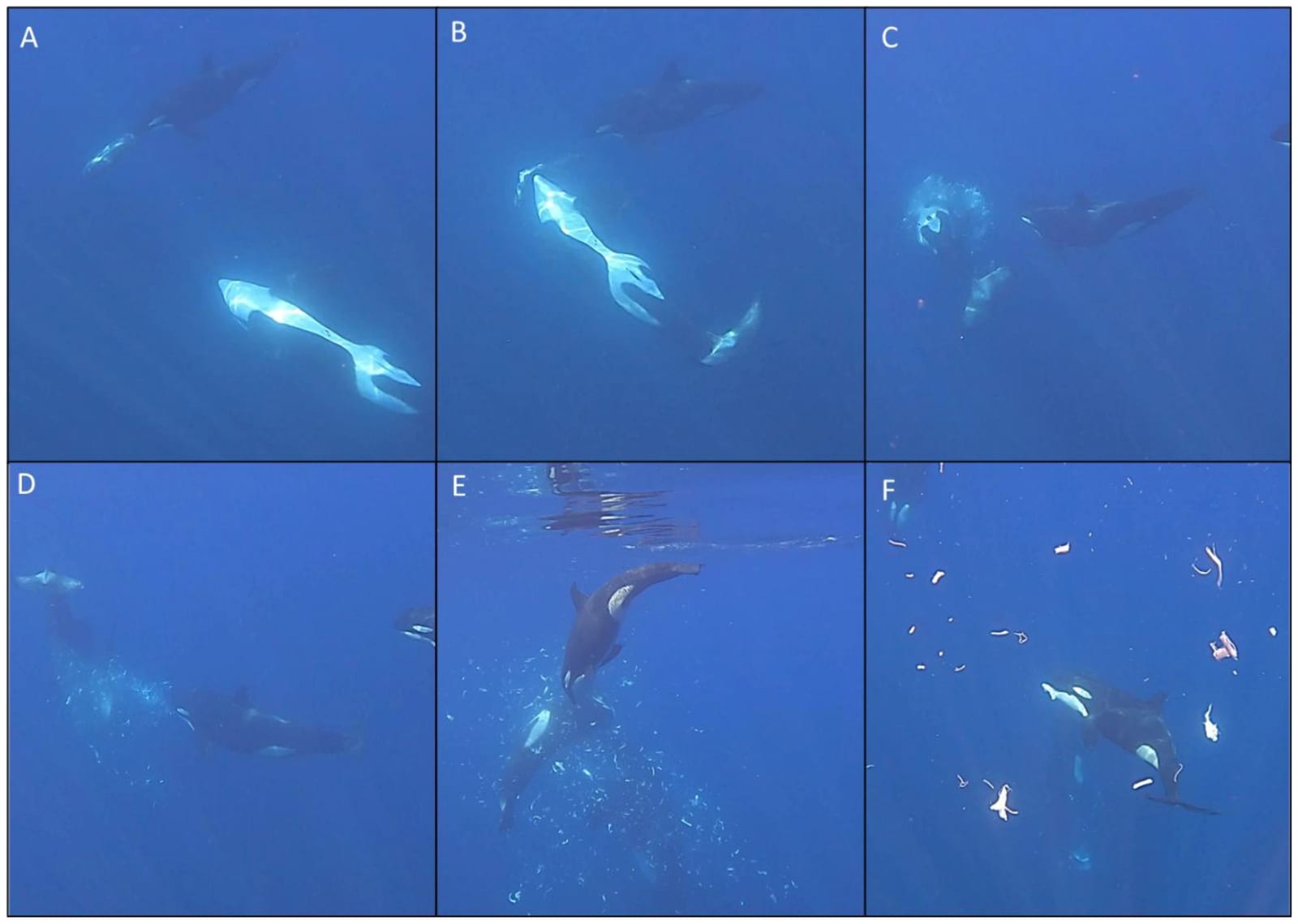
In July 2024, off the coast of San Jose del Cabo at the southern tip of Baja California, a group of orcas finished eating a spine-tail devil ray, then turned to a second carcass: a dead sharp-tail sunfish, one of the heaviest bony fish in the ocean. What happened next had never been formally documented. An adult female orca gripped the sunfish by its tail fin and held it steady in the water. An adult male accelerated toward the fish, belly up, at high speed. The female let go just before impact. The male slammed headfirst into the sunfish with enough force that the body came apart into thousands of fragments, with an audible impact that carried through the water. A juvenile orca, roughly half to three-quarters the size of the adult female, swam in and began eating the smaller pieces, while the adults fed on the split-open body and left the scattered fragments behind.
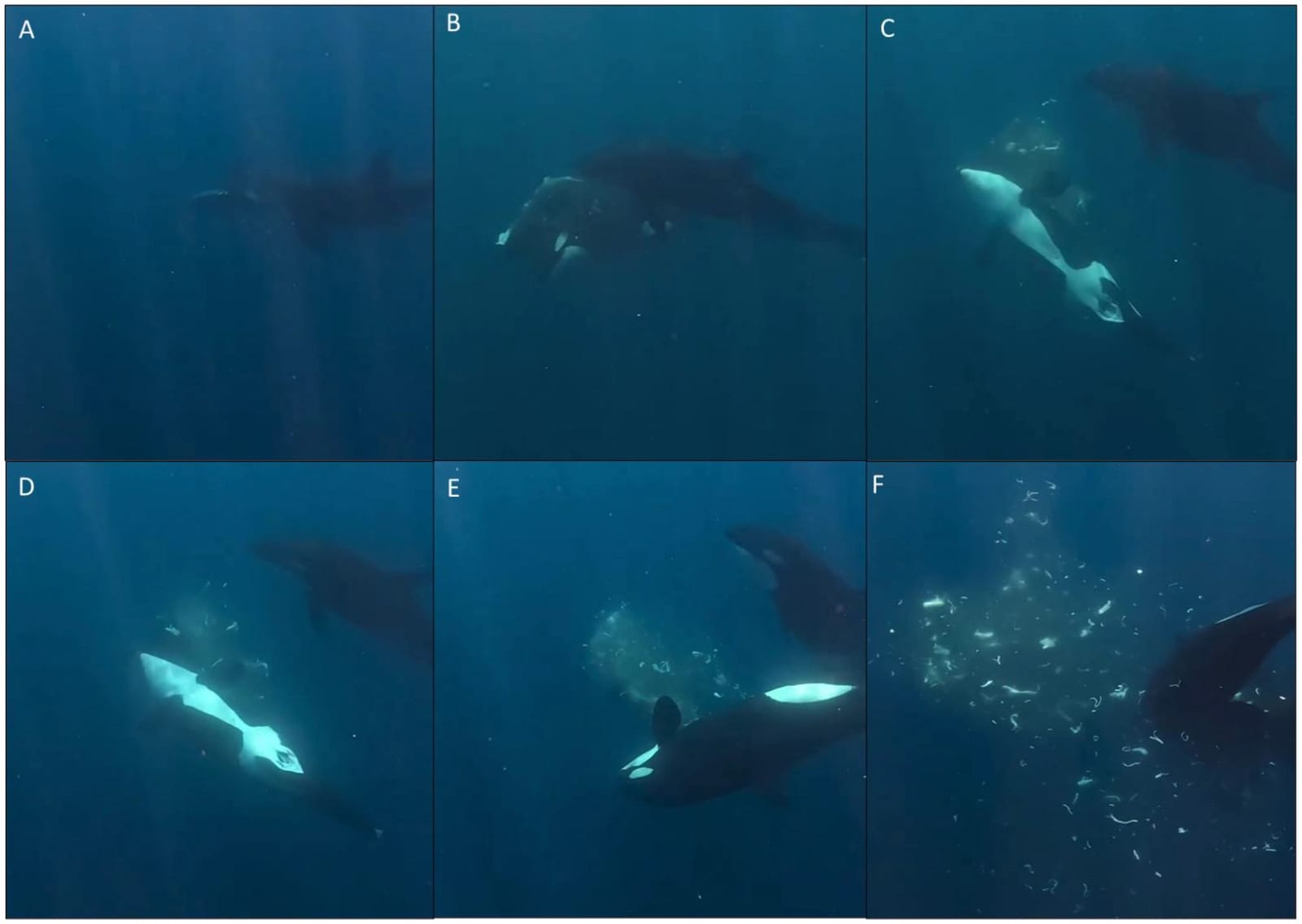
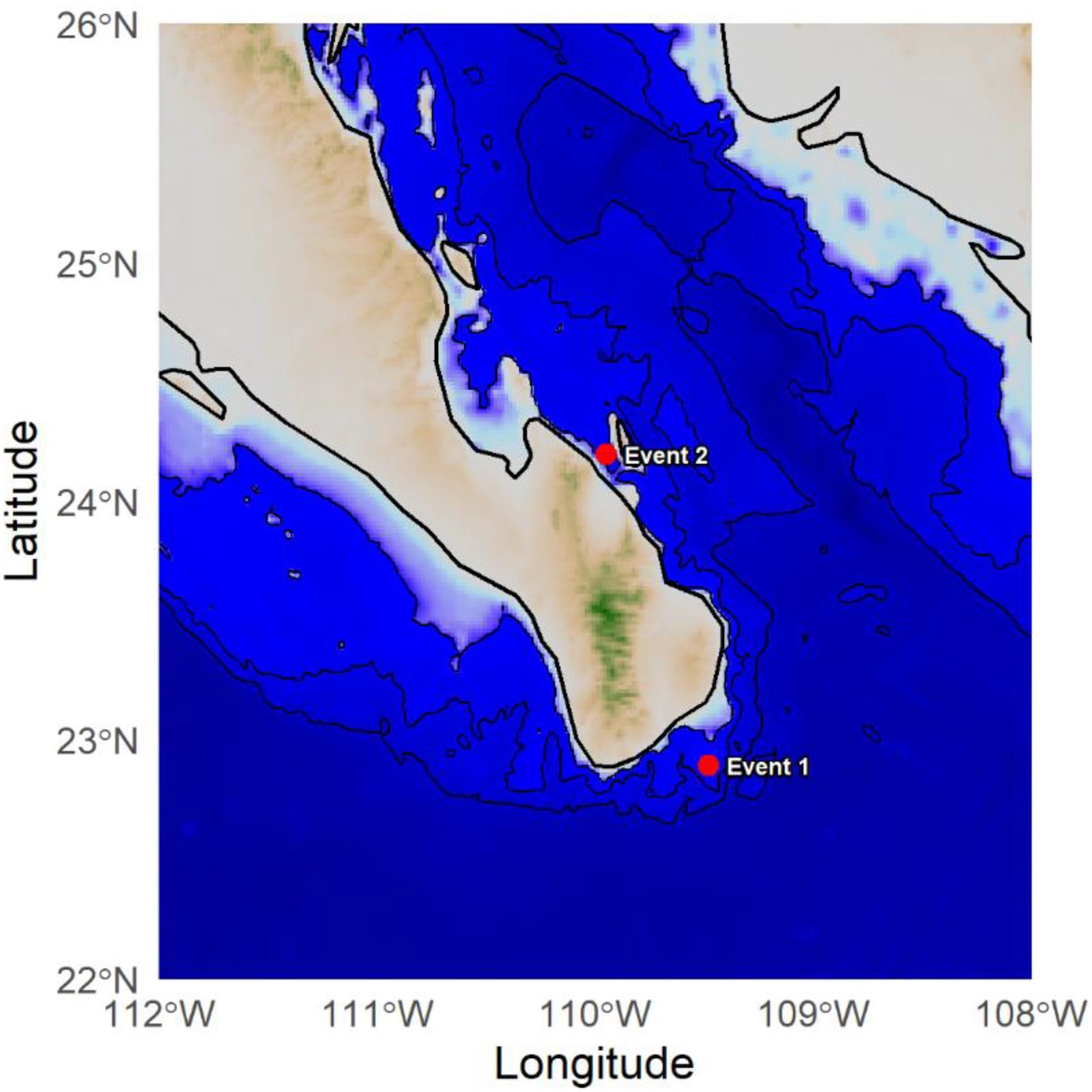
Kathryn Ayres, a research scientist at the ocean-health nonprofit Beneath The Waves, filmed the encounter herself with a GoPro. Just over a year later, in September 2025, a second group of orcas in the Gulf of California performed the same sequence: one female stabilized a sunfish while a second orca rammed it at speed, producing the same burst of fragments, with a third adult joining in afterward. That footage was filmed by Héctor Franz with a DJI Osmo Action 5. Ayres and her colleagues, including marine biologist Erick Higuera Rivas of Conexiones Terramar, published both events on July 23, 2026 in Frontiers in Ethology, and gave the behavior a name: ram-to-fragment.
A fish built like a floating slab
The sharp-tail sunfish, Masturus lanceolatus, belongs to the family Molidae, the sunfishes, which are the largest bony fish on Earth. Adults can exceed three meters in length and weigh as much as 2,000 kilograms, roughly 4,400 pounds. Despite their size they are not built like typical predators. Molids mostly eat gelatinous plankton, and they spend much of their time near the surface, basking, regulating body temperature, and having parasites removed, habits that leave them exposed to hunters in open water.
Under the skin, a molid carries a thick, gelatinous collagen layer called the capsule, made of nearly 90 percent water. That structure may be part of why the ramming is so dramatic. The researchers note that this level of fragmentation has not been reported for other sunfish species, and they suggest sharp-tail sunfish tissue may respond to high-energy impacts in a distinctive way. The species also has a more pronounced clavus, the tail fin, than other molids, which the paper says may give orcas an effective grip point during the maneuver.
Orcas already had a playbook for sunfish
Orca-sunfish encounters are not new. A 2023 global review led by Ingrid Visser of the Orca Research Trust catalogued 73 interactions between 1961 and 2022, clustered in Oceania, the eastern Pacific off Central and North America, and the South Atlantic. That review also documented the previously known hunting strategy: orcas target the sunfish's pectoral fins, open a wound in its side, remove the intestines and other organs, and then insert their rostrum into the body cavity to extract tissue.
The Gulf of California is one of the hotspots. A 2025 study documented 21 orca-sunfish predation events involving 17 photo-identified individual orcas, and suggested that at least four distinct orca groups include sunfish in their diet. The new paper's contribution is the specific maneuver: the force of the impact, and the near-total disintegration of the prey, which had not been described before.
Working in tandem is itself established orca behavior in the region. In the Gulf of California, orcas have been documented cooperating to hunt whale sharks, with several individuals holding the shark steady while another rammed it. The authors draw a direct comparison: the stabilize-and-ram coordination in the sunfish events, they write, indicates a high degree of cooperative precision.
A feeding strategy, a game, or both
The team's interpretation is deliberately open. The most obvious reading is parental investment: shattering the carcass turns one enormous, awkward meal into bite-size pieces that a calf or juvenile can actually eat. In the first event, the juvenile fed on the small fragments while the adults ate the main body, which fits that picture. Orcas are known to tear prey apart and share it with younger members of the group.
The other reading is play. Orcas are famous for playing with their food, and they engage in non-consumptive interactions with prey, striking or killing animals without eating them. Higuera Rivas told NPR that the two events had the character of a social game, with one orca setting up the prey for another to hit. For a behavior to count as fun, he said, it needs to be voluntary, rewarding, and involve modified or exaggerated behaviors, and both encounters fit that description in his view.
Robert Pitman, a marine ecologist at Oregon State University who was not involved in the study, leans toward the feeding explanation. Sunfish are difficult prey, he told NPR: their skin is dense, rubbery, and collagenous, several inches thick, and "there just doesn't seem to be much to eat on a sunfish." Older orcas that hunt sharks can wear their teeth down to the gums, and young orcas may have no teeth at all. Ramming a sunfish into pieces, Pitman said, is "a clever way to deal with a difficult prey item."
Higuera Rivas came to a similar conclusion from a different angle. "Orcas do not possess hands or tools to tear apart their prey," he said, so ramming sunfish into "bite-size pieces" is "incredibly practical." His working view is that the behavior is a feeding-plus-fun social activity, and he wants more examples before committing. If scientists ever watched adults ram a sunfish with no young present and no one eating the shreds, he said, that would support the entertainment reading.
The fragments change the water
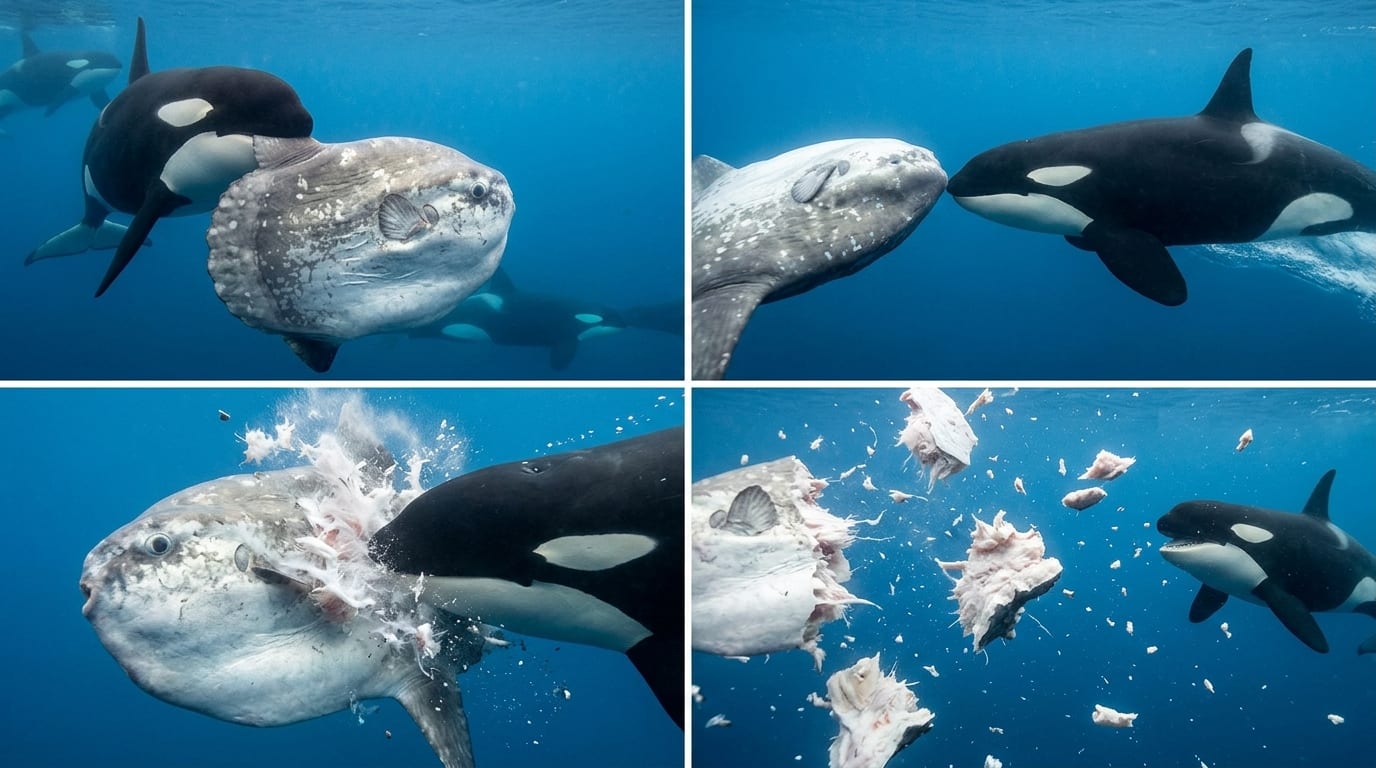
There is a quieter side effect. The sunfish's gelatinous capsule and outer skin host distinct microbial communities, and when the tissue shatters, those microbes disperse into the surrounding water, changing its nutrient composition. The paper suggests this redistribution may facilitate contact between the sunfish's microbiome and the orcas', which could carry nutritional or other functional benefits. It is a speculative thread, and the authors present it as such, but it is a reminder that a single high-speed collision can ripple through an ecosystem in ways that are easy to miss.
Two sightings, many open questions
Two events is a tiny sample. The researchers cannot say whether the same orcas were involved in both encounters, because the identification features, dorsal fins and eye patches, were not captured clearly enough in both. They cannot say whether ram-to-fragment is a local specialty or a widespread technique. Pitman noted that the behavior could be a regional innovation; Higuera Rivas said it may be "cultural knowledge" restricted to a handful of pods in the area. Whether orcas elsewhere in the world practice it remains to be seen.
There is also an observation-bias problem, which the paper flags itself. Tourism in the Gulf of California has grown, and affordable drones and underwater cameras have put capable recording gear in far more hands. Many orca-sunfish interactions have been documented through social media posts. More sightings may reflect more eyes on the water rather than more actual behavior. Mexican authorities, the authors note, recently released a management plan to regulate swimming with orcas in the Gulf of California, and the paper argues that managed collaboration between scientists and tour operators is one of the best ways to catch rare behaviors like this one on camera.
What would settle the question? More footage, especially with clear identification shots. "Collecting good identification photographs whenever possible is key: we are still seeing new techniques of how orcas hunt and process their prey," Ayres said. "They're one of the most iconic marine predators in the world, yet they continue to surprise us."
Pitman, who has seen orcas carrying sunfish "like a large pizza box in its mouth" many times without knowing what they were doing, put it more simply: "Maybe now I know."
Sources
- Ayres et al., "Fragmentation of sharp-tail sunfish (Masturus lanceolatus) caused by high-impact ramming behavior in orcas (Orcinus orca)," Frontiers in Ethology 5:1835536 (July 23, 2026), DOI 10.3389/fetho.2026.1835536 - the primary peer-reviewed paper, open access under CC BY 4.0, with the video-still figures reproduced here
- ScienceDaily / Frontiers, July 23, 2026: Orcas filmed smashing giant sunfish into thousands of pieces - event details, the sunfish size and weight figures, and the Ayres quotes
- NPR, July 24, 2026: Video: Scientists watch orcas ram a sunfish so hard it explodes - the Robert Pitman and Erick Higuera Rivas comments
- Smithsonian Magazine: Video Captures Orcas Ramming a Sunfish So Hard It Explodes - coverage with the Héctor Franz footage credit (link requires a browser)
- Orca Research Trust: Orca and Sunfishes - Visser et al. 2023 global review of orca-sunfish interactions and the previously known hunting strategies
Hero and inline figures: reproduced from Ayres et al., Frontiers in Ethology 5:1835536 (2026), an open-access article licensed under CC BY 4.0. The video stills in the paper were filmed by Kathryn Ayres (July 2024 event) and Héctor Franz (September 2025 event). Behavior-sequence diagram: generated illustration by the Impossible Universe Editorial Team.
Related on Impossible Universe
- Goblin Shark Filmed Alive in the Deep Ocean for the First Time - another rarely filmed marine predator, documented in its natural habitat for the first time
- A Golf-Ball-Sized Blue Octopus From 6,000 Feet Deep - a tiny new octopus species discovered in the Galapagos
- This Shark Walks on Four Fins. Scientists Just Found a New One. - a tenth species of walking shark found off Papua New Guinea
- In Two Weeks Off Brazil, Scientists Identified 31 New Deep-Sea Species - the ocean's largest habitat keeps yielding animals science has never described