
Solar Panels Just Hit 35.5% Efficiency. The 43% Ceiling Is Now in Sight.
On July 14, 2026, LONGi announced a certified crystalline silicon-perovskite tandem solar cell efficiency of 35.5%, verified by the European Solar Test Installation. The theoretical limit for these cells is 43%, far above the 33.7% Shockley-Queisser limit that constrains traditional silicon panels. The technology stacks a perovskite layer on top of silicon to capture more of the solar spectrum, and the remaining barriers are manufacturing and stability, not physics.
On July 14, 2026, Chinese manufacturer LONGi announced that its crystalline silicon-perovskite tandem solar cell had reached a certified conversion efficiency of 35.5 percent. The certification came from the European Solar Test Installation (ESTI), an independent authority in Pamplona, Spain, that validates photovoltaic performance claims for the global solar industry.
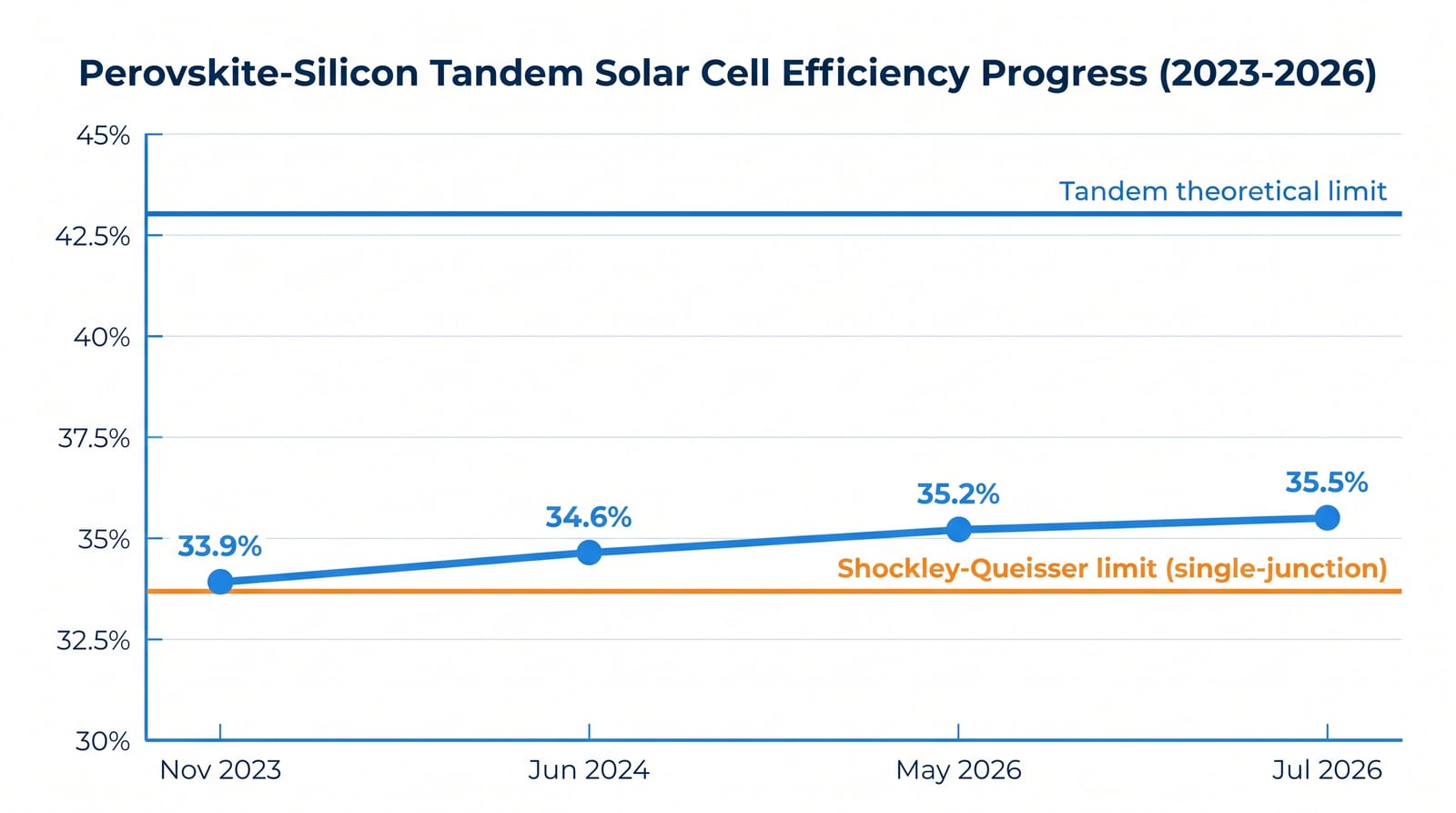
The number matters because it sits well beyond the theoretical ceiling that governs every conventional solar panel on the market today. The Shockley-Queisser limit, a fundamental constraint derived in 1961, sets the maximum efficiency of a single-junction silicon solar cell at 33.7 percent. No amount of engineering can push a standard silicon cell past that boundary.
Tandem cells break that limit by layering two different materials on top of each other. The perovskite layer on top absorbs blue and green light efficiently. The silicon layer underneath captures red and infrared light that passes through the perovskite. Together, they cover more of the solar spectrum than either material alone, and their combined theoretical ceiling sits at roughly 43 percent.
The new record is the latest step in a climb that has accelerated noticeably. LONGi's tandem cell team reported 33.9 percent in November 2023, then 34.6 percent in June 2024, then 35.2 percent in May 2026, and now 35.5 percent. Each jump is a fraction of a percentage point, but in photovoltaic engineering, those fractions represent real advances in material quality, interface engineering, and optical management.
LONGi also demonstrated the technology at industrial-scale sizes. On a 261 square centimeter cell, roughly the dimensions of a smartphone screen, the team achieved 34.3 percent efficiency. On full tandem modules, the company reported 31.4 percent and 29.4 percent, both independently certified. Those module-level numbers are closer to what a rooftop or utility-scale installation would actually produce, and they suggest that the gap between lab records and commercial reality is narrowing.
Two records, different architectures
The LONGi announcement came alongside a separate but complementary milestone from Nankai University in China. On April 30, 2026, a team led by professors Yuan Mingjian and Jiang Yuanzhi published a paper in Nature reporting a certified steady-state efficiency of 27.17 percent for a single-junction n-i-p perovskite solar cell. That is a different architecture from LONGi's tandem cell, and it sets a world record for that specific design.
The Nankai team identified a fundamental bottleneck in n-i-p perovskite cells: the interface between the electron transport layer and the perovskite absorber. By engineering a continuously gradient-doped layer of tin oxide (SnO2), they reduced energy losses at that junction and pushed the efficiency past the 27 percent mark that had been a stubborn ceiling for this architecture. The reverse-scan efficiency reached 27.50 percent, also a record.
Together, the two records mark separate fronts in the same campaign. Tandem cells aim for the 43 percent theoretical ceiling by stacking materials. Single-junction cells aim to reach the practical maximum of their own simpler design, which is cheaper to manufacture and already closer to commercial deployment.
What tandem cells actually do
A standard silicon solar cell works because photons from sunlight knock electrons loose in the silicon crystal. Those electrons flow as current. But silicon absorbs only part of the solar spectrum efficiently. High-energy blue and violet photons generate heat instead of electricity. Low-energy infrared photons pass through without being absorbed.
A perovskite-silicon tandem cell solves this by splitting the spectrum. The perovskite layer on top, a crystalline material with a tunable bandgap, captures the high-energy photons. The silicon layer underneath captures the lower-energy ones that the perovskite let through. The two layers are connected in series, so the voltage adds while the current stays matched.
The concept is not new. Perovskite materials were first described crystallographically in 1839, named after Russian mineralogist Lev Perovski. Their potential for photovoltaics was recognized only in the late 2000s, and the first perovskite solar cells appeared around 2009 with efficiencies below 4 percent. The speed of improvement since then has been extraordinary, faster than any other photovoltaic technology in history.
The barriers that remain
Efficiency is not the only metric that matters. Perovskite-silicon tandem cells face three main hurdles before they can replace conventional silicon panels at scale.
Stability. Perovskite materials degrade faster than silicon when exposed to heat, moisture, and continuous sunlight. A silicon panel can operate for 25 to 30 years with gradual degradation. Perovskite tandem cells have not yet demonstrated commercial-level lifespans, though accelerated aging tests have improved significantly in the last two years. Encapsulation techniques and new perovskite compositions are the main lines of attack.
Manufacturing scale. Making a perovskite layer that is uniform across a square-meter panel is harder than making one on a lab-scale substrate. LONGi's 261 square centimeter cell at 34.3 percent shows progress, but commercial solar panels are 1.6 to 2 square meters. The transition from lab-scale to production-scale is the classic valley of death for emerging photovoltaic technologies, and several companies in the US, Germany, and South Korea are now attempting the crossing.
Lead content. The highest-performing perovskite formulations contain lead, a toxicity concern for manufacturing, installation, and end-of-life disposal. Lead-free alternatives exist but have not matched the efficiency and stability of lead-based perovskites. Researchers are exploring tin-based perovskites and other substitutes, and encapsulation can contain the lead during the panel's operational life, but the question remains open.
These are engineering problems, not physics problems. The 43 percent theoretical ceiling means the fundamental science supports much higher efficiencies. The question is whether manufacturing can deliver them reliably and economically.
Why this matters for the energy transition
Solar photovoltaic capacity has been doubling roughly every three years for the last two decades. The International Energy Agency projects that solar will become the largest single source of electricity by 2035. Tandem cells could accelerate that timeline by producing more power per square meter, reducing the land area and materials required for utility-scale solar farms, and enabling solar installations in space-constrained environments like rooftops and building facades in dense urban areas.
The economic logic is straightforward. If a tandem panel produces 40 percent more electricity than a conventional panel of the same physical size, the cost of the electricity drops even if the panel itself costs more to manufacture. The balance of system costs, the racking, wiring, labor, and land, are roughly the same regardless of panel efficiency. Higher efficiency means those fixed costs are spread over more kilowatt-hours.
LONGi's results suggest the industry is not slowing down. The company operates a tiered research structure that the press release described as "one generation in mass production, one in development, and one in reserve." The 35.5 percent record is the generation in development. Commercial tandem panels, if the stability and manufacturing challenges are resolved, would be the generation in production.
Sources
- LONGi press release: 35.5% crystalline silicon-perovskite tandem solar cell efficiency (July 14, 2026)
- Nankai University: Continuously graded-doped SnO2 for efficient n-i-p perovskite solar cells, Nature (April 30, 2026)
- The Energy Mix: Two Chinese companies set new world records for solar cell efficiency
- Green Fuel Journal: Perovskite solar cell revolution 2026 (review)
- Shockley, W. and Queisser, H.J., "Detailed Balance Limit of Efficiency of p-n Junction Solar Cells," Journal of Applied Physics, 1961