The Planet Nine Mystery Just Got a Twist. A New Frozen Object Called Ammonite Deepens the Debate.
Astronomers using the Subaru Telescope in Hawaii discovered 2023 KQ14, a frozen sednoid nicknamed Ammonite whose orbit is misaligned with the three other known extreme trans-Neptunian objects. The discovery weakens one of the key arguments for Planet Nine but also narrows where a hidden planet could be hiding, as the Vera C. Rubin Observatory begins its search.
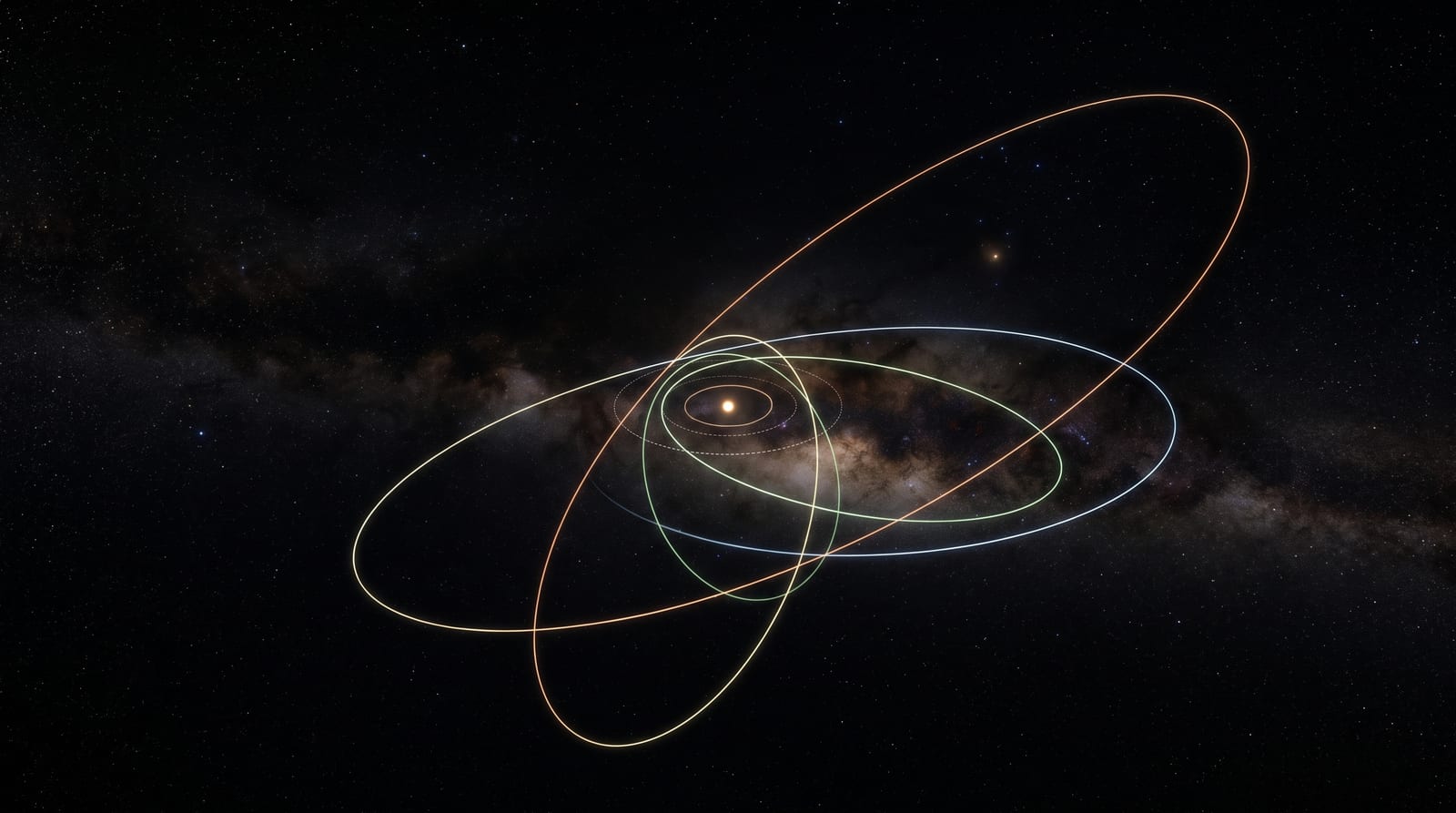
For nearly a decade, the case for a hidden ninth planet in the outer solar system has rested on a single line of evidence: the strange orbital alignment of the most distant known objects beyond Neptune. A handful of frozen worlds out beyond the Kuiper Belt all appeared to share the same tilted, elongated orbital geometry, as if something massive and unseen was herding them into place.
Then, in June 2026, a new frozen object called Ammonite was discovered. It does not fit the pattern.
Announced in Nature Astronomy on June 8, 2026, the object officially designated 2023 KQ14 was discovered by the Subaru Telescope on Maunakea as part of the FOSSIL II survey, a project specifically designed to find high-perihelion trans-Neptunian objects. The survey covers about 25 square degrees of sky to a limiting magnitude of roughly 25.2, deep enough to spot the faintest residents of the outer solar system.
What the team found was a sednoid, a rare class of object defined by its extreme distance and large perihelion. Ammonite orbits the Sun with a perihelion of 66 astronomical units and a semi-major axis of 252 AU, taking roughly 4,000 years to complete a single circuit. It is dynamically stable over the entire age of the solar system, meaning its orbit has not been significantly altered by Neptune's gravity since formation.
And its orbit is misaligned with the three other known sednoids, filling a previously unexplained gap in the observed distribution of distant solar system objects while simultaneously weakening the orbital clustering that had been the strongest observational argument for a hypothetical Planet Nine.
The orbital clustering argument
In 2016, Caltech astronomers Konstantin Batygin and Mike Brown proposed the existence of a ninth planet, roughly 5 to 10 times the mass of Earth, orbiting at 400 to 800 AU from the Sun. Their argument was based on the unusual orbital clustering of several extreme trans-Neptunian objects, whose elongated orbits all appeared to point in roughly the same direction and tilt at similar angles. The probability that this clustering was random, they calculated, was roughly 0.007 percent.
The explanation, they argued, was a distant undiscovered planet whose gravity was sculpting the orbits of these objects into alignment, much the same way that Neptune's gravity shapes the classical Kuiper Belt.
The theory gained traction over the following decade. Additional extreme TNO discoveries added more data points, and refined calculations narrowed the predicted planet's parameters to roughly 4.4 plus or minus 1.1 Earth masses at a distance of around 290 AU. In 2024, a search of archival infrared data from NASA's IRAS and JAXA's AKARI missions turned up a candidate moving 47.5 arcminutes over 23 years, though its extreme 120-degree orbital tilt contradicted the predicted 15 to 20 degree tilt expected for Planet Nine, leading Brown himself to publicly doubt the candidate.
The search has not been for lack of looking. It is that the outer solar system is enormous, dark, and mostly unexplored. An object at 500 AU would be so faint that even the largest telescopes would struggle to detect it directly. And a single 10,000-year orbit means humans have been watching for less than 0.1 percent of one full circuit.
Ammonite changes the math
Ammonite does not disprove Planet Nine. But it does weaken one of the key lines of evidence.
Dr. Yukun Huang of the National Astronomical Observatory of Japan, a co-author of the discovery paper, put it directly: "The fact that 2023 KQ14's current orbit does not align with those of the other three sednoids lowers the likelihood of the Planet Nine hypothesis."
The discovery fills what the team calls the "q-gap," a region of perihelion distances between roughly 60 and 75 AU where no sednoids had been found. The existence of a sednoid in this gap was predicted by some models of outer solar system dynamics, and finding one there provides independent constraints on the history of the solar system, whether or not Planet Nine exists.
The team's simulations suggest that Ammonite and the other sednoids may have shared a primordial orbital clustering around 4.2 billion years ago, when the solar system was still settling into its current configuration. If that is correct, the clustering seen today may be a fossil signature of an earlier era, not evidence of a current gravitational influence.
What would confirm Planet Nine?
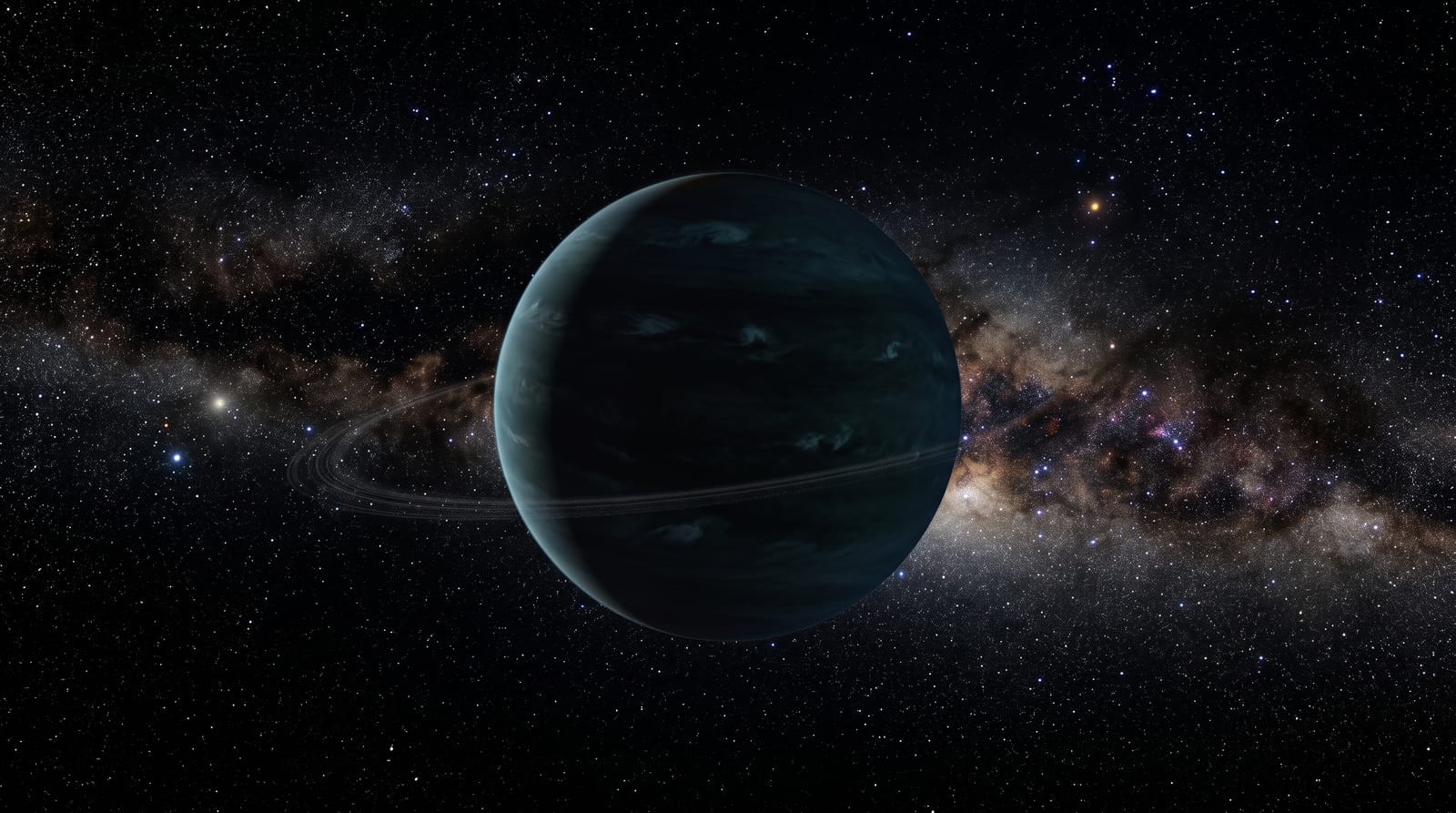
The strongest constraint from Ammonite's discovery is not about whether Planet Nine exists but about where it could be. The team's simulations show that Ammonite's stable orbit favors larger orbits, around 500 AU, for a hypothetical planet rather than closer ones. That is consistent with the original Batygin and Brown prediction and rules out some of the tighter orbital windows that had been proposed in recent refinements.
Mike Brown, speaking to Physics Today in 2026, summarized the search parameters clearly: "If we find something moving out around 500 to 600 AU, it will be Planet Nine."
The Vera C. Rubin Observatory in Chile began its full Legacy Survey of Space and Time on June 30, 2026, just weeks before this article was published. Rubin's 3,200-megapixel camera will image the entire southern sky every few nights for a decade, cataloging everything that moves. In its first month alone, Rubin discovered over 11,000 never-before-seen asteroids. The Rubin team has stated that finding or ruling out Planet Nine is one of the survey's explicit goals.
If Planet Nine exists within the predicted distance range, Rubin should detect it within its first two years of operations. If it does not, the survey will push the upper limit on any undiscovered large planet further out, shrinking the parameter space where it could hide.
Either result would settle a question that has stood for nearly a decade. A detection would be one of the most significant solar system discoveries in a century. A non-detection would force astronomers to reconsider whether the orbital clustering of sednoids has a different explanation entirely, such as a passing star in the Sun's birth cluster or a primordial dynamical instability.
Beyond Planet Nine
Even if Planet Nine does not exist, the search has produced real discoveries. Ammonite itself is a permanent addition to the solar system's census. The FOSSIL II survey that found it will keep scanning. Rubin will keep imaging. And each new object discovered in the outer solar system, whether or not it points toward a hidden planet, adds to the understanding of how the solar system formed and evolved.
"Sedna-like objects with large perihelia and semi-major axes provide insights into the early evolution of the Solar System," the team wrote in their Nature Astronomy paper. Their stable orbits preserve a record of conditions from the first few hundred million years after the Sun formed, a time when the solar system looked very different from the orderly planetary arrangement seen today.
Whether Planet Nine is real or not, the story of its search is a case study in how science works when the evidence is indirect, the data is sparse, and the object is too far away to see. It is orbital mechanics as detective work, and the case is still open.
Sources
- Discovery and Dynamics of a Sedna-like Object With a Perihelion of 66 AU (Nature Astronomy, June 2026) - the primary discovery paper for 2023 KQ14 (Ammonite), with analysis of orbital dynamics and implications for Planet Nine
- Planet Nine Mystery Deepens as New Discovery Challenges Hidden Planet Theory (ScienceDaily, June 8, 2026) - news coverage of the Ammonite discovery and its implications for the Planet Nine hypothesis
- Planet Nine 2026: Is It Real? New Candidate and Rubin Search (Zendar Universe, June 2026) - summary of the current state of the Planet Nine search, including the IRAS/AKARI candidate and Rubin Observatory contributions
- Planet X / Planet Nine (NASA Solar System Exploration) - NASA overview of the Planet Nine hypothesis and search history
- Rubin Observatory Begins Its 10-Year Survey of the Sky (Rubin Observatory, June 30, 2026) - Vera C. Rubin Observatory's role in the search for outer solar system objects
- Caltech researchers find evidence of a real ninth planet (Caltech, January 2016) - original 2016 Planet Nine proposal by Batygin and Brown
Related on Impossible Universe
- New Horizons Heads for the Solar System's Edge. Forecasts Predict When It Will Cross. - another spacecraft exploring the outer solar system, heading for the termination shock at 66 AU and beyond
- The Greatest Cosmic Movie Ever Made. Rubin Observatory Just Started Its 10-Year Survey of the Sky. - the same telescope that will find or rule out Planet Nine is already discovering thousands of new objects
- 390 Black Hole Mergers and Counting. The Gravitational Wave Catalog Just Got 161 New Entries. - how astronomy handles indirect detection of invisible objects
- A Spacecraft Just Arrived at Earth's Second Moon. The First Close-Up Images Reveal an Oblong Rock That Might Be a Lunar Fragment. - asteroid exploration at the other end of the solar system size scale
Hero image: Generated illustration for Impossible Universe. The four sednoid orbits are shown schematically; actual orbital shapes and orientations are derived from published data. The Planet Nine concept illustration is a generated artist impression based on theoretical parameters. The discovery paper for 2023 KQ14 (Ammonite) was published in Nature Astronomy by Huang et al. Vera C. Rubin Observatory images and data are from NSF/DOE/NOIRLab.