An Asteroid Pretended to Be Normal for 27 Years. Astronomers Finally Caught It Venting Gas.
For 27 years, the near-Earth object 1998 SH2 sat in astronomy catalogs as an ordinary asteroid. Then in August 2025, NASA radar observations found it was not where gravity predicted it should be. Follow-up observations with the Canada-France-Hawaii Telescope and the Very Large Telescope revealed a faint dust tail and coma. After nearly three decades masquerading as an asteroid, 1998 SH2 is actually a "dark comet" generating rocket-like thrust from escaping gas. The discovery was published in Nature Astronomy on July 10, 2026.
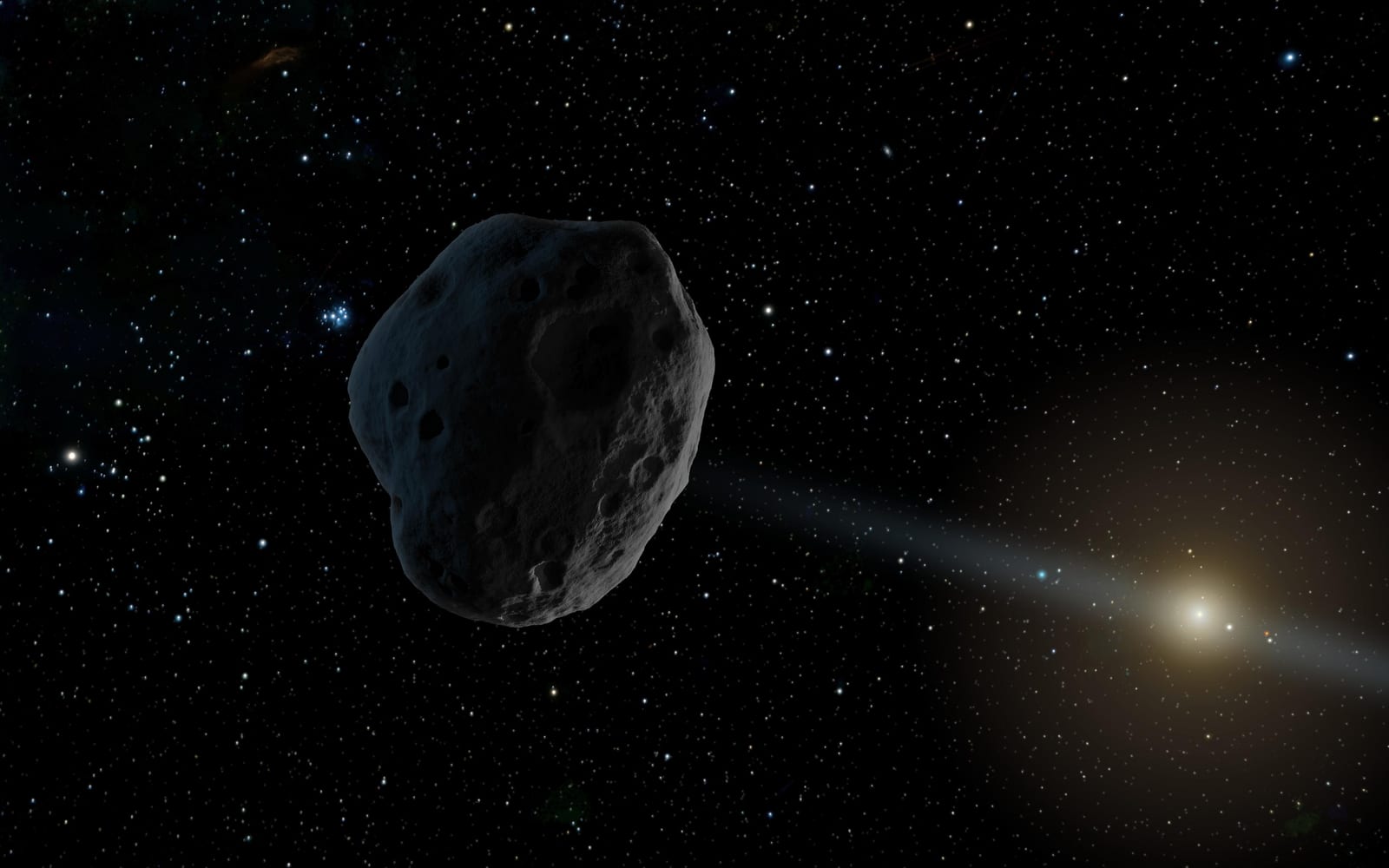
For 27 years, the object cataloged as 1998 SH2 sat in astronomy databases as an ordinary near-Earth asteroid. It had a well-measured orbit, a known 4.5-year path around the Sun, and no reason to attract attention.
In August 2025, that changed. When NASA's Center for Near-Earth Object Studies (CNEOS) aimed the Deep Space Network planetary radar at 1998 SH2 during a routine close approach, the asteroid was not where gravity said it should be. It was off course, pushed by a force no one had accounted for.
Follow-up observations with the Canada-France-Hawaii Telescope on Mauna Kea and the European Southern Observatory's Very Large Telescope in Chile revealed the reason: a faint dust tail extending more than 20 arcseconds from the nucleus, and a weak coma surrounding it. After nearly three decades masquerading as an asteroid, 1998 SH2 is actually a comet.
The discovery, led by Davide Farnocchia of NASA's Jet Propulsion Laboratory and published in Nature Astronomy on July 10, 2026, places this object in a growing category of hybrid bodies known as dark comets: objects that look like asteroids but move like comets, powered by gas venting that produces no visible tail to most telescopes.
How a normal asteroid stopped acting normal
1998 SH2 was discovered in 1998 and tracked consistently over the next 18 years. Its orbit was well understood: a 4.5-year elliptical path that crosses the orbits of Mars and Earth, taking it from the inner solar system out toward Jupiter and back. Everything about it looked like a standard near-Earth asteroid.
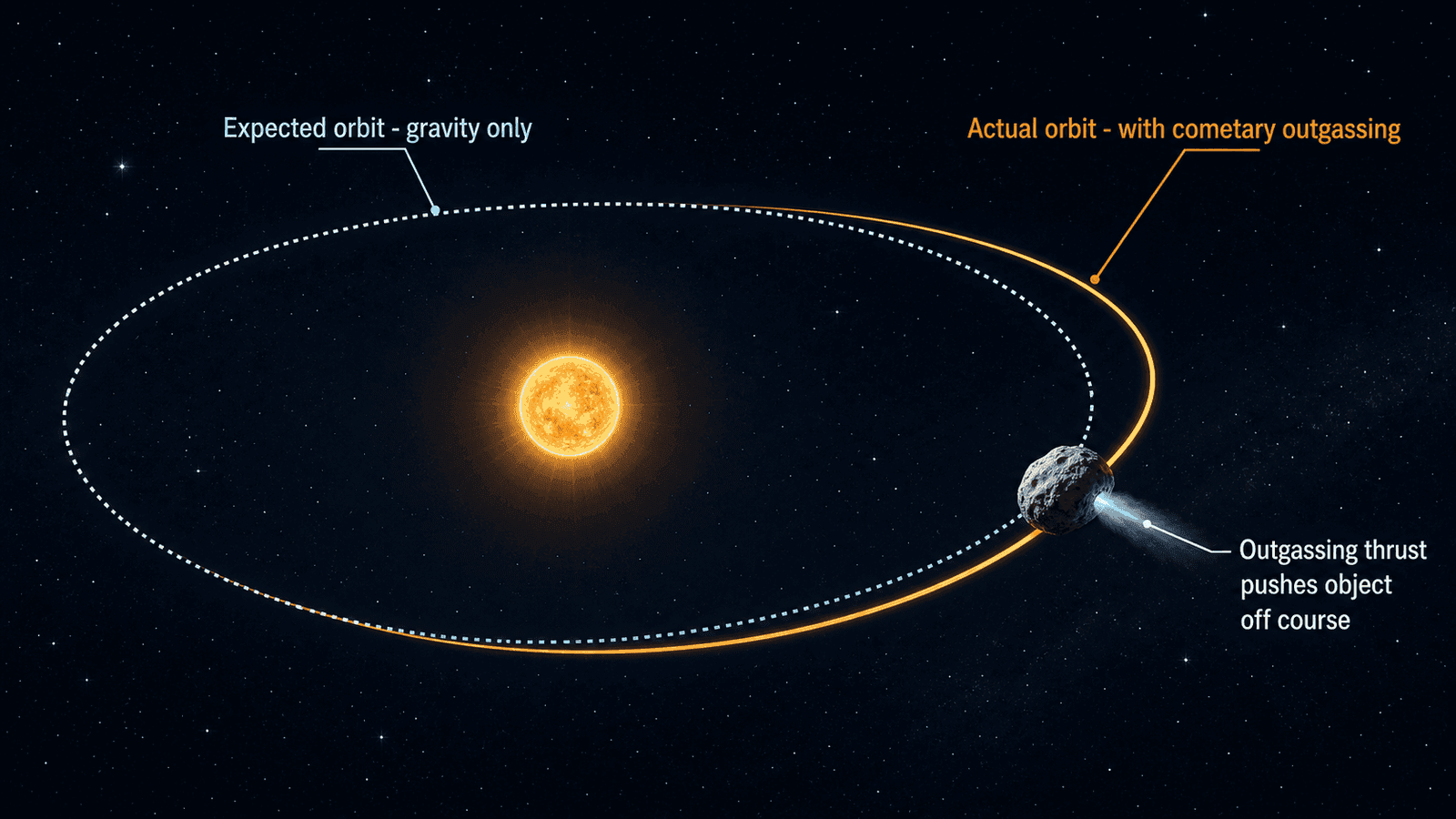
But between 2016 and 2025, the object completed two full orbits without being observed. When CNEOS researchers prepared to detect it with the Goldstone Solar System Radar DSS-14 antenna in August 2025, they calculated its position using the standard gravitational model: the Sun's gravity, planetary perturbations, and the faint thermal radiation force known as the Yarkovsky effect.
The object should have been right where the models placed it. It was not. The antenna saw nothing.
Three days later, the Southern Observatory for Near Earth Asteroids Research in Brazil spotted 1998 SH2 a full 153 arcseconds from its predicted position, equivalent to roughly 190 kilometers of drift. That is a massive position error by astrometry standards, far too large to be explained by the Yarkovsky effect, which for an object of this size can account for only about a tenth of the observed deviation.
Something else was pushing it.
What dark comets actually are
The term "dark comet" describes objects that produce cometary outgassing, the rocket-like thrust generated when solar heat turns buried ice into gas, without producing the bright coma and tail that make a normal comet visible. To most telescopes, a dark comet looks like a single point of light, indistinguishable from an asteroid.
The first dark comet, 2003 RM, was identified in 2016 when researchers noticed its trajectory had shifted in ways that could not be explained by the Yarkovsky effect or any other known asteroid acceleration mechanism. The following year, the interstellar object 1I/'Oumuamua exhibited similar behavior: it looked like an asteroid, but its trajectory changed as if gas were venting from its surface. By 2023, researchers had identified seven solar system objects in this category, enough for the astronomical community to adopt "dark comet" as an official classification.
That number has since doubled to 14 known dark comets, and research published in the Proceedings of the National Academy of Sciences in December 2025 identified two distinct populations: outer dark comets, hundreds of meters or more across with highly elliptical orbits resembling Jupiter-family comets, and inner dark comets, tens of meters or smaller with nearly circular orbits in the inner solar system.
1998 SH2, at roughly 380 meters across with its elongated orbit, falls in the outer dark comet category. But unlike most known dark comets, it was observed directly during a close approach to Earth, allowing researchers to confirm its faint tail and coma with the most sensitive telescopes available. The object now carries the additional comet designation P/1998 SH2.
The technique that caught it
What makes the 1998 SH2 discovery notable is not the object itself but the way it was found. The researchers detected the cometary activity without looking for it. They noticed an orbital anomaly first, a positional error in radar tracking data, and then used that anomaly to predict that the object must be venting gas. Only after making that prediction did they point powerful telescopes at it to confirm the tail.
This is the first time the cometary nature of an object was inferred from its motion and then confirmed by direct imaging, rather than the other way around. The method opens a new channel for identifying dark comets from existing orbital data, without requiring dedicated telescope time for every candidate.
Most of the dust grains detected in the tail were roughly 400 micrometers across, and the activity appeared to peak several weeks after the object's closest approach to the Sun, suggesting the ice driving the outgassing is buried deep inside the body, not near the surface.
Why planetary defense needs to know
The discovery has practical implications. NASA's Center for Near-Earth Object Studies tracks every known near-Earth object and calculates its future orbit to assess any risk of impact with Earth. Those calculations currently assume purely gravitational motion, with small corrections for the Yarkovsky effect.
But cometary outgassing produces accelerations that are far larger and far more chaotic than anything an asteroid of the same size would experience. A comet that looks like an asteroid could drift off its predicted orbit in ways that standard models do not account for, potentially introducing errors in impact risk assessments.
There are roughly 285 near-Earth objects classified as potentially hazardous asteroids that have comet-like orbits. If even a fraction of them turn out to be dark comets, the current orbital models for planetary defense may need to account for the small but real possibility of unmodeled outgassing thrust.
The researchers do not suggest that the system is broken. The point is that it can be improved. By analyzing the motion of all near-Earth objects using precision astrometry, subtle non-gravitational perturbations can reveal which ones are venting gas, without needing to see the tail directly.
NASA's upcoming NEO Surveyor mission, a space-based infrared telescope designed specifically for planetary defense, will collect the kind of data that could support this effort at scale. NEO Surveyor will be the first space survey telescope built for planetary defense, designed to find dark asteroids and comets that do not reflect much visible light.
Farnocchia put it simply: "This work shows the importance of continuously tracking near-Earth objects. Detecting these perturbations can be an important diagnostic tool for planetary defense that will help understand which objects may be comets rather than asteroids, how their orbits evolve, and how that influences their Earth impact risks."
Sources
- NASA JPL: NASA Study Finds Near-Earth Asteroid Is Actually Comet (July 16, 2026)
- Farnocchia et al., Nature Astronomy: Non-gravitational acceleration indicative of cometary activity of near-Earth object 1998 SH2 (July 10, 2026)
- NASA JPL: NASA Researchers Discover More Dark Comets (December 2025)
- Universe Today: Astronomers Catch a Dark Comet Red-Handed
- TechTimes: Dark Comet Disguised as Asteroid Derailed 27 Years of Planetary Defense Math (July 18, 2026)