A Neighbouring Galaxy Is Being Pulled Apart, and Astronomers Just Mapped Every Star's Escape
Astronomers assumed the Small Magellanic Cloud was a rotating dwarf galaxy like a scaled-down Milky Way. After tracking millions of stars across 11 years with ESO's VISTA telescope, they found the opposite: the galaxy is expanding, stretched apart by the gravitational pull of its larger neighbour, the Large Magellanic Cloud.
For as long as astronomers have studied it, the Small Magellanic Cloud has been described as a dwarf galaxy, a satellite of the Milky Way, a rotating disk of stars like a scaled-down version of our own. None of those descriptions survived contact with 11 years of data from a telescope in the Chilean desert.
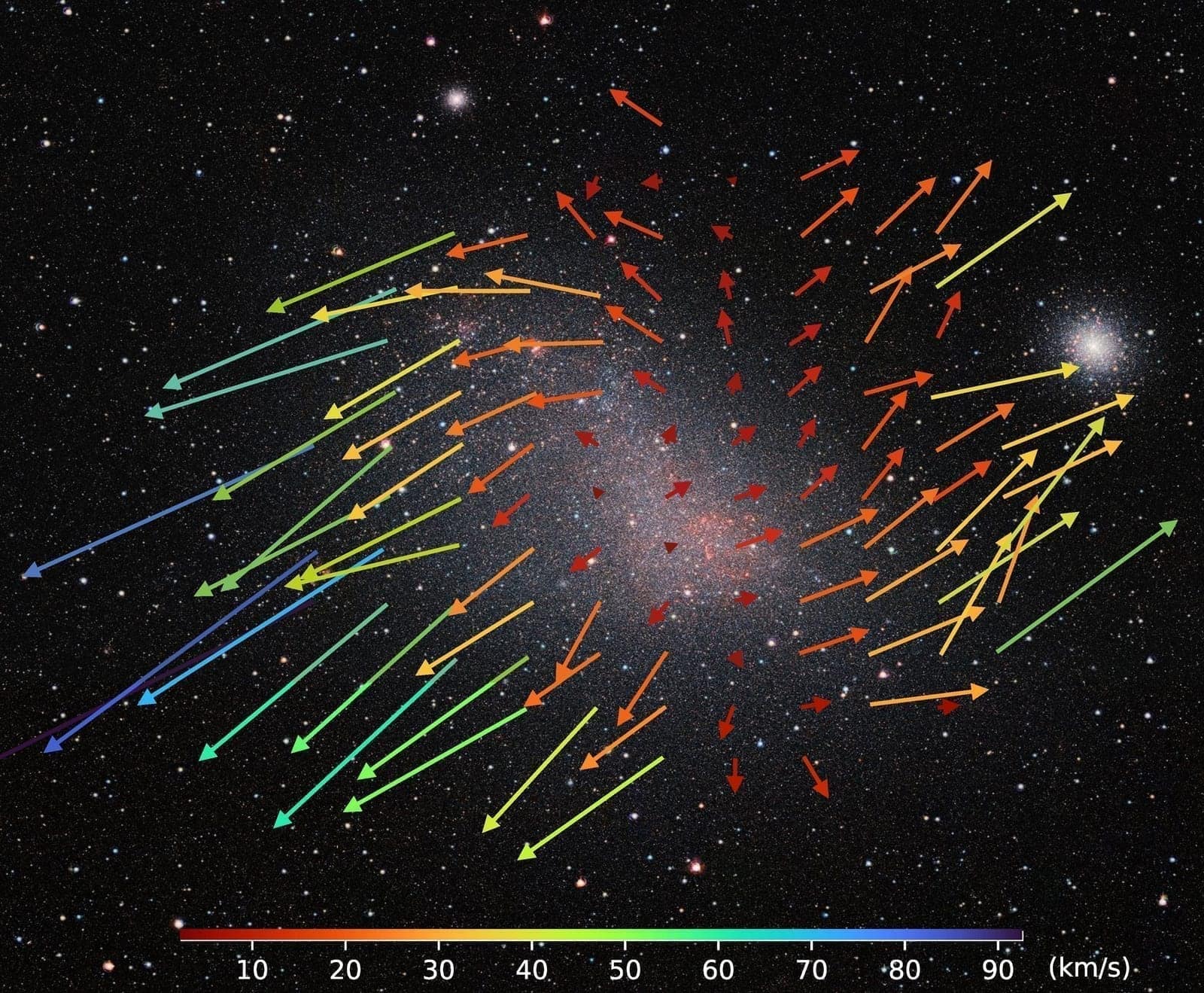
In a study published in Astronomy & Astrophysics in June 2026, an international team led by doctoral student Sreepriya Vijayasree at the Leibniz Institute for Astrophysics Potsdam (AIP) presented the most precise map ever made of how stars move inside the Small Magellanic Cloud. The galaxy is not rotating. It is expanding.
Stars across the entire Small Magellanic Cloud, even deep in its central regions, are moving outward along a southeast-northwest axis at an average speed of about 17 kilometres per second. The culprit, the researchers say, is the gravitational pull of its larger neighbour, the Large Magellanic Cloud, which has been stretching and distorting it over billions of years.
Eleven years, millions of stars
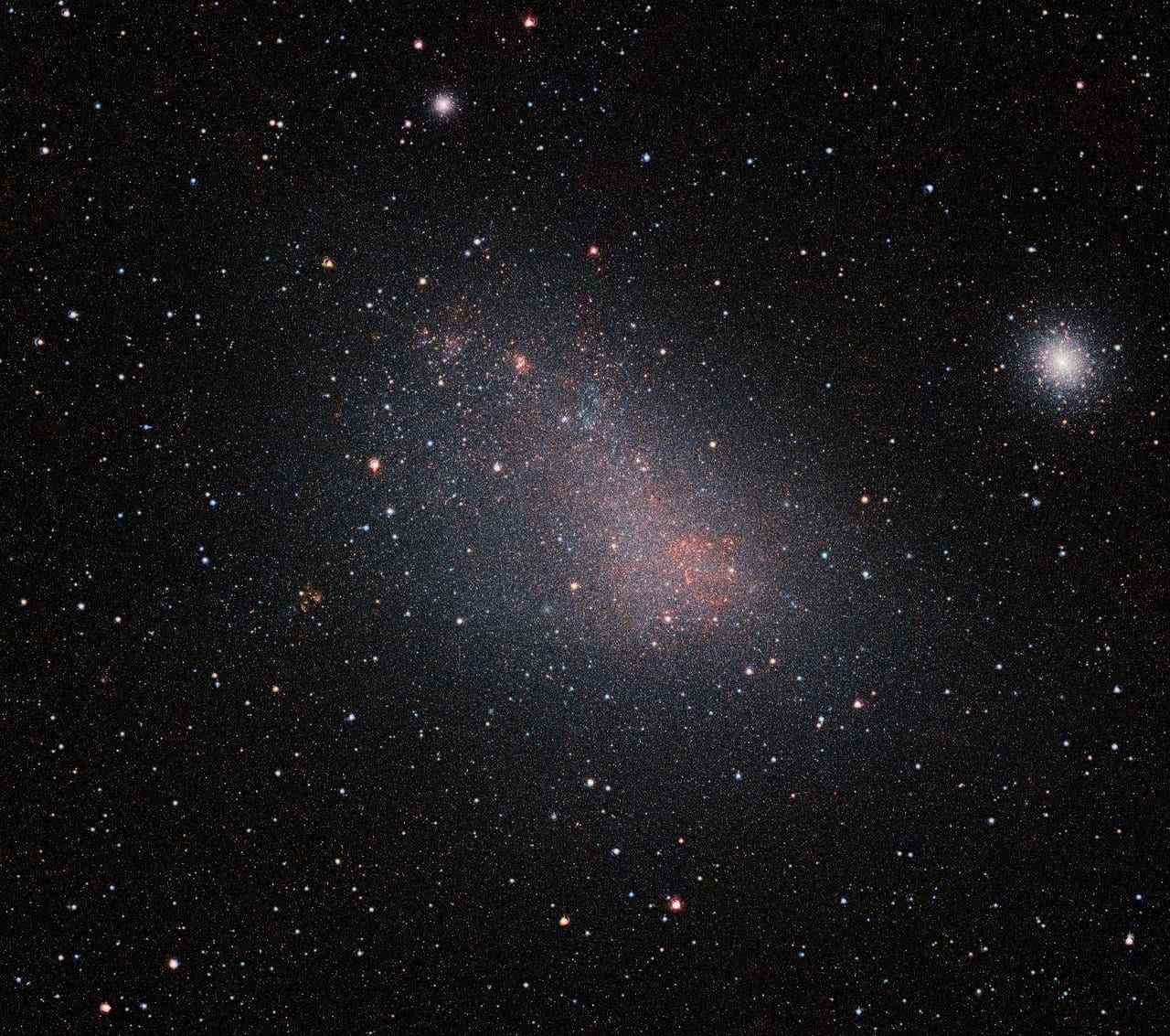
The Small Magellanic Cloud, or SMC, is one of the Milky Way's closest galactic neighbours at roughly 200,000 light-years from Earth. Visible to the unaided eye from the Southern Hemisphere, it appears as a faint smudge of light alongside its larger companion, the Large Magellanic Cloud (LMC). Together, the two are the brightest and best-studied satellite galaxies orbiting the Milky Way.
Because of their proximity, the Magellanic Clouds offer astronomers something rare: a close-up view of how galaxies interact. Over time, the gravitational pull between the SMC and the LMC has distorted their shapes, pulled streams of gas and stars into intergalactic space, and triggered bursts of star formation. A bridge of gas already known to connect the two galaxies is actively forming new stars.
To measure the motions of individual stars across the SMC, the team used the VISTA Survey of the Magellanic Clouds, or VMC, an extensive near-infrared imaging programme conducted with the VISTA telescope at ESO's Paranal Observatory in Chile. VISTA is the largest telescope in the world dedicated to near-infrared surveys. Its ability to see through interstellar dust made it possible to track millions of stars that visible-light telescopes cannot clearly resolve.
"The VMC survey was designed to map the Magellanic Clouds in unprecedented detail in infrared light, allowing astronomers to peer through dust and study stellar populations spanning a wide range of ages," said Prof. Dr. Maria-Rosa Cioni, principal investigator of the VMC survey. "The latest VMC data release extends the observational time baseline to as much as 11 years, enabling much more precise measurements of stellar motions than earlier studies."
By comparing images of the same star fields taken years apart, the researchers measured how each star had shifted against the background, a technique called proper-motion measurement. The 11-year time baseline delivered a threefold improvement in precision compared with earlier VMC-based studies.
"When I saw the results for the first time, I was really amazed by the quality of the measured stellar motions," said Dr. Florian Niederhofer, co-author of the study and postdoctoral researcher at AIP. "By combining observations that have been taken over a time baseline of more than a decade, we were able to map the internal kinematics of the Small Magellanic Cloud with a level of detail that is outstanding for observations from the ground."
No rotation, just escape
Stable galaxies rotate. The Milky Way rotates. The Andromeda Galaxy rotates. Most spiral and disk galaxies exhibit orderly motion, with stars orbiting the galactic centre in roughly the same direction. For decades, astronomers assumed the Small Magellanic Cloud did the same, modelling it as a rotating disk.
The new data demolishes that picture. Once the researchers accounted for the bulk motion of the whole galaxy through space and corrected for perspective effects from line-of-sight movement, they found no evidence of coherent rotation anywhere in the SMC. Instead, the residual motion of its stars is predominantly radial, streaming outward from the centre along a southeast-to-northwest axis.
"The results reveal large-scale tidal expansion throughout the Small Magellanic Cloud galaxy and challenge long-standing assumptions that the Small Magellanic Cloud behaves like a rotating disk," said Vijayasree. "The study shows that the internal motions of stars in the Small Magellanic Cloud are dominated not by orderly rotation, but by gravitational disturbances caused by repeated encounters with the LMC over billions of years."
The expansion is not subtle. At an average outward speed of 17 kilometres per second, stars in the SMC can be displaced by several thousand light-years over a few hundred million years. That is enough to significantly distort the structure of the entire galaxy. The stretching is visible in the galaxy's outskirts, where tidal forces are expected to be strongest. It is also visible deep within the inner regions, which caught the researchers off guard.
A fossil record in the stars
Perhaps the study's most striking finding is that different generations of stars in the SMC are responding differently to the tidal disruption. The researchers separated the galaxy's stellar populations by age and found that each group tells a distinct story.
Older red giant stars, born more than two billion years ago, show a coherent northward motion away from the galaxy's centre that is not seen in younger populations. This is likely a fossil signature of a gravitational interaction that occurred more than two billion years ago, a ghost printed into the kinematics of the oldest surviving stars. Younger and intermediate-age stars, by contrast, show stronger and more coherent outward motions, responding to the same tidal forces in a more concentrated way.
The researchers also examined what are called "gradient-corrected residuals," subtracting the large-scale expansion to look for any remaining rotation. There was none. The leftover motions point inward toward the galaxy's centre, exactly what you would expect from a gravitationally bound system that is being pulled apart but has not yet escaped its own gravity fully.
"We are privileged to be witnessing a galaxy ripping its neighbour apart, on our doorstep," said Dr. Jacco van Loon, Reader in Astrophysics at Keele University and co-author of the study. "However, most of these stars will not be torn out of the SMC, which will be breathing a sigh of relief as it separates from the LMC."
A lesson in galaxy evolution
The Magellanic Clouds are sometimes described as being on a collision course with the Milky Way, destined to merge with our galaxy in the distant future. The new study adds an important nuance: before that happens, the SMC and LMC are locked in their own gravitational drama, and the SMC is losing.
The SMC will eventually part ways with the LMC, van Loon explains. The two galaxies are not on a permanent collision course with one another. But the damage already done is permanent. The SMC's structure has been fundamentally reshaped, and generations of astronomers have been studying an expanding debris field under the mistaken assumption that they were looking at a settled, rotating galaxy.
That is the deeper lesson of the VMC survey. The motions of stars carry a memory of everything that has happened to them. With enough precision and enough patience, astronomers can read that memory. The Small Magellanic Cloud, a galaxy 200,000 light-years away, has begun to tell its story. It turns out to be a story of violence, stretching, and a long, slow escape from a much larger neighbour.
Sources
- Leibniz Institute for Astrophysics Potsdam: Galactic Neighbour caught strongly disturbed and expanding - primary press release from the lead research institution
- Keele University: Nearby dwarf galaxy being stretched and disrupted by larger neighbour - institutional press release with researcher quotes from co-author Dr. Jacco van Loon
- Vijayasree et al., The VMC survey. LV. The coherent expansion of the SMC, Astronomy & Astrophysics (2026) - peer-reviewed research paper presenting the proper-motion measurements and tidal expansion analysis
- Phys.org: Small Magellanic Cloud is being pulled apart, reshaping how astronomers read its past - detailed coverage with methodology and context
- Universe Today: A New Map of Stars Shows That the Small Magellanic Cloud is Expanding - overview with accessible explanation of proper motion measurement techniques
The hero image shows stellar proper motions across the Small Magellanic Cloud measured by the VISTA Survey of the Magellanic Clouds. Image credit: ESO/VISTA VMC / AIP / S. Vijayasree. The VISTA SMC image in the article body was captured by ESO's VISTA telescope. Both images are publicly released press imagery associated with the research publication. This article describes peer-reviewed research published in Astronomy & Astrophysics (DOI: 10.1051/0004-6361/202659431).
Related on Impossible Universe
- A Third Galaxy Without Dark Matter Just Showed Up. It's Right Where Scientists Predicted. - another galaxy-scale puzzle about what holds a galaxy together or tears it apart
- Euclid Spent 26 Hours Looking at the Milky Way's Core. It Came Back With 60 Million Stars. - a different large-scale galactic survey producing data at unprecedented scale