
The Tunguska Event Flattened 830 Square Miles of Forest in 1908. For 19 Years, No One Could Even Find the Site.
On June 30, 1908, an asteroid or comet exploded above the remote Podkamennaya Tunguska River in Siberia with the force of a 10 to 15 megaton bomb, flattening about 830 square miles of forest and leaving no crater. The blast zone sat undiscovered for 19 years, and the first expedition to reach it found trees felled in a radial pattern around an empty epicenter. Today the airburst model explains the event, and Tunguska anchors planetary defense planning.
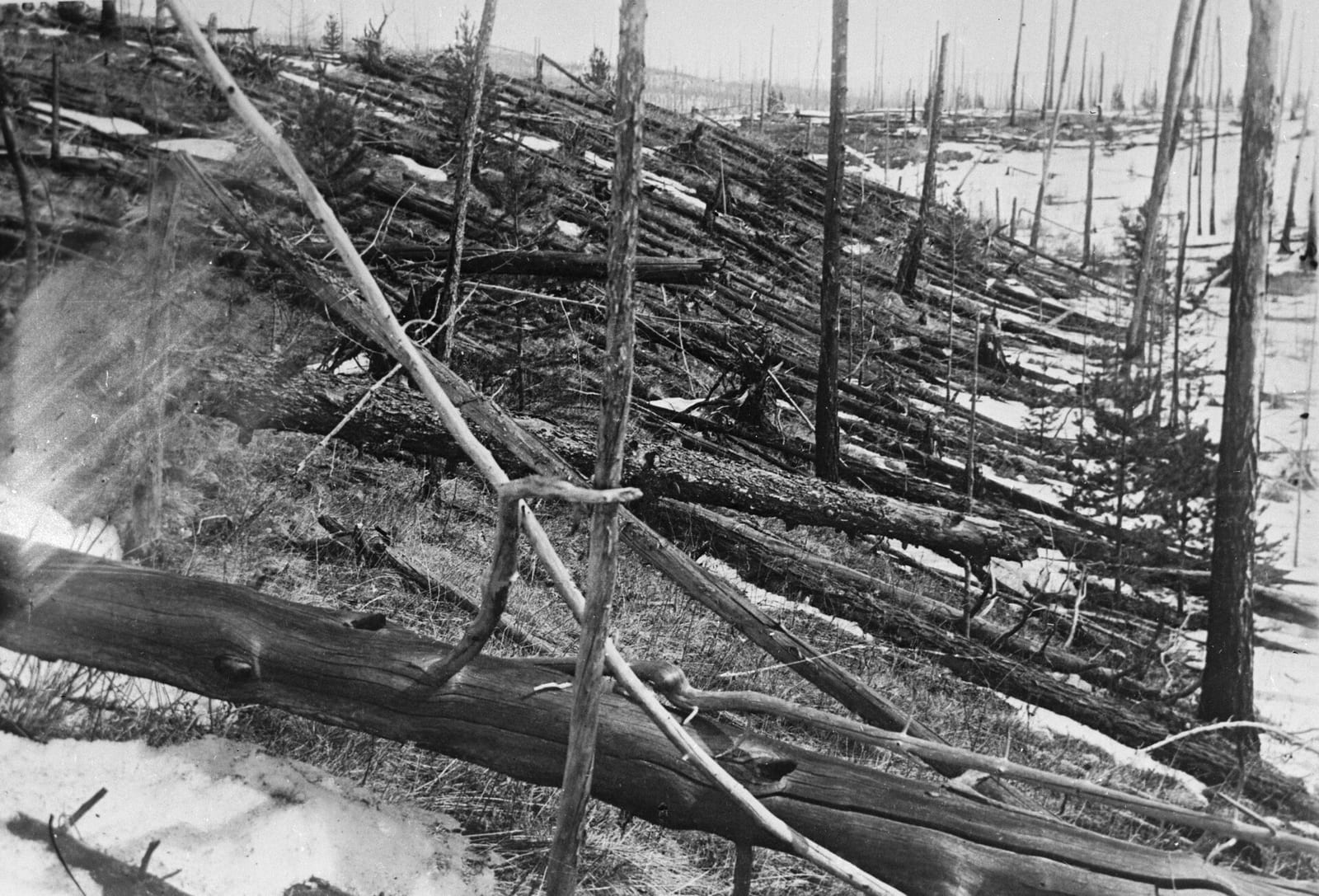
On the morning of June 30, 1908, a fireball brighter than the Sun crossed the sky over central Siberia and exploded above the Podkamennaya Tunguska River with an energy most estimates put at 10 to 15 megatons of TNT, roughly a thousand times the Hiroshima bomb. The blast flattened about 2,150 square kilometers, or 830 square miles, of untouched forest. It left no crater. And then the site sat unvisited for almost two decades, because nobody could find it.
The first scientific expedition did not reach the blast zone until 1927, nineteen years after the event. What it found became one of the most reproduced images in planetary science: hundreds of square kilometers of trees felled in a radial pattern, all pointing away from an empty epicenter. The Tunguska event remains the largest cosmic airburst in recorded history, and it is now a cornerstone of how humanity plans to defend the planet against asteroids. The story of how a mystery stayed unsolved for nineteen years, and how it was finally explained, is also the story of how planetary defense began.
What happened on June 30, 1908
At about 7:15 in the morning, near the Podkamennaya Tunguska River in what is now Krasnoyarsk Krai, a small group of Evenki reindeer herders saw a fireball trailing smoke, followed by a flash brighter than the Sun and a sound like thunder. Witnesses at the Vanavara trading post, about 65 kilometers from the blast, reported searing heat: S. Semenov, whose testimony was recorded by Kulik's expedition in 1930, described the sky splitting in two and fire appearing high over the road to Onkoul, followed by heat so intense it felt like his shirt was on fire. The shock wave knocked people off their feet and damaged dwellings. Herds of reindeer perished. Wikipedia's survey of the accounts puts possible human deaths at up to three, a remarkably low number for an event of this scale, because the area was almost empty.
Seismic instruments hundreds of miles away recorded the tremors, and barometers around the world registered the atmospheric pressure wave. For nights afterward, the sky glowed over Europe and Central Asia. In London, the glow was bright enough to read a newspaper by after midnight, a detail preserved in the collection of the Royal Observatory Greenwich, which holds a photograph of the bright sky taken there just after the event.
Yet within Tsarist Russia, the event earned only brief attention, and almost none outside it. The site was remote, the region was sparsely populated, and the records that existed were fragmentary. For the next two decades, the world had other concerns.
Why the site stayed lost for 19 years
The delay was a combination of geography and history. The blast zone sat in the middle of the East Siberian taiga, hundreds of kilometers from the nearest settlement of any size, reachable only by weeks of travel through swamp and forest. And the years that followed the event were not kind to scientific expeditions: World War I began in 1914, the Russian Revolution followed in 1917, and the Russian Civil War dragged on into the early 1920s. Between the remoteness and the upheaval, no one went looking.
Even when the Soviet Academy of Sciences finally sent a geologist, Leonid Kulik, in 1921, he could not reach the site. The area proved too inaccessible, and the expedition turned back. Kulik kept trying, and in 1927 he succeeded. Nineteen years after the explosion, the forest still bore unmistakable signs of what had happened: a vast radial pattern of trees knocked over like matchsticks, all pointing away from a central point. Near the epicenter, trees remained standing but stripped of branches and bark, their trunks resembling telegraph poles. The scene matched nothing Kulik had seen. He searched for the meteorite itself, expecting a crater or fragments, and found neither.
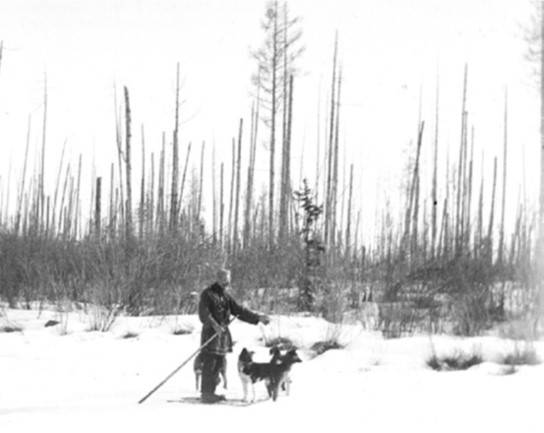
Kulik led further expeditions in 1929 and the 1930s, and his photographs and aerial surveys produced the first detailed documentation of the damage. Later work in the 1950s and 1960s by professional scientists and volunteer researchers outlined the full extent: a butterfly-shaped zone of destruction covering 830 square miles, with trees knocked over from nine to 22 miles from the epicenter. Estimates of the tree count circulated for decades, most famously the figure of 80 million trees, but that number is a documented overestimate, based on a preliminary guess that multiplied tree density by an affected area four times larger than the real blast zone. The area figure, 2,150 square kilometers, is the reliable one.
The decades of exotic theories
With no crater and no confirmed fragments, the Tunguska event became a blank canvas for speculation. Over the decades, the explosion was blamed on a comet, on antimatter, on a miniature black hole passing through the Earth, on an alien spacecraft crashing, and even on Nikola Tesla experimenting with wireless energy. The wilder theories made good headlines and bad science. The evidence, when it was finally assembled, pointed somewhere else entirely.
Later expeditions did find microparticles in the area that indicated an extraterrestrial origin, but the remnants could not be conclusively tied to the blast. The asteroid-versus-comet question remained open for decades. A comet was the early favorite, because a comet, being mostly ice, could vanish without leaving fragments. But as computer modeling improved, the balance shifted. Most scientists today believe the object was a stony asteroid, and the modern models explain why no crater exists.
What an airburst actually is
The key to the whole event is that the object never touched the ground. It exploded in the air, at an altitude NASA's Earth Observatory puts at 6 to 10 kilometers above the surface. The blast wave, traveling downward and outward, did the damage. The trees were not hit by a meteorite; they were flattened by a shock wave, the same way a supersonic boom rattles windows, but with the force of a nuclear explosion.
That explains the pattern on the ground. A shock wave arriving from the side knocks trees over in one direction, away from the blast. Directly beneath the explosion, the wave arrives from above, compressing the trees downward, which is why the trunks near the epicenter stood upright while losing every branch. And it explains the absence of a crater: an object that vaporizes in midair, depositing its energy into the atmosphere, leaves no hole in the ground. It also explains the heat: witnesses felt searing radiation from the fireball, and the scorching reached the ground.
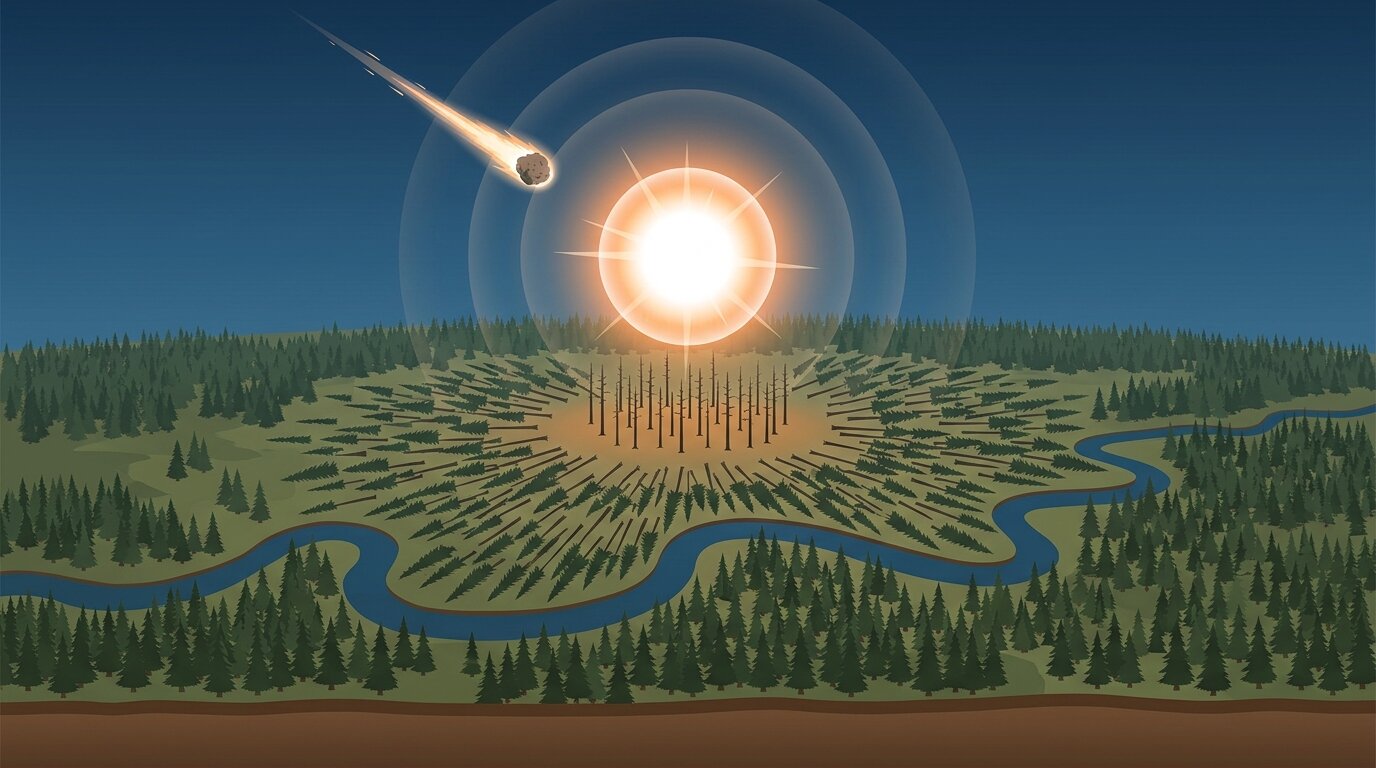
The modern reconstruction comes from a NASA workshop held at Ames Research Center, sponsored by the Planetary Defense Coordination Office, whose results were published in a 2023 special issue of the journal Icarus. The modelers ran more than 50 million combinations of asteroid and entry properties that could produce Tunguska-scale damage, checking their models against both the treefall pattern and the recorded atmospheric pressure waves and seismic signals. The most promising candidate was a stony body between 164 and 262 feet in diameter, entering the atmosphere at about 34,000 miles per hour at a roughly 30-degree angle, and depositing the energy of a 10 to 30 megaton explosion at an altitude of 6 to 9 miles. For comparison, the 1980 eruption of Mount St. Helens released a comparable amount of energy.
The honest open questions
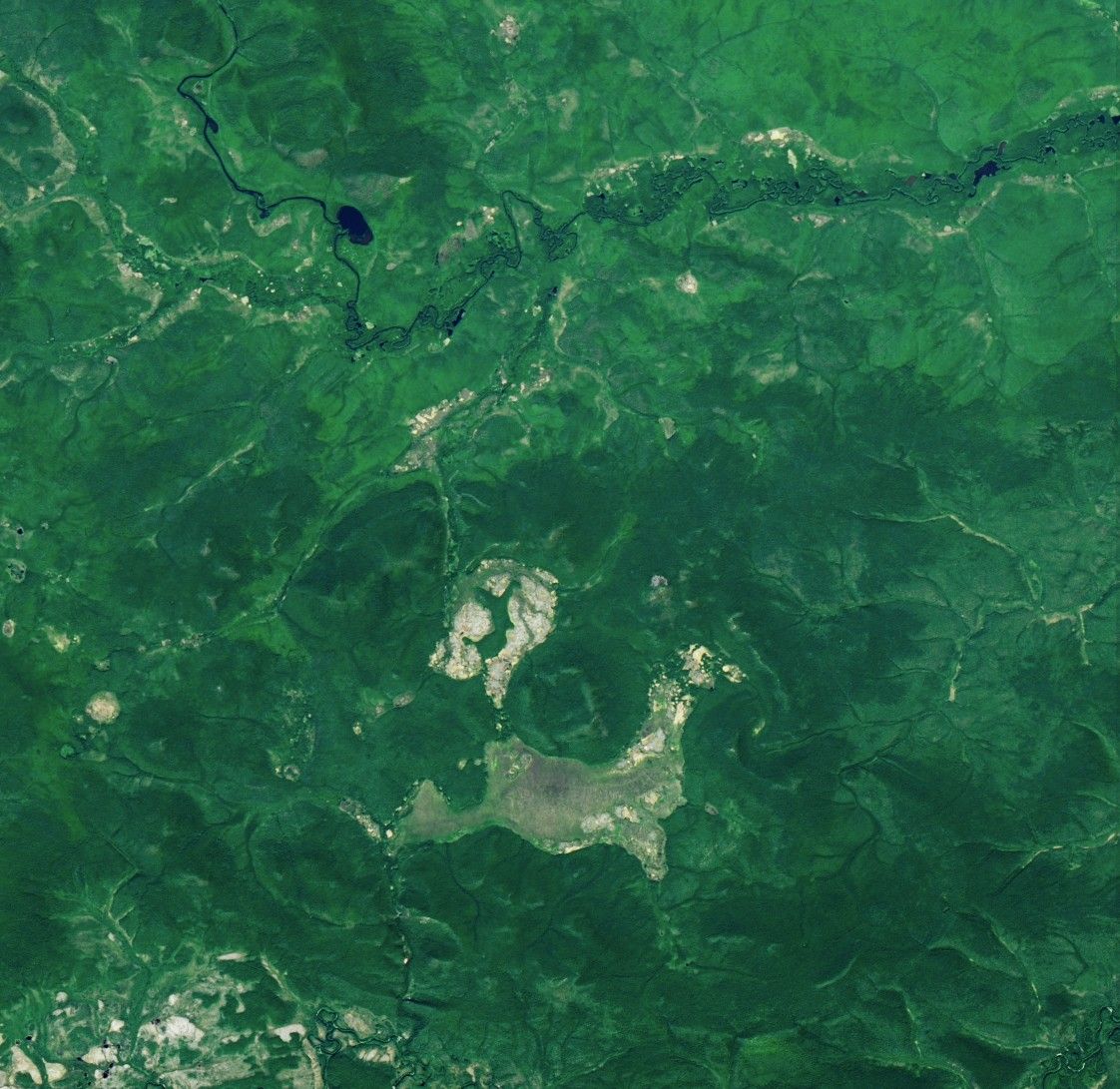
The airburst model explains the damage, but it does not close every question. No confirmed meteorite fragments from the Tunguska object have ever been found. In 2007, a team led by Luca Gasperini proposed that nearby Lake Cheko, a small, unusually deep lake about 8 kilometers from the epicenter, might be an impact crater formed by a fragment of the object, but other research teams have disputed the idea, and the lake's origin remains debated.
In February 2025, a study published in the hosted journal Advances in Cosmochemistry and Impacts reported shock-metamorphosed and melted grains in samples from a rimmed, crater-like feature near the epicenter, analyzed with scanning electron microscopy, and argued the grains point to high-temperature, high-pressure processes consistent with an airburst. The finding is interesting, but the venue is niche and the claim has not been broadly tested, so it is best read as an open thread rather than a settled one. The energy estimate itself is a range, not a single number: most sources cite 10 to 15 megatons, NASA's 2023 modeling suggests 10 to 30, and Wikipedia's summary brackets the event between 3 and 50 megatons. The honest answer is that the exact yield, like the exact object, remains an estimate.
The Chelyabinsk connection
On February 15, 2013, a much smaller asteroid exploded over Chelyabinsk, Russia, and gave researchers something Tunguska never had: a fully documented, video-recorded airburst. The Chelyabinsk object was a stony asteroid roughly the size of a five-story building, about 20 meters across, that broke apart about 15 miles above the ground, releasing energy equivalent to roughly 500 kilotons of TNT, about twenty to thirty times less than Tunguska's best estimates. The shock wave blew out about a million windows and injured more than a thousand people, mostly from flying glass. It also produced a fireball so bright it was captured by dashcams across the region.
Chelyabinsk became the calibration point for the Tunguska models. Researchers used the video observations and ground damage maps to reconstruct the object's size, speed, and breakup, then applied the same modeling techniques to the 1908 event. Four independent computer modeling codes produced similar conclusions, which gave the Tunguska reconstruction much more confidence than it had ever had. Per current understanding of the asteroid population, an object like the Chelyabinsk meteor hits the Earth every 10 to 100 years on average. The larger Tunguska-class objects, the modeling suggests, arrive on the order of millennia, not centuries, which was the more optimistic headline of the 2023 NASA research: these regional-scale impacts are rarer than earlier estimates claimed.
Why Tunguska anchors planetary defense
"Tunguska is the largest cosmic impact witnessed by modern humans," David Morrison, a planetary science researcher at NASA Ames, said in the 2023 retrospective. "It also is characteristic of the sort of impact we are likely to have to protect against in the future." That sentence captures why a 1908 explosion in an empty forest still drives policy today: it is the benchmark for the class of event that could destroy a city, the kind we might actually be able to prevent.
The institutional response is recent. NASA established its Planetary Defense Coordination Office on January 7, 2016, tasked with finding near-Earth objects and coordinating global response. In 2016 the United Nations proclaimed June 30, the anniversary of Tunguska, as International Asteroid Day. And in 2022, NASA's Double Asteroid Redirection Test, or DART, demonstrated the kinetic impact technique: a spacecraft slammed into the moonlet Dimorphos at about 14,000 miles per hour, changing its orbit around the asteroid Didymos by 33 minutes, the first time humanity changed the motion of a celestial body on purpose.
The survey work continues to accelerate. NASA's database of known near-Earth asteroids passed 38,000 entries in June 2025. In that same month, the Vera C. Rubin Observatory in Chile announced it had discovered 2,104 new asteroids in just a few days of operation, including seven near-Earth objects, and astronomers expect its enormous camera to find millions more as the survey expands. The objects we know about are, overwhelmingly, harmless, but the point of the survey is precisely the ones that are not yet known.
The Tunguska event is the reason all of this exists. It was the largest airburst in recorded history, the only one of its scale that happened while humans with instruments were around to notice, and the template for the threat that planetary defense is designed against. "A collision of a NEO with Earth is the only natural disaster we now know how humanity could completely prevent," NASA Planetary Defense Officer Lindley Johnson said in the 2023 retrospective.
The mystery of 1908 is mostly solved. The blast was an airburst, the object was almost certainly a stony asteroid, and the tree pattern that confused Kulik for years is exactly what a midair explosion does to a forest. What remains open, the exact size and composition of the object, the disputed lake, the possible grains, is the honest residue of a century-old event with no crater and no fragments. The reason the event still matters is not the mystery. It is what the mystery taught us to build: a planetary defense system, designed around the lesson of a forest in Siberia that fell in a circle around nothing at all.
Sources
- NASA History: 115 Years Ago: The Tunguska Asteroid Impact Event (February 2026) - the anchor retrospective covering the eyewitness accounts, Kulik's 1921 and 1927 expeditions, the airburst consensus, Chelyabinsk comparison, and planetary defense context
- NASA Earth Observatory: A Cosmic Explosion Over Siberia (June 2026) - object size estimate of 50 to 100 meters, airburst altitude of 6 to 10 kilometers, the Landsat 8 image of the area today, and the 1929 Kulik expedition photo
- NASA: Tunguska Revisited: 111-Year-Old Mystery Impact Inspires New, More Optimistic Asteroid Predictions (September 2023) - the Ames workshop and Icarus special issue, the 50-million-scenario modeling, the 164 to 262 foot stony body estimate, and the millennia-not-centuries frequency finding
- Wikipedia: Tunguska event - the 3 to 50 megaton energy bracket, 2,150 km squared area, witness testimony, the 80-million-trees correction, the Lake Cheko debate, and possible death toll
- Royal Observatory Greenwich: The Tunguska event explained - the London glow observation bright enough to read a newspaper by, and the meteor airburst explanation
- New Evidence of High-Temperature, High-Pressure Processes at the Site of the 1908 Tunguska Event (Advances in Cosmochemistry and Impacts, February 2025) - the study reporting shock-metamorphosed and melted grains from a rimmed crater-like feature near the epicenter
- EarthSky: The Tunguska explosion rocked Siberia 118 years ago (June 2026) - anniversary explainer with the fallen-trees photo
Hero image: photograph of the flattened forest taken by the Soviet Academy of Sciences 1929 expedition led by Leonid Kulik (public domain, via Wikimedia Commons). Telegraph-pole trees photograph: courtesy of the Kulik expedition, hosted by NASA (public domain). Landsat 8 satellite image and map: NASA Earth Observatory, OLI instrument data from July 6, 2024 (public domain). Airburst diagram: generated illustration by the Impossible Universe Editorial Team. The Scientific American and Asteroid Day sources cited in research are referenced for completeness; they can block automated readers but work in a normal browser.
Related on Impossible Universe
- The Mysterious Bloop Sound Was Heard Around the World. It Was Ice, Not a Monster. - another famous mystery that turned out to be a real, explained natural phenomenon
- Red Sprites Explained: The Alien-Looking Lights Above Thunderstorms - a third story in the same arc: strange phenomena, dismissed for years, revealed as real atmospheric physics
- An Asteroid Pretended to Be Normal for 27 Years. Astronomers Finally Caught It Venting Gas. - near-Earth objects and the planetary defense context that Tunguska helped create
- Telescopes and Space Missions Topic Hub - the survey telescopes, from ATLAS to Vera Rubin, that now watch for objects like the one that hit in 1908