A Wandering Black Hole Tore a Star Apart 30,000 Light-Years From Its Galaxy's Center. It Was the Most Misplaced Star-Killing Event Ever Seen.
Every tidal disruption event astronomers had ever confirmed happened at the center of a galaxy, exactly where supermassive black holes are supposed to live. Then an AI scanning half a million nightly flashes from the Zwicky Transient Facility flagged a flare in a galaxy 750 million light-years away, in a place no black hole was expected: 30,000 light-years from the galaxy's core. Follow-up observations with the SOAR telescope and NASA's Swift confirmed the most misplaced star-killing event ever seen, a wandering supermassive black hole roughly a million times the mass of the Sun.
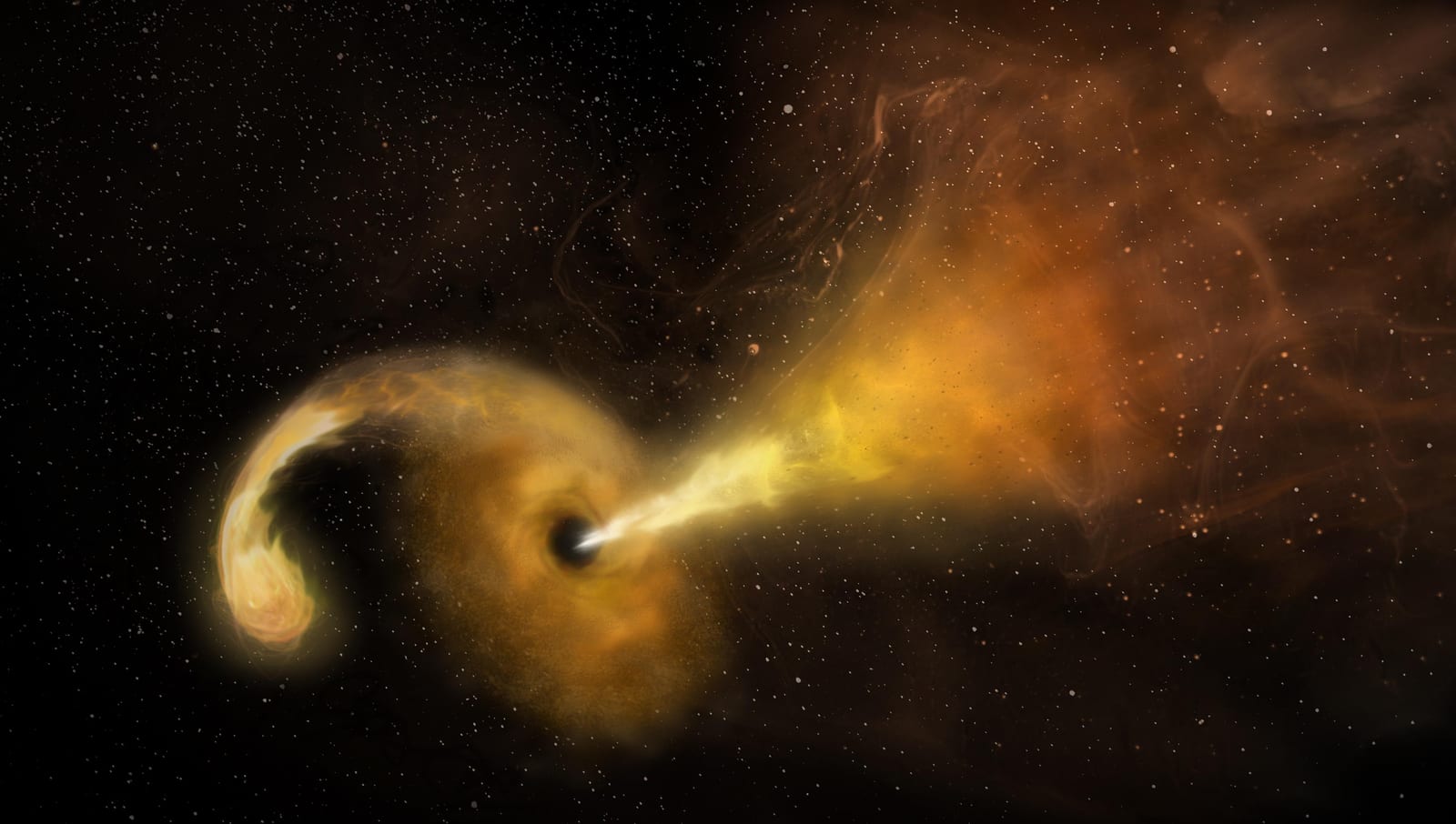
Every tidal disruption event astronomers had ever confirmed happened in the same place: the center of a galaxy, exactly where supermassive black holes are supposed to live. Then an artificial intelligence scanning half a million nightly flashes from a survey telescope flagged a flare that did not fit the pattern. It was 30,000 light-years from its galaxy's core, in a region so empty that no black hole was expected to be there at all.
Follow-up observations with the SOAR telescope in Chile and NASA's Neil Gehrels Swift Observatory confirmed what the AI had suspected: a supermassive black hole, roughly a million times the mass of the Sun, had torn a star apart in the galactic outskirts. The event, cataloged as TDE 2025abcr and reported in The Astrophysical Journal Letters on July 27, 2026, is the most misplaced star-killing event ever seen.
Why star-shredding only happens around supermassive black holes
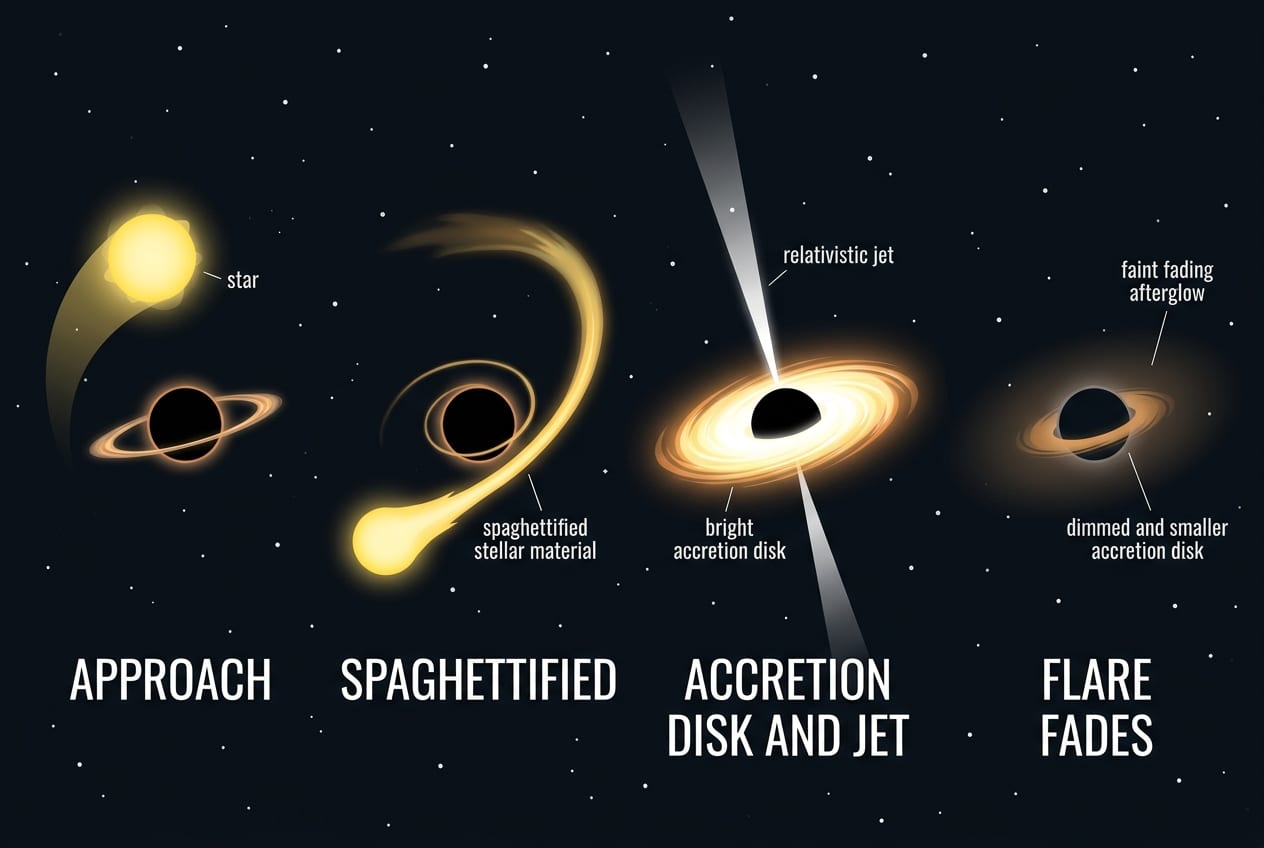
A tidal disruption event, or TDE, is what happens when a star drifts too close to a black hole and the difference in gravitational pull across the star's body tears it apart. Astronomers sometimes call the process spaghettification, because the star gets stretched into a long, thin stream of gas before it spirals into a glowing disk of debris around the black hole.
Ordinary stellar-mass black holes cannot do this. Their gravity is strong up close, but the tidal forces they exert are not enough to shred a star before it simply falls in. You need a supermassive black hole, the kind that anchors nearly every galaxy in the universe, to produce the kind of tidal stress that rips a star apart and lights up the wreckage.
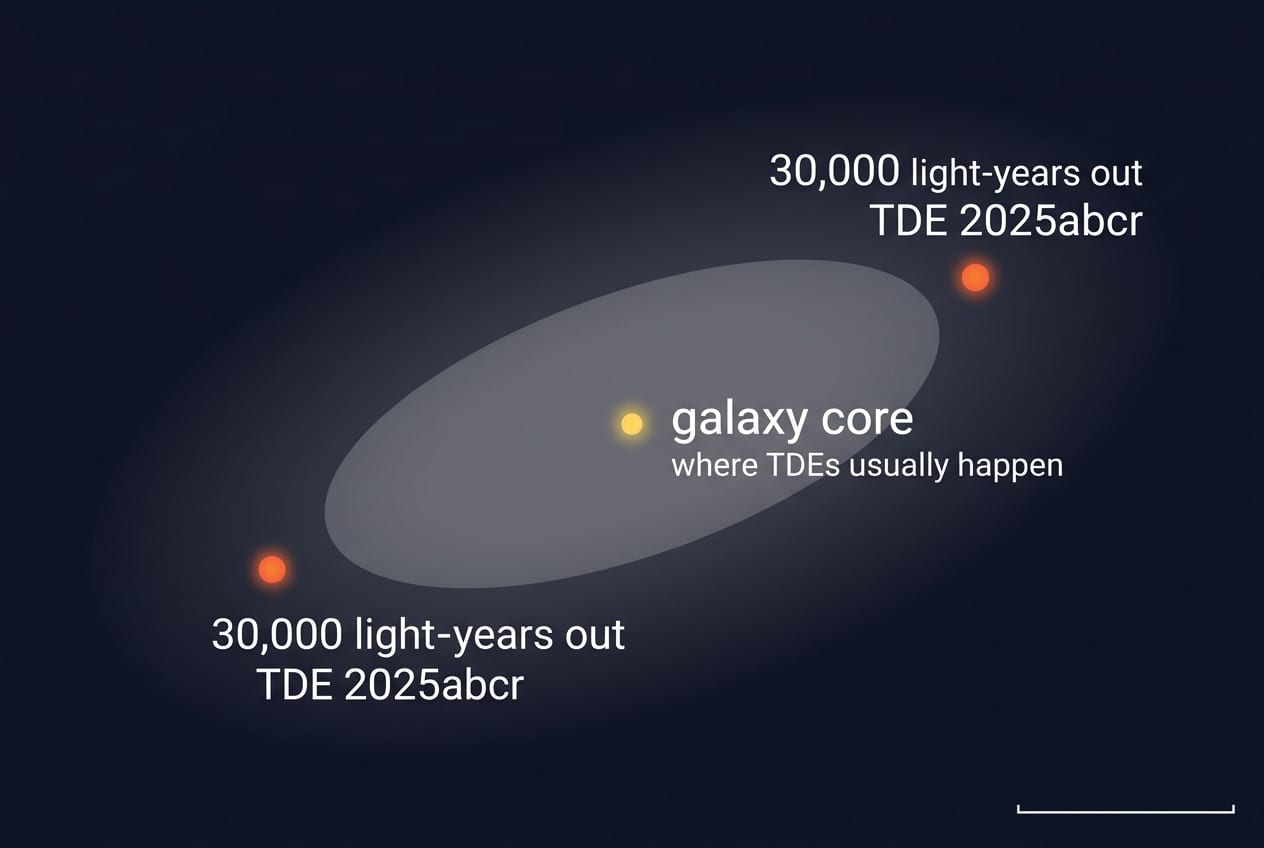
That is why the location of TDE 2025abcr is so strange. Almost every known supermassive black hole sits in the center of its galaxy, so almost every TDE ever found was spotted there too. In a given galaxy, a star only drifts this close to the central black hole about once every 100,000 years, but surveys scan millions of galaxies, and astronomers typically catch about 30 of these events somewhere in the universe each year.
A flare in a place no one expected
The story began in November 2025, when the Zwicky Transient Facility at Palomar Observatory in Southern California recorded an unusual brightening in a galaxy about 750 million light-years away. ZTF sees a huge number of transient events, roughly half a million flashes per night, so the team behind the discovery had trained an artificial intelligence algorithm to look specifically for tidal disruption signatures far from galactic cores.
"Out of the half million flashes ZTF detects each night, our new artificial intelligence algorithm automatically recognized a flare that looked a lot like a tidal disruption event, despite its unusual location in the outskirts of a galaxy," said Robert Stein, a research fellow at the University of Maryland, College Park and NASA's Goddard Space Flight Center, who led the study.
For a few months, the flare outshone its entire host galaxy in ultraviolet light, temporarily radiating with the brightness of about 10 billion suns. Jonathan Carney, a doctoral student at the University of North Carolina at Chapel Hill, took the first spectra with the SOAR telescope in Chile, and the spectral features supported the tidal disruption interpretation. Swift then observed the event at wavelengths ground telescopes cannot see. Its Ultraviolet/Optical Telescope measured the flare's temperature at about 54,000 degrees Fahrenheit (30,000 degrees Celsius), hot enough to help rule out supernovae and other explanations.
"The combination of all this data helped us rule out other explanations and confidently say it's a tidal disruption event, despite its strange location," Carney said.
The black hole that should not be there
Until 2024, TDEs had only ever been seen in galaxy cores, partly because that is where astronomers mainly looked: it is where all the known supermassive black holes are, and you cannot get a tidal disruption event without one. Then scientists spotted a star being shredded 2,600 light-years from the center of its host galaxy, a result that inspired astronomers to look beyond galaxy cores. TDE 2025abcr is more than ten times farther out.
So how did a million-solar-mass black hole end up 30,000 light-years from the nearest galactic center? Stein and his colleagues outline two possibilities. In the first, three or more galaxies merged, and the gravitational tug-of-war between their central supermassive black holes flung the lightest one out to the galaxy's edge. In the second, a dwarf galaxy is midway through a merger with the larger galaxy: as the dwarf's stars fell into the big galaxy, one of them may have passed too close to the dwarf's own supermassive black hole.
"It must have originated in a galaxy's center, but not the one it's in the outskirts of now," Stein said. "We think the host galaxy's supermassive black hole is still at its core, but the one eating the star could have started off in a small galaxy that merged with the big one we see today."
A new way to count invisible black holes
Beyond solving the puzzle of this single event, the discovery validates a new technique for finding supermassive black holes that are invisible on their own. A black hole only reveals itself when it feeds, and most wandering black holes may be doing nothing at all.
"We were looking for these star-shredding events as a way to find otherwise invisible supermassive black holes wandering away from the galactic cores where they usually reside," Stein said. "With this discovery, which is one of just a couple that have been confirmed so far, we've validated a new technique and can use it to hunt for more."
The key question the team wants to answer is simple: how common are wandering black holes? Several upcoming facilities should help. The Vera C. Rubin Observatory in Chile, now operational, will collect a much larger sample of tidal disruption events, including off-center ones, and NASA's Nancy Grace Roman Space Telescope will extend the search deeper into cosmic history. "Roman's space-based surveys will extend the current search zone by seeing ones that are farther away, looking back through 9 billion years of cosmic history," Carney said.
Swift itself is in a holding pattern. Its pointed science observations are temporarily suspended while the mission prepares for an orbit boost planned for summer 2026, which would extend the spacecraft's life after more than 20 years in orbit. "Once it resumes normal operations, Swift could continue searching for more examples of out-of-place black holes," said S. Bradley Cenko, Swift's principal investigator at NASA Goddard.
What this event does and does not prove
A few caveats matter. The black hole's mass, about a million times the Sun's, is estimated from the properties of the flare rather than measured directly. The wandering interpretation is the leading explanation, but astronomers cannot completely rule out a central black hole in a merged or dwarf companion that is only now being absorbed. And the flare itself faded months ago; this is a retrospective analysis of archival data, not an event still burning today.
There is also a selection effect to keep in mind. The ZTF algorithm was specifically trained to find off-center tidal disruption events, so the handful of confirmed detections so far does not yet tell us how abundant wandering black holes really are. That census is exactly what Rubin, Roman, and a restored Swift are built to complete.
For now, TDE 2025abcr stands as proof of a strange idea: that black holes can be ripped from their homes by the violence of galaxy formation, drifting through the dark outskirts of galaxies until a passing star gives them away.
Sources
- NASA Science: NASA's Swift Sees 'Wandering' Mega Black Hole Shredding Star (July 27, 2026) - primary mission coverage with quotes from Stein, Carney, and Cenko
- Stein et al., "TDE 2025abcr: A Tidal Disruption Event in the Outskirts of a Massive Galaxy," The Astrophysical Journal Letters 1006(2): L57 (2026) - primary peer-reviewed paper
- ScienceDaily: Blazing Like 10 Billion Suns: NASA's Swift Sees a Wandering Black Hole Devouring a Star (July 28, 2026) - coverage with full author list and citation
- Universe Today: A Wandering Black Hole Meets a Wandering Star (July 29, 2026) - detailed coverage
- ABC News: NASA Detects Rare Phenomenon of a Black Hole 'Devouring' a Star With Help of AI (July 2026) - mainstream coverage
Related on Impossible Universe
- Black Holes Topic Hub - the complete collection of black hole stories, from missing black holes in star clusters to energy extraction in the lab
- The Rubin Observatory Is Online. Its 10-Year Sky Survey Will Change How We Find Everything. - the wide-field survey that will find many more tidal disruption events, including off-center ones
- NASA's Roman Space Telescope Launches in 36 Days. It Will Map a Billion Galaxies and Find Thousands of New Worlds. - Roman's wide-field surveys will extend the search for wandering black holes back through 9 billion years
- Astronomers Used AI to Find 5,000 New Exoplanets in Old Kepler Data. Then the AI Found Something Weird. - how machine learning is changing the way astronomical surveys are searched
- An Astronomer Spent 20 Years Looking for a Black Hole in Omega Centauri. It Was There the Whole Time. - another hunt for a black hole far from where one was expected
Correction and clarification
This article was updated to clarify that the black hole's mass is estimated from the flare's properties and has not been directly measured, and that the 'wandering' interpretation is the leading hypothesis rather than a confirmed fact. The event itself faded months ago; the discovery is a retrospective analysis of archival data from ZTF, SOAR, and Swift. Published July 31, 2026.