
The Antikythera Mechanism Survived a Shipwreck, Then 2,000 Years Underwater. It's the World's First Known Computer.
Sponge divers off the Greek island of Antikythera found a corroded bronze lump in a 2,000-year-old shipwreck in 1901. X-rays eventually revealed what it was: a hand-powered astronomical calculator with about 30 bronze gears that could predict eclipses, track the Sun and Moon through the zodiac, and model the Moon's irregular orbit. Nothing this complex appears again in history for over a thousand years. Here is what the mechanism did, how the gears worked, and what the latest studies say about whether it even worked well.
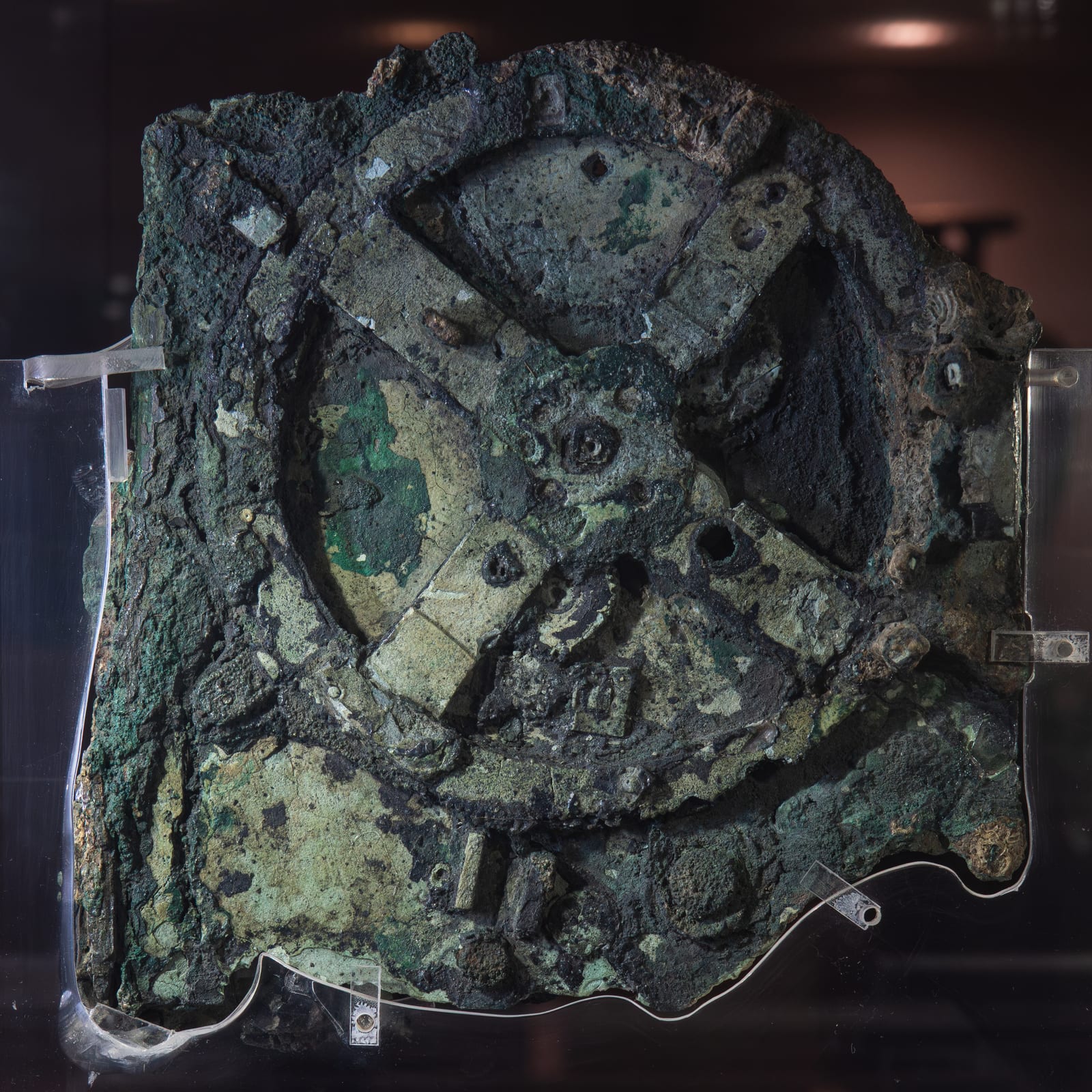
In 1900, a crew of sponge divers sheltering from a storm off the Greek island of Antikythera found something on the seafloor: a Roman cargo ship that had gone down more than 2,000 years earlier, loaded with statues, coins, jewelry, and glassware. Over the next year, divers hauled up the wreck's treasures. Among the marble horses and bronze figures came a corroded lump of bronze and wood that looked like a piece of statuary that had melted in the sea.
It sat in the National Archaeological Museum in Athens for more than a year before anyone noticed what was inside. In 1902, the Greek politician Spyridon Stais was visiting the museum when he spotted what looked like a gear wheel embedded in the lump, and pointed it out to the museum director, Valerios Stais, who made the first study of the fragment. The object became known as the Antikythera mechanism, and it has been surprising people ever since: an astronomical calculator from the 2nd century BC, built from dozens of bronze gears, capable of predicting eclipses and tracking the Sun, the Moon, and the planets. Nothing of comparable complexity appears again in the historical record for more than a thousand years.
It is often called the world's first computer. That framing is a metaphor, and it matters: the mechanism was not a programmable machine in any modern sense. It was a hand-powered astronomical calculator, an analog device that mechanized the cycles Greek astronomers had worked out by observation. But no device of similar mechanical sophistication is known from antiquity anywhere else, which is why more than a century of study has not exhausted it.
What the mechanism actually did
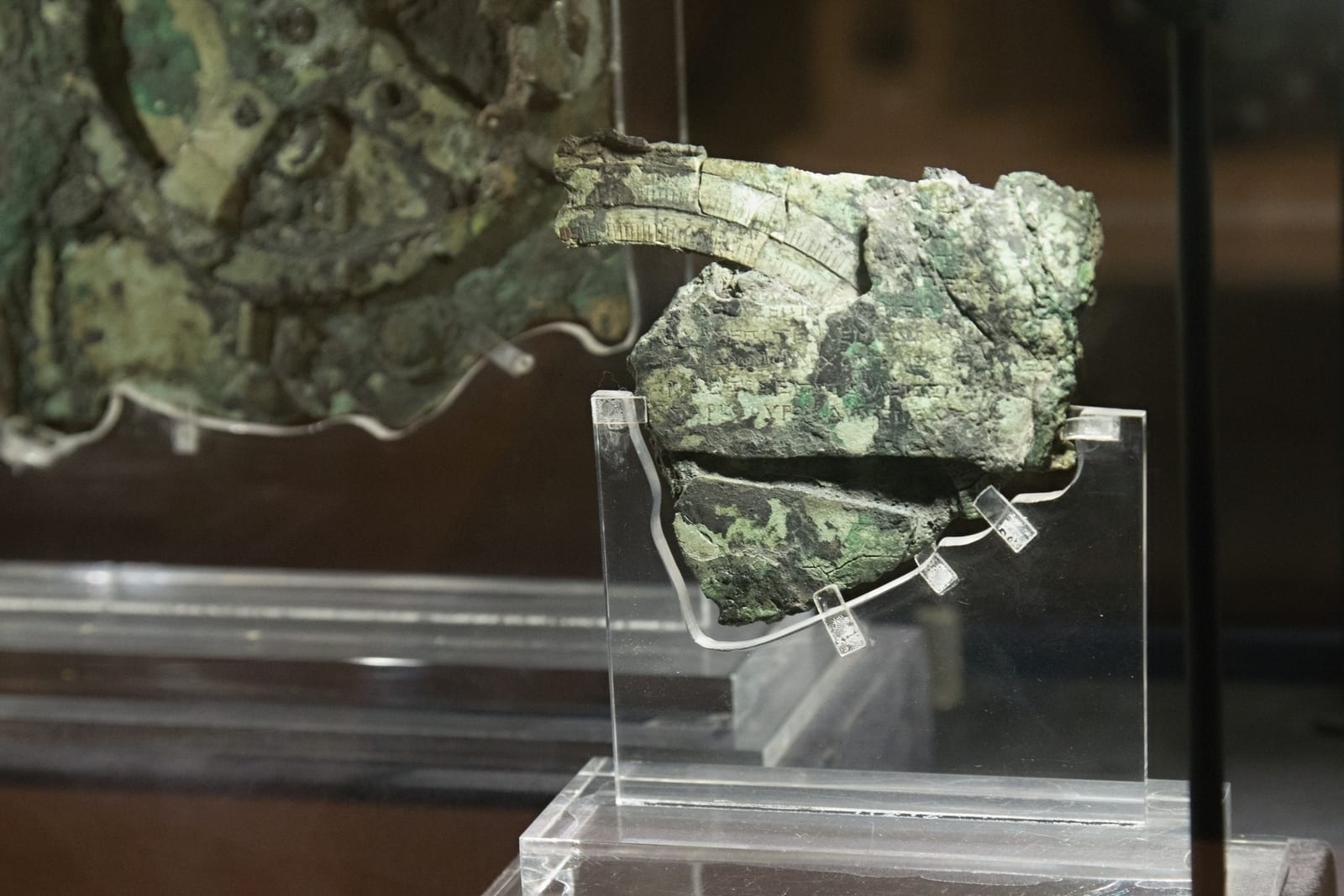
The mechanism was housed in a wooden-framed case about 34 by 18 by 9 cm, roughly the size of a thick book or a small clock, with doors on the front and back that carried long Greek inscriptions. When it was recovered it was a single fused lump. Conservators separated it into three main fragments, and those are now divided into 82 pieces. Four of the fragments contain gears; inscriptions survive on many others.
The front of the device carried two rings: an outer ring marked with the twelve signs of the zodiac, each divided into 30 degrees, and an inner, rotatable ring marked with the months and days of the Egyptian calendar, twelve months of 30 days plus five extra days. Pointers driven by the gears showed the positions of the Sun and the Moon against the zodiac on any given date.
The back carried the more complex displays: a spiral dial for the 19-year Metonic calendar, which aligns the lunar and solar years, with the names of the months inscribed; a Saros dial for predicting eclipses, based on the 18-year cycle after which eclipses repeat; and smaller dials for the Exeligmos, the triple Saros of 54 years, and the 76-year Callippic cycle. A fourth small dial, long called the Olympiad dial, tracks a four-year cycle of athletic games; the surviving inscriptions show it recorded the games that mattered to the mechanism's owner, and researchers now often call it the Games dial.
That is a remarkable amount of astronomy to encode in bronze. The gears reproduce the Moon's irregular motion, which speeds up at perigee and slows at apogee, a subtlety studied by the astronomer Hipparchus of Rhodes in the 2nd century BC. The mechanism's makers built that variation into the gear train with a pin-and-slot mechanism that converts uniform rotation into the Moon's uneven motion.

The engineering inside the lump
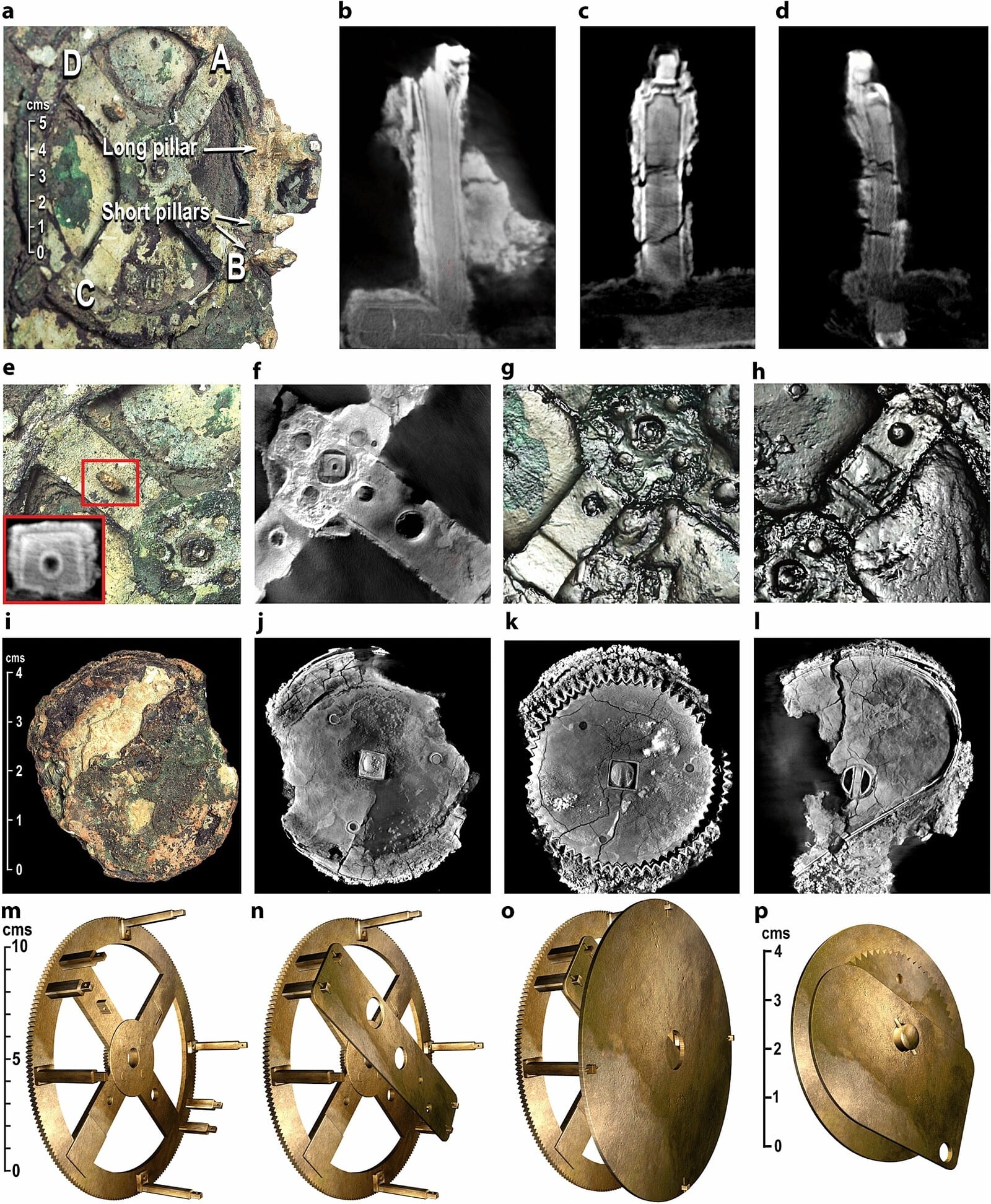
The surviving fragments hold about 30 bronze gears, and scans suggest the original had around 35. Fragment A alone contains 27 of them. The largest surviving gear, the main drive wheel, is about 13 cm in diameter and originally had 223 teeth. The teeth are triangular, cut by hand, and the gears mesh in trains that reduce or multiply rotation in precise ratios: 19 years to 235 lunar months for the Metonic cycle, 223 lunar months to 38 eclipse seasons for the Saros dial, and so on.
The gearing is layered, with the wheels stacked on parallel axes inside the wooden frame, connected by shafts and pins. The mechanism was turned by hand, probably with a small crank on the side of the case. Turning it moved the pointers on the front dial and advanced the spirals on the back, so a user could set a date and read the positions of the Sun and Moon, the phase of the Moon, and upcoming eclipses.
In 2005, a team led by Mike Edmunds of Cardiff University scanned all 82 fragments with X-ray computed tomography and polynomial texture mapping. The scans read inscriptions that had been unreadable for 2,000 years, revealed the layout of the back dials, and confirmed the sophistication of the gear trains, including the lunar anomaly mechanism. Those scans are why so much is now known about a device that spent two millennia on the seafloor.
A century of decipherment
The modern story of the mechanism begins with Derek de Solla Price, a physicist and historian of science at Yale, whose 1950s work and 1974 paper "Gears from the Greeks" established that the lump was a geared astronomical computer, a claim that seemed outlandish when he first made it. His X-ray studies revealed the internal gear trains and set the research agenda that continues today.
In 2021, a team at University College London led by Tony Freeth published a full model of the front of the mechanism in Scientific Reports, proposing how its gears could have driven pointers for the Sun, the Moon, and all five planets known in antiquity, displayed in the order the Greeks called the customary cosmological order. The model is a reconstruction proposal, not a confirmed original design, and it is presented as such in the paper. It showed, among other things, that the front dial's planetary displays could have been driven by a compact epicyclic system, with gears mounted on other gears, fitting within the space the surviving fragments allow.
The calendar ring and the 2024 lunar-calendar study
One of the mechanism's most studied pieces is the calendar ring, a circular scale on the back that survives only in fragments, with hundreds of tiny holes drilled around its circumference. In July 2024, two researchers, Graham Woan of the University of Glasgow and Joseph Bayley of University College London, published an analysis in the Horological Journal using Bayesian statistics and the same nested-sampling techniques used to analyze gravitational-wave signals from LIGO. They concluded the ring originally held 354 or 355 holes, which matches a lunar calendar of 354 days, rather than the 365 days of a solar calendar. The finding overturned a long-standing assumption that the ring tracked the solar year, and it is a good example of how new tools, in this case built for detecting ripples in spacetime, keep extracting information from a 2,000-year-old fragment.
The 2025 jamming debate: did it even work?
In April 2025, two Argentinian physicists, Alejandro Gangui and Esteban Toscano, published a preprint on arXiv simulating how the mechanism's hand-cut gears would actually have behaved. Their model combined an analytical solution for the non-uniform motion caused by triangular gear teeth with an error model for manufacturing imprecisions. Their results: the triangular shape of the teeth alone produced negligible errors, but manufacturing inaccuracies significantly increased the likelihood of the gears jamming or disengaging. Under their assumptions, the mechanism might have jammed after months of cranking, which led some coverage to ask whether it was a working instrument or a prestige object.
It is important to read this result carefully. The study is a preprint, not yet peer-reviewed, and the authors themselves warn that their results "must be interpreted with caution," because the impact of the variables is speculative. They also note a key uncertainty: either the mechanism never functioned, or its actual errors were smaller than those measured in the corroded fragments. That second possibility matters, because the fragments are warped and corroded, and measurements taken from them may overstate the original machining errors. The jamming study is best read as an open debate about how well the mechanism worked, not a settled verdict that it did not.
Who built it, and when
The date of the mechanism is not settled, but the range is narrow. Radiocarbon and other evidence place the shipwreck itself at roughly 70 to 60 BC. The mechanism must have been built before the ship sank, and proposed dates for its construction cluster around 150 to 100 BC, with some arguments for about 87 BC and others for roughly 205 BC. In 2022, researchers proposed that the mechanism's initial calibration date, the date it was set to display, was 23 December 178 BC, while other experts argue for 204 BC. The calendar on the Metonic spiral is of the Corinthian type, which points to Corinth or one of its colonies in northwest Greece or Sicily, and the connection to Syracuse has long made Archimedes a candidate for the engineering tradition behind it, a link that remains speculative.
What is not in doubt is the technological gap. Nothing of comparable mechanical complexity is known from anywhere in the world for more than a thousand years after the mechanism was built. The geared astronomical clocks of western Europe do not appear until the 14th century. The mechanism is an outlier in the archaeological record, and it is evidence that a tradition of precision mechanical engineering existed in the Hellenistic world, and that nearly all of it was lost. The ship that sank at Antikythera was probably carrying looted treasures from the coast of Asia Minor to Rome. It preserved, by accident, the only surviving example of a technology that historians would otherwise never have known existed.
What is still unknown
More than a century of research has answered the big question, what the mechanism was, but the open questions remain substantial. Who designed it, and in which workshop? The Corinthian calendar suggests a connection to Corinth or its colonies, but the mechanism itself may have been built anywhere in the eastern Mediterranean. Was it a one-off masterpiece, the work of a single brilliant maker, or the product of a working tradition of Greek mechanical engineering that simply left no other surviving examples? The ongoing excavations of the Antikythera shipwreck, which have continued in recent years and recovered more of the cargo, including the skeleton of a young man dubbed the Antikythera Man, keep the possibility alive that more of the mechanism, or something like it, may still be on the seafloor.
There is one more thing worth saying plainly. The Antikythera mechanism is extraordinary, but it is not mysterious in the paranormal sense. It is a human artifact, built by Greek craftsmen and astronomers with tools and skills that were remarkable for their time, and then lost. The reason it still fascinates is that it rewrites what historians thought ancient technology could do, and it does so with hard evidence: gears, inscriptions, and calibrated dials that survive to be X-rayed, measured, and debated. Every new technique, from CT scanning to gravitational-wave statistics, finds something new in it. That is the pattern of real science, and it is more impressive than any myth.
Sources
- Freeth, T., Higgon, D., Dacanalis, A. et al. "A Model of the Cosmos in the ancient Greek Antikythera Mechanism." Scientific Reports 11:5821 (2021), DOI 10.1038/s41598-021-84310-w - the open-access UCL reconstruction proposal for the front dial's planetary display, with the CT evidence for the gear trains. CC BY 4.0
- Gangui, A. & Toscano, E. "The Impact of Triangular-Toothed Gears on the Functionality of the Antikythera Mechanism." arXiv:2504.00327 (April 2025) - the preprint simulating gear jamming; the authors caution the results are speculative and the errors may be overstated by corrosion
- ScienceAlert: "Mysterious Antikythera Mechanism May Actually Be a Toy, Study Says" (April 22, 2025) - accessible coverage of the jamming preprint and the working-instrument versus prestige-object debate
- Live Science: "Mysterious Antikythera Mechanism May Have Jammed Constantly Like a Modern Printer" (April 10, 2025) - coverage of the jamming simulation and its limits
- Smithsonian Magazine: "How Well Did the Mysterious Antikythera Mechanism Actually Work?" (April 18, 2025) - the months-of-cranking figure and the debate context
- Archaeology Magazine: "New Study Suggests Antikythera Mechanism Had Design Flaws" (April 15, 2025) - carries the corrosion caveat: warped-gear measurements may overstate the errors
- Wikipedia: Antikythera mechanism - discovery history, the 1900-1901 sponge-diver recovery, the 1902 Stais identification, the dial functions, dating debates, and the 2024 Woan-Bayley lunar-calendar study
- The New York Times: "Antikythera Mechanism's Purpose Is Studied Using Cosmic Research Tool" (July 5, 2024) - the Woan-Bayley calendar-ring study, which found 354 or 355 holes matching a 354-day lunar calendar
Hero image: Fragment A of the Antikythera mechanism, National Archaeological Museum of Athens, photo by Logg Tandy, CC BY 4.0. Reconstruction and X-ray CT figures: Freeth et al., Scientific Reports 11:5821 (2021), DOI 10.1038/s41598-021-84310-w, open access under CC BY 4.0. Fragment B photo by Zde, CC BY-SA 4.0. All images used with attribution per their licenses.
Related on Impossible Universe
- A Lost Maya City Was Found Hidden in the Mexican Jungle. It Survived 1,000 Years Undisturbed. - what modern tools and patient field work can pull from a landscape, in the same way X-rays pulled a computer from a lump of bronze
- History and Archaeology Topic Hub - more stories on reading the buried past with DNA, LiDAR, and new instruments
- NASA's Roman Space Telescope: The Launch Preview - from a bronze gear train that tracked the heavens to a space telescope that will map a billion galaxies, a 2,000-year span of humans building machines to read the sky