A Third Galaxy Without Dark Matter Just Showed Up. It's Right Where Scientists Predicted.
Astronomers predicted another dark matter-free galaxy would be found along a mysterious chain stretching through space. Then KCWI at Keck Observatory confirmed one. The third such galaxy ever discovered, NGC 1052-DF9, completes a pattern that scientists say points to a violent collision that tore ordinary matter from its invisible halo.
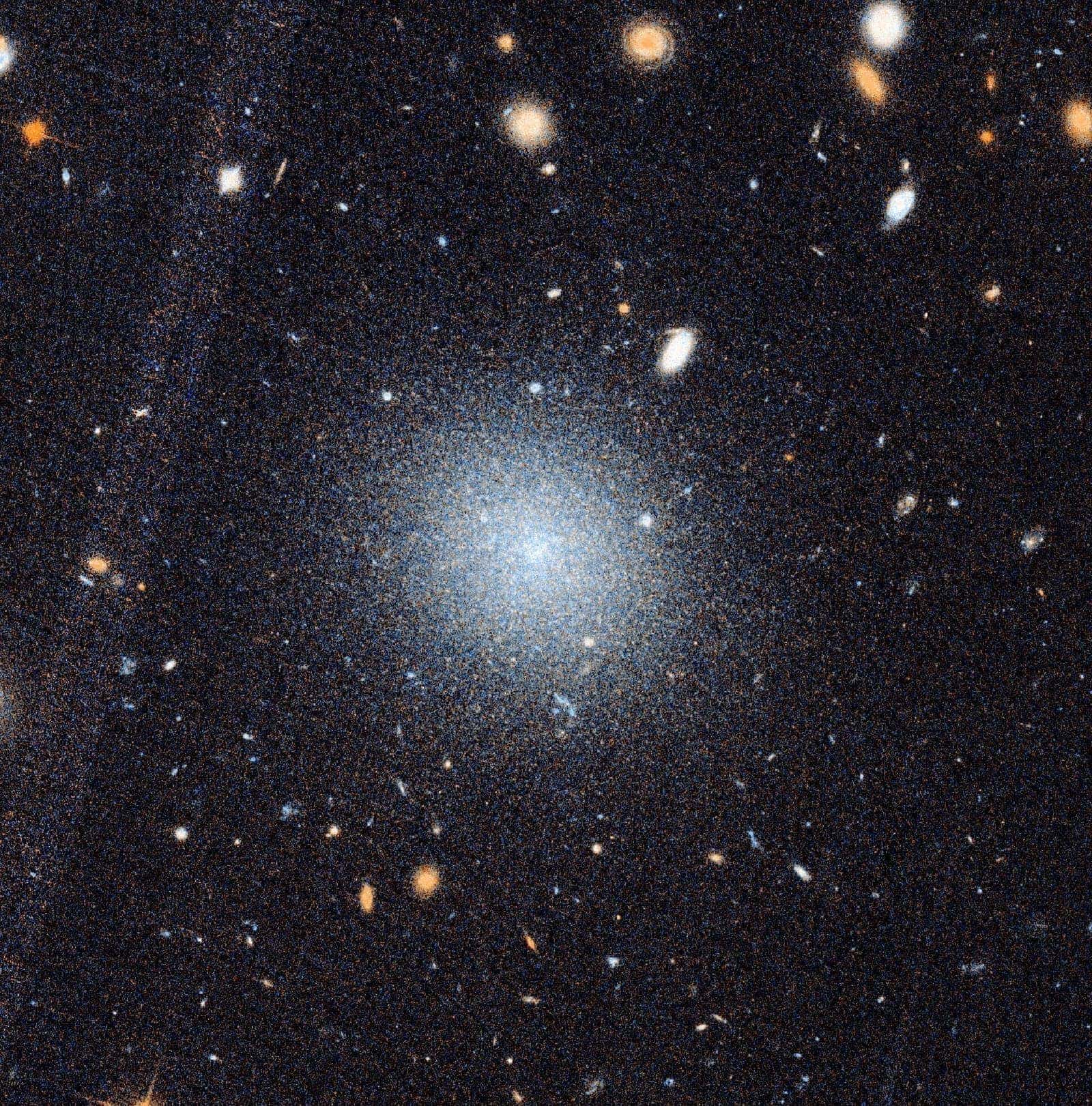
In 2018, a team at Yale announced they had found something that should not exist: a galaxy called NGC 1052-DF2 that seemed to contain no dark matter. The claim met immediate skepticism. Galaxy formation theory says galaxies form inside massive dark matter halos. A galaxy without one was like a tree without roots.
Then they found a second one. DF4 sat in the same region of space, about 67 million light-years from Earth, and showed the same impossible signature. Two anomalies were still easier to dismiss than accept. Maybe the measurements were wrong. Maybe the galaxies were closer or farther than estimated, throwing off the mass calculations. Maybe it was a fluke.
Now there is a third.
On June 16, 2026, a team led by Yale astrophysicist Michael Keim published the discovery of NGC 1052-DF9 in The Astrophysical Journal. Using the Keck Cosmic Web Imager at W. M. Keck Observatory in Hawaii, they measured the velocities of stars inside the ultra-diffuse dwarf galaxy and found a total mass of roughly 100 million suns. That figure matches the mass of the galaxy's visible matter alone. A normal galaxy of comparable brightness would be about 100 times more massive, with dark matter making up the overwhelming majority of its gravitational pull. DF9, like DF2 and DF4 before it, appears to have none.
Not Just an Outlier. A Chain.
What makes the discovery more than a curiosity is the geometry. DF9 does not sit randomly in the sky. It belongs to the same narrow, linear structure as DF2 and DF4, a chain of roughly a dozen faint galaxies stretching across the NGC 1052 field. The galaxies in the trail share similar positions and move through space in a coordinated way. They are not neighbors by accident. They are a family.
The existence of a third dark matter-free galaxy in the same trail turns a pattern into a prediction. If a bullet-like collision between two dwarf galaxies ripped gas away from its surrounding dark matter, the gas could cool, fragment, and form a string of new galaxies composed almost entirely of ordinary matter. The dark matter, interacting with itself and with the gas only through gravity, would continue on a different trajectory. The result: a trail of galaxies that look impossible because they are missing the one ingredient astronomers thought was mandatory.
"A line of galaxies lacking dark matter has never been seen before," Keim said. "The discovery provides some of the strongest evidence yet that these galaxies formed through an extreme and previously unseen process and offers a rare new window into the nature of dark matter itself."
The leading scenario, known as a bullet dwarf collision, is essentially a scaled-down version of the Bullet Cluster, the famous galaxy cluster merger where X-ray observations revealed clouds of hot gas separated from the bulk of the dark matter. In this case, the collision happened between much smaller dwarf galaxies. Their stars and dark matter halos passed through each other. Their gas, however, collided and pooled, creating the raw material for new star systems while the dark matter kept moving.
Measuring What Is Not There
Proving a galaxy lacks dark matter is harder than proving it has some. You cannot point a telescope at the absence of a signal. Instead, you measure the motions of stars and gas and work backward to the total mass required to produce those motions. If the mass you get from gravity matches what you can see in starlight, there is no room left for dark matter.
The team used KCWI, an integral field spectrograph on the Keck II telescope, to collect spectra across the face of DF9. By tracking how stars in different parts of the galaxy move relative to one another, they calculated the gravitational mass needed to hold the system together. The answer: about 100 million solar masses. The visible mass, estimated from the galaxy's brightness and stellar population: also about 100 million solar masses. The dark matter fraction is consistent with zero.
"KCWI's exceptionally high precision enabled us to measure DF9's extraordinarily low mass with the accuracy needed to demonstrate its lack of dark matter," Keim said. "Up until now, it was assumed galaxies formed within pools of dark matter called halos. This system shows that stars and galaxies can form outside of dark matter halos in extreme events and indicates that dark matter is a physical substance that can act independently of normal matter or gas, challenging alternative theories that dark matter is gravity."
That last point cuts to the heart of a long-running debate. Some physicists have argued that what we call dark matter is not a substance at all but a sign that our theory of gravity breaks down at galactic scales. The modified gravity approach, known as MOND, predicts that every galaxy should show the same systematic deviation from Newtonian dynamics. Galaxies that show no deviation at all, like DF2, DF4, and now DF9, are extremely difficult to explain under modified gravity. If dark matter is a modification of the force law, it should affect every galaxy equally. These three galaxies suggest it does not.
What Comes Next
The Keim team is now searching for additional remnants of the same collision. One target is diffuse gas that may have been stripped during the encounter and left scattered along the trail. Instruments on upcoming observatories, including the Vera C. Rubin Observatory and next-generation spectrographs, could detect it. If gas is found, it would place an even tighter constraint on how the collision unfolded and when it happened.
Pieter van Dokkum, the Yale astronomer who discovered DF2 and DF4 and co-authored the new study, has spent years defending the dark matter-free galaxy claim against the broader community's doubts. The addition of DF9 strengthens the case considerably, but it also sharpens the questions. How common are bullet dwarf collisions? Do the resulting galaxies survive for billions of years, and how many more are hiding in existing survey data? Could there be entire populations of dark matter-free galaxies waiting to be found around other massive host galaxies?
For now, the chain stretching from DF2 through DF4 to DF9 is the only known system of its kind. It is a natural laboratory for testing what dark matter is and how galaxies can form without it. Two galaxies could be a coincidence. Three galaxies, aligned and moving together, look a lot like a rule.
Sources
- W. M. Keck Observatory: Astronomers Discover Third Galaxy Without Dark Matter - press release, June 16, 2026
- Keim et al., "A Third Dark-Matter-Deficient Galaxy in the NGC 1052 Group," The Astrophysical Journal, 2026 - DOI: 10.3847/1538-4357/ae6b8d
- Daily Galaxy: Astronomers Spot A Third "Dark Matter Free" Galaxy In A Strange Cosmic Alignment - June 2026 coverage
- SpaceEyeNews: Dark Matter Free Galaxy Discovery Reveals a Growing Cosmic Pattern - June 2026
- W. M. Keck Observatory - KCWI instrument description and prior DF2/DF4 research by van Dokkum et al.
The hero image is a composite from Keim et al. (2026) using Hubble Space Telescope data (NASA/ESA) and DECaLS survey imagery. Research published in The Astrophysical Journal. Observations conducted at W. M. Keck Observatory on Maunakea, Hawai'i.
Related on Impossible Universe
- A Dying Star Could Create a Tiny New Universe Instead of a Black Hole - another challenge to the standard picture of what fills the universe, this time from theoretical physics
- A Neighbouring Galaxy Is Being Pulled Apart, and Astronomers Just Mapped Every Star's Escape - a different kind of galactic disruption, driven by gravity that is not in doubt