Euclid Spent 26 Hours Looking at the Milky Way's Core. It Came Back With 60 Million Stars.
The European Space Agency's dark universe telescope paused its survey of distant galaxies to stare at the brightest part of our own. The resulting visible-light mosaic contains more than 60 million stars and 51 known planetary systems, and it may change how astronomers find exoplanets.
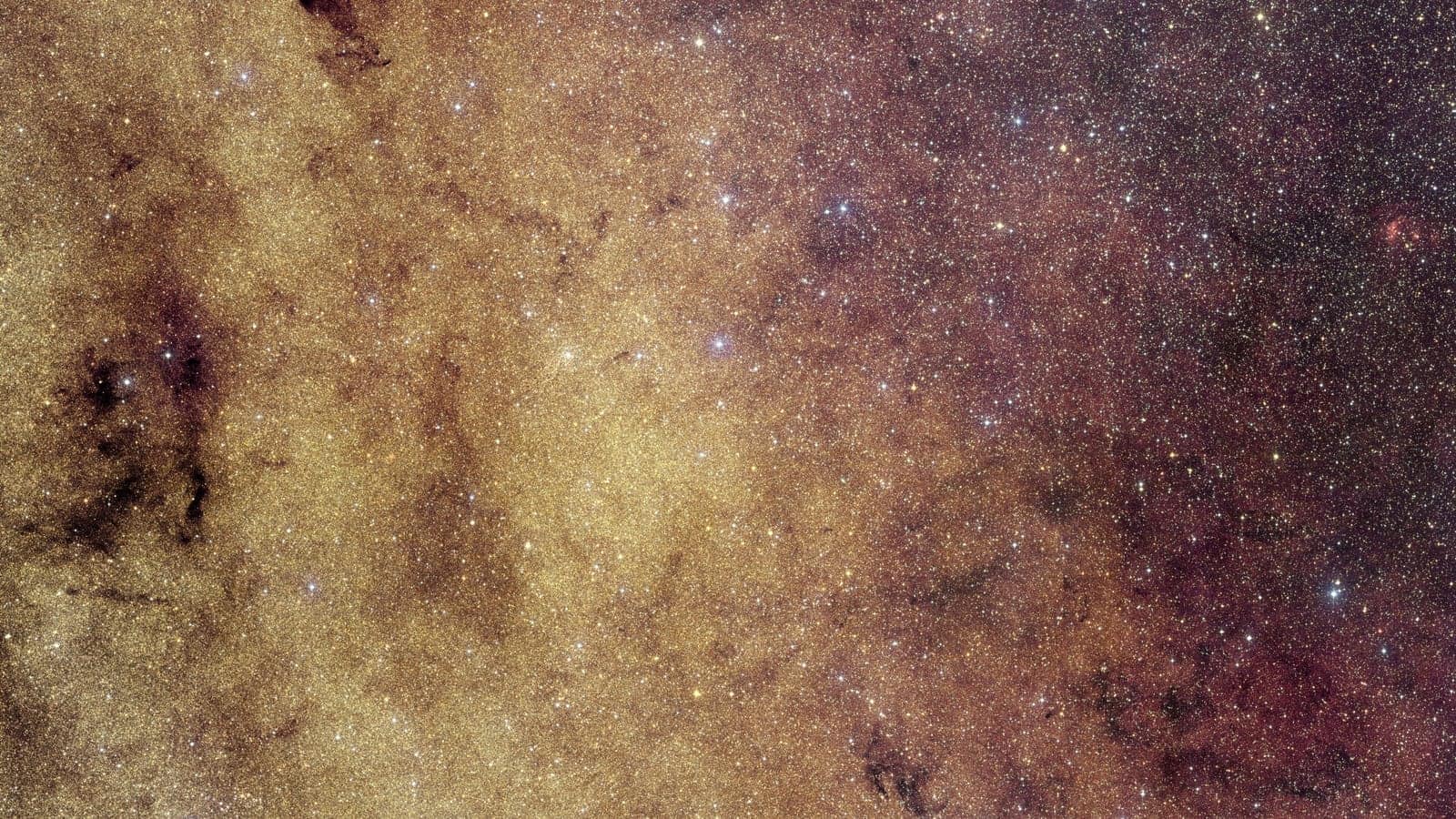
In March 2025, the European Space Agency's Euclid space telescope did something it was never built to do. Designed to map billions of distant galaxies and probe the invisible forces shaping the universe, it turned instead toward the brightest, most crowded part of our own galaxy. For 26 hours, it stared at the Milky Way's center.
The result, released June 24, 2026, is the largest and most detailed visible-light portrait of the galactic core ever made. More than 60 million individual stars fill a single mosaic. Fifty-one known planetary systems sit inside the frame. And for astronomers hunting worlds beyond our solar system, the image changes everything.
A telescope with two lives
Euclid launched in 2023 on a 1 billion euro mission to build the most accurate 3D map of the cosmos. Its job is to measure how dark energy and dark matter have shaped the distribution of galaxies across cosmic time. The telescope's visible light camera, called VIS, was built for that dark universe survey, not for taking pictures of bright stars in our own galaxy.
But that same camera has a rare skill. Its sensitivity in visible light is comparable to Hubble's Wide Field Camera, yet each pointing it captures spans an area 270 times larger than Hubble's field of view. To observe the same patch of sky, the Keck Observatory on Mauna Kea would need roughly 2,000 hours. Euclid did it in 26.
"It was never built with this science in mind, but it has proved to be a superb facility for the work," said Eamonn Kerins, an astrophysicist at the University of Manchester's Jodrell Bank Centre for Astrophysics.
The crowded heart of the galaxy
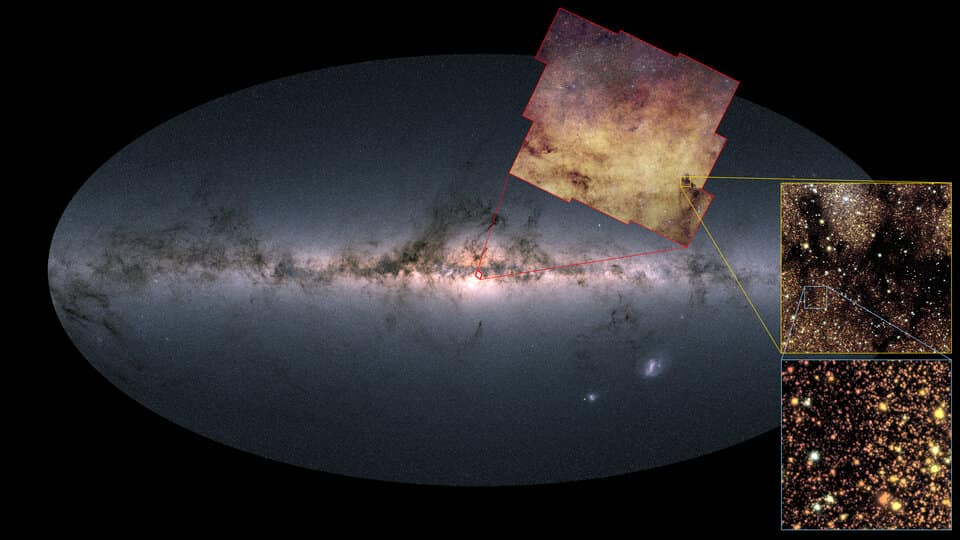
The region Euclid observed is the galactic bulge, a dense, bar-shaped structure at the center of the Milky Way made mostly of old, cooler stars packed together far more tightly than the spiral arms where our Sun lives. From Earth, the bulge appears as a brilliant band of light in the constellation Sagittarius, but its true structure is hidden behind thick lanes of interstellar dust.
Euclid's visible light camera can see through enough of that dust to resolve individual stars, something few telescopes can manage in such a crowded field. The result is a mosaic made from nine separate pointings, each one covering more sky than the full Moon. Stitched together, they form a single 4.8-square-degree portrait of the galaxy's most densely populated neighborhood.
Why 60 million stars matter
The image is beautiful, but its scientific purpose is specific. Astronomers want to use it for microlensing, a technique that relies on the chance alignment of two stars with an observer on Earth.
When one star drifts in front of another, the nearer star's gravity bends the light of the more distant one, making it appear brighter. If a planet orbits the nearer star, its gravity adds a tiny extra tug to the light, creating a distinctive spike in brightness. The pattern reveals the planet's presence and, critically, allows astronomers to measure its mass.
"To catch microlensing, you need to observe parts of the sky that are crowded with stars, such as close to the centre of our galaxy," said Jean-Philippe Beaulieu of the Institut d'Astrophysique de Paris, who originally pushed for Euclid to observe the galactic bulge. "During the last twenty years, almost 300 exoplanets have been discovered using this technique, all with ground-based telescopes and all towards the centre of our galaxy."
This single Euclid image already includes 51 known planetary systems. And it will do more than just photograph them. Because Euclid captured the stars before any microlensing alignment occurs, the image serves as a baseline. When future telescopes, particularly NASA's Nancy Grace Roman Space Telescope launching this August, detect microlensing events in the same region, astronomers can compare the overlapping stars to Euclid's earlier snapshot.
"This means that anyone who detects a microlensing event in the same region will be able from now on to use Euclid data as a time reference in the past," said Natalia Rektsini, who led the data release of the galactic bulge survey. "Since Euclid can clearly separate individual stars, one can then measure how fast they move over time and use that information to confirm the existence of a planet and determine its mass."
A preview of what Roman will do
The timing is no coincidence. NASA's Roman Space Telescope, scheduled for launch no earlier than August 30, 2026, will scan the same region of the galactic bulge for microlensing events. Roman is expected to discover roughly 1,500 microlensing exoplanets over its primary mission. The Euclid image covers the entire area Roman will monitor, providing a before picture taken more than a year before any of those events happen.
"The Euclid snapshot will improve those measurements possibly by up to a factor of three, which for a single image is quite something," Kerins said.
Roman's data will also help address one of the big unknowns in exoplanet science: the population of cold, icy planets. Most planet-hunting techniques favor large, hot worlds close to their stars. Microlensing is different. It finds whatever is out there, regardless of the planet's temperature or the brightness of its host star. The technique is uniquely sensitive to cold exoplanets in the outer reaches of their solar systems, worlds that other methods routinely miss.
One day of Euclid time
The image was taken on March 23, 2025, during a single 26-hour observation window. Euclid has spent most of its mission surveying distant galaxies, but its ability to cover large areas of sky at high resolution makes it uniquely suited for this kind of bonus science. The same quality that lets Euclid map the dark universe at unprecedented speed also lets it produce the sharpest wide-angle portrait of our own galaxy's core.
"This data fires the starting pistol in a new age of exoplanet discovery, where we go from knowing about 6,000 exoplanets to finding more than 100,000 across the galaxy," Kerins said.
The image and its associated data are publicly available through the ESA Euclid archive and the ESASky science portal. The data covers not just the visible light shown in the mosaic, but also near-infrared measurements that can help astronomers distinguish between different types of stars and understand the structure of the galactic bulge itself. More than just a pretty picture, it is a reference frame for a generation of exoplanet science to come.
Sources
- ESA: "ESA's Euclid captures the Milky Way's crowded heart" - primary ESA science release, June 24, 2026, with full image details and researcher quotes
- The Guardian: "Millions of stars light up largest and most detailed shot of Milky Way's centre" - coverage with Eamonn Kerins quotes
- Popular Science: "Over 60 million stars dazzle in new image of the Milky Way" - coverage with Jean-Philippe Beaulieu quotes
- Space.com: "This is the largest and most detailed image of our Milky Way" - additional context and image details
- Live Science: "Euclid space telescope snaps largest ever close-up photo of the Milky Way" - additional reporting
Related Stories
- A Star Cluster That Refused to Die: Terzan 5 and the Bulge Fossil Fragments - another relic hiding in the Milky Way's bulge
- NASA's Next Flagship Telescope Just Arrived in Florida. It's Launching 8 Months Ahead of Schedule. - the Roman telescope that will follow up Euclid's exoplanet survey
- Webb Peered Into the Cigar Galaxy and Found 16.5 Million Stars Hidden Behind the Dust - another telescope resolving millions of stars in a distant galaxy
All images are from ESA/Euclid/Euclid Consortium/NASA, CFHT, with image processing by J.-C. Cuillandre and E. Bertin (CEA Paris-Saclay). These images are publicly released under ESA's standard image use policy (CC BY-SA 3.0 IGO) and may be used with proper attribution.
Related on Impossible Universe
- The Greatest Cosmic Movie Ever Made. Rubin Observatory Just Started Filming the Southern Sky for 10 Years. - the Vera C. Rubin Observatory, another survey telescope that will work alongside Euclid to map the universe
- The Small Magellanic Cloud Is Drifting Apart. Euclid Caught It in the Process. - another Euclid observation revealing the structure and evolution of a nearby dwarf galaxy