The First True Sugar Found in Space Is the Same Sugar Found in Raspberries
Astronomers have detected erythrulose, a four-carbon sugar, in a giant molecular cloud near the center of the Milky Way. It is the same sugar found in raspberries, and it is the first true sugar ever found beyond our solar system. The discovery, published in Nature Astronomy, suggests complex sugars can form on icy dust grains long before stars and planets exist, feeding directly into the question of how life's chemistry began.
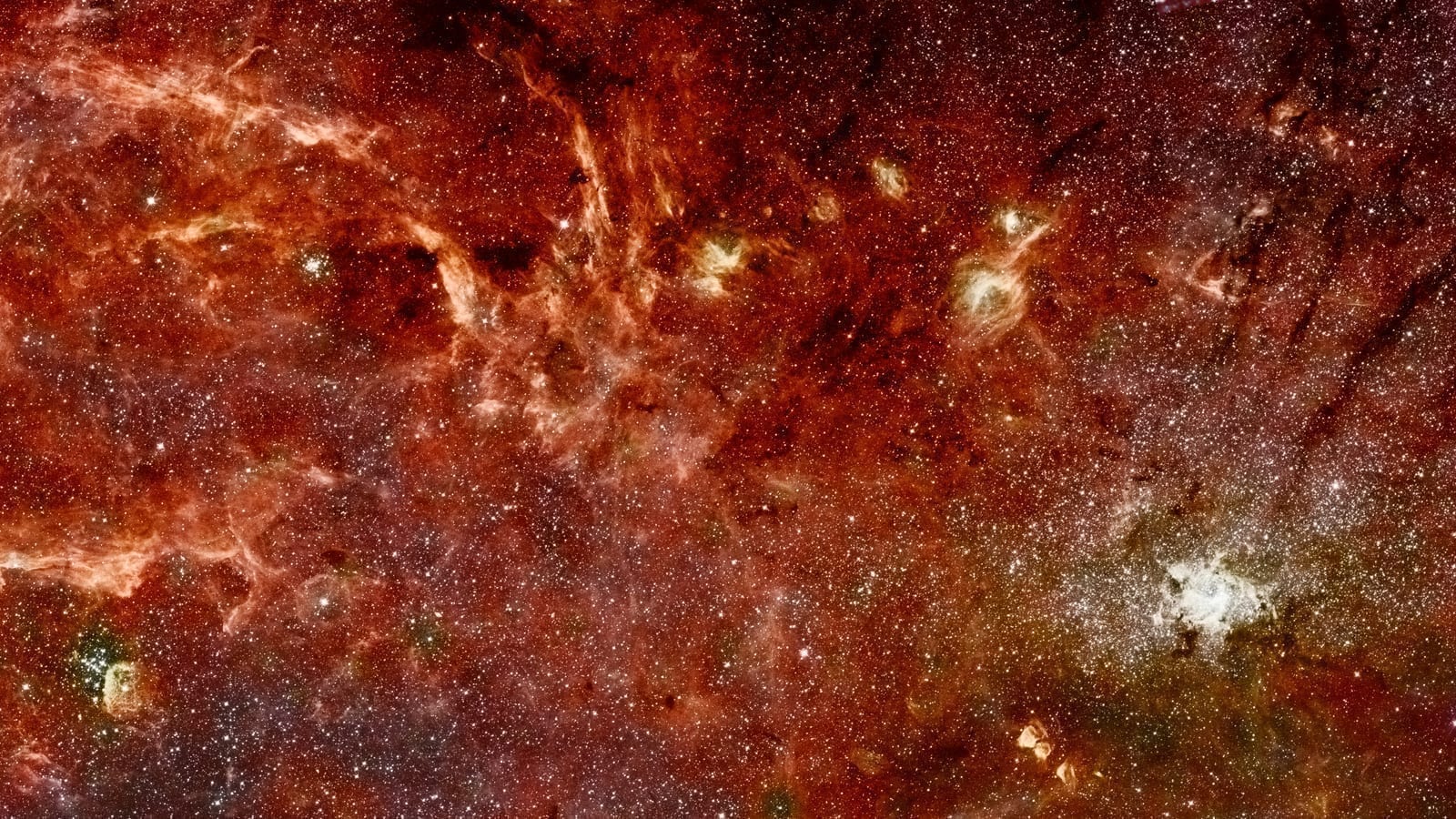
In July 2026, astronomers announced that they had found a sugar in interstellar space for the first time. Not a molecule that vaguely resembles a sugar, and not a sugar on a comet or an asteroid. A true sugar, floating in gas and dust between the stars, in a cloud a few hundred light-years from the center of the Milky Way.
The molecule is erythrulose, a four-carbon monosaccharide. It is the same sugar found in raspberries, and it is also used in self-tanning products. It is the first true sugar ever detected beyond our solar system, and its discovery, published in Nature Astronomy by a team led by Izaskun Jiménez-Serra of Spain's Center for Astrobiology (CAB), feeds directly into one of biology's oldest questions: where did the chemistry of life come from?
More than 340 molecules have now been identified in the interstellar medium, the thin gas and dust between the stars. Nearly 30 of them are tied to the chemistry of life: precursors of amino acids, of the building blocks of RNA, of the molecules that make cell membranes. But none of them was a sugar. That gap lasted for decades, and it was strange, because sugars are everywhere in biology.
What counts as a sugar, and why this was the first
Sugars are simple carbohydrates: molecules built from carbon, hydrogen, and oxygen, with a backbone of carbon atoms and a characteristic arrangement of chemical groups. Chemists group them by the number of carbons in the chain. A two-carbon sugar is a diose. Three carbons, a triose. Four, a tetrose. Five, a pentose, which is where ribose lives, the sugar that forms the backbone of RNA.
By a chemist's definition, the smallest true sugars have at least three carbons. That distinction matters, because in 2000 astronomers detected glycolaldehyde, a two-carbon molecule, toward the galactic center and some news coverage called it a sugar. Glycolaldehyde is a diose, a two-carbon compound, and while it is a crucial precursor, it is not formally a sugar.
"We have previously reported the detection of precursors of ribonucleotides, precursors of protolipids, and precursors of amino acids, but this is the first sugar," Jiménez-Serra said.
Erythrulose is a tetrose: a four-carbon sugar. It is a ketose, meaning its sugar chemistry is built around a ketone group, a specific arrangement of a carbon double-bonded to an oxygen. And it is chiral, meaning it comes in two mirror-image forms, like a pair of gloves.
How you find a sugar in a cloud 27,000 light-years away
The cloud in question is cataloged as G+0.693−0.027, a giant molecular cloud near the galactic center, the region Jiménez-Serra calls the richest chemical repository in the Milky Way. Large columns of gas and dust there concentrate molecules that formed on icy dust grains, then released into the gas, which makes them comparatively easy to detect.
The detection method is called rotational spectroscopy. In the cold cloud, molecules rotate, and each molecule rotates at specific frequencies determined by its exact shape and mass. As they spin, they emit radio waves at those frequencies, like a fingerprint in the radio spectrum. Point a sensitive radio telescope at the cloud, and every molecule present contributes its own pattern of lines.
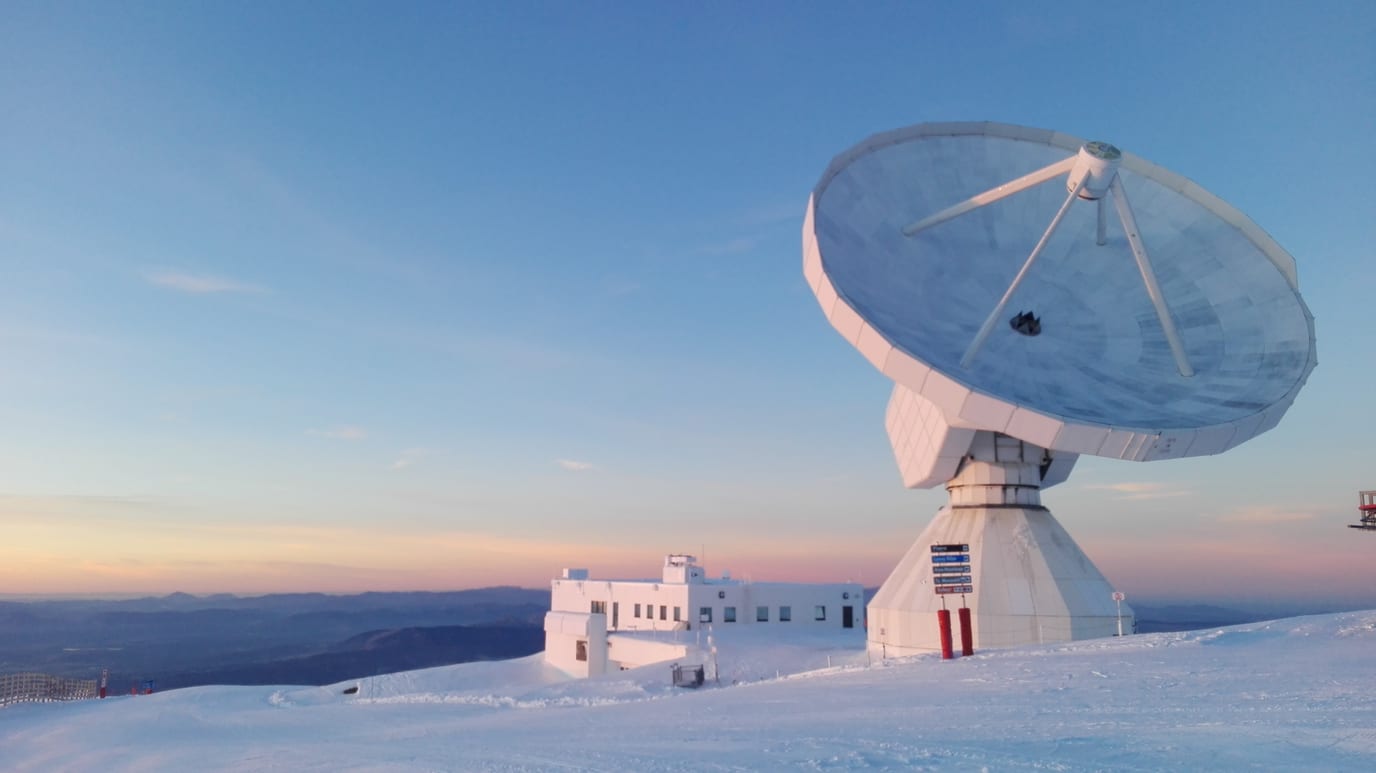
The team used two dish-shaped radio telescopes in Spain: the 40-meter Yebes telescope and the 30-meter IRAM telescope on Pico Veleta in the Sierra Nevada. They collected ultrasensitive broadband spectra of the cloud, then compared the observed lines against laboratory measurements of erythrulose's rotational spectrum.
Measuring the sugar's spectrum in the lab was itself an achievement. Sugars are difficult to vaporize without decomposing, so the team mixed erythrulose with talc, which helped release intact gas-phase molecules for the spectroscopic measurements. Then they identified and modeled more than 180 molecular species in the observational dataset, to determine which erythrulose signals were free of interfering emission from other molecules.
"I was looking at the data without any hope because we hadn't detected the three-carbon sugars," Jiménez-Serra said. "Then I started seeing that all the transitions were matching signals present in the observations."
The surprise: it skipped a step
The detection carries a puzzle that has astrochemists excited. In interstellar space, larger molecules generally form less often than smaller ones: building a bigger molecule takes more steps, so it should be rarer. By that logic, three-carbon sugars should be easier to find than four-carbon ones.
The team looked. The three-carbon sugars were not there, or at least not above the detection limit. Meanwhile, the four-carbon erythrulose appears to be at least eight times more abundant than its analogous three-carbon sugars would be.
"We've never managed to detect a sugar outside of our solar system," said Brett McGuire, a chemist at MIT who was not involved in the study. "And now we skipped all the three-carbon sugars and went straight to four carbons. That's astonishing."
The finding overturns the usual assumption that interstellar molecules grow one carbon at a time, by sequential addition of single atoms. Instead, the team's quantum chemical calculations and astrochemical simulations suggest erythrulose forms when two abundant two-carbon molecules, glycolaldehyde and ethylene glycol, react on the surfaces of icy dust grains. Two mid-sized pieces combine into one larger sugar, a pathway that sidesteps the missing three-carbon rungs.
"This chemistry is weird and unexpected, meaning it goes against our chemical intuition," McGuire said. "That's exciting because it opens an entirely new avenue to explore, and it might give us clues for other larger, more complex sugars that we should be looking for."
Icy dust grains as a sugar factory
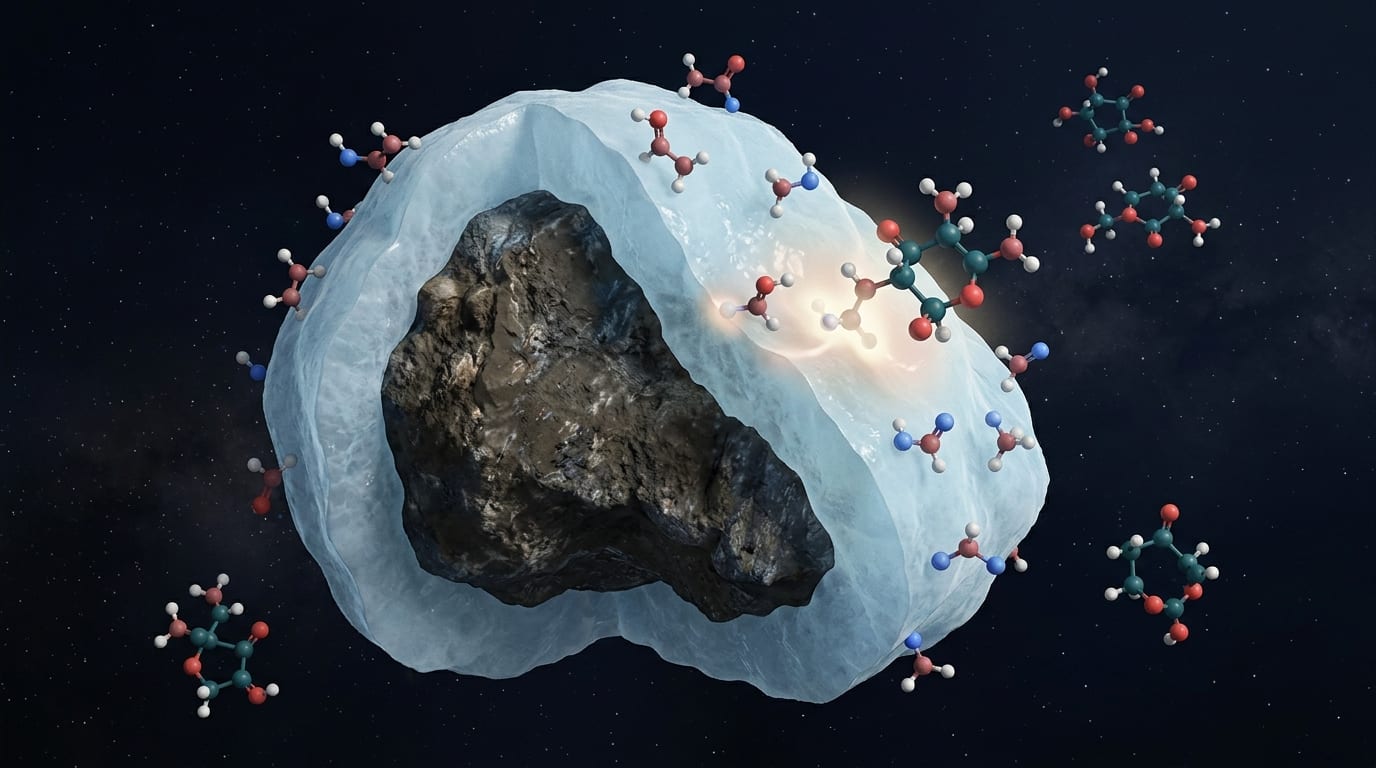
Molecular clouds are the coldest, emptiest places where chemistry demonstrably happens. Temperatures hover near absolute zero, and pressures are far lower than any laboratory vacuum on Earth. Individual chemical reactions occur only rarely, but the clouds persist for millions of years, and that is enough time for simple molecules to accumulate on dust grains, react on the icy surfaces, and build increasingly complex organics before the cloud collapses to form stars and planetary systems.
The new result places sugars on that list. "What we know for certain is that these molecules formed during the initial conditions of the process of planetary formation, even before a star or a planet forms," Jiménez-Serra said.
That is the piece that matters for the origin of life. Ribose, the sugar at the backbone of RNA, is also a monosaccharide, and RNA is widely thought to have played a central role in the earliest biology. If sugars can form in interstellar space, before planets exist, then the raw material for RNA's backbone was available in the clouds from which solar systems are built.
Two delivery routes, one open question
Sugars have reached planets by at least two routes, and the new detection clarifies the first of them. Ribose and other sugars have been found inside meteorites, including in analyses led by Yoshihiro Furukawa's group (PNAS 2019; Nature Geoscience 2026). Those sugars formed or were preserved inside asteroid parent bodies, then rode to Earth inside rocks. The interstellar detection opens the other route: sugars synthesized in cold clouds, incorporated into comets and asteroids as the cloud collapses, and delivered to young planets by impacts.
Erythrulose itself is not essential for life as we know it, but it converts readily into forms that are. In water, ketoses like erythrulose isomerize into aldoses, the other major family of sugars. "It's not essential for life, but can easily convert to a form that's thought to be crucial to kick-starting life on Earth," said Erika Hamden of the University of Arizona, who was not involved in the work.
Finding erythrulose in one cloud suggests the chemistry is not rare. "Finding them in one spot means they're likely also hiding in distant corners of the galaxy along with other important bits," Jiménez-Serra said.
What the discovery does and does not say
It is worth being precise about the claims. The detection is a single cloud, identified by matching multiple spectral lines against laboratory measurements, and the team modeled more than 180 other molecular species to rule out interference. That is a solid identification, but it is one cloud.
The "first true sugar" framing depends on definition. Glycolaldehyde, detected in 2000, is sometimes loosely called a sugar in news coverage, but it is a two-carbon diose, not formally a sugar. Erythrulose is the first true monosaccharide found in interstellar space, and the paper is careful about that distinction.
And the link to life's origins is a hypothesis, not a measured pathway. Astronomers have shown the sugar exists out there and that it forms before stars and planets. Whether interstellar sugars actually seeded early Earth's chemistry is a separate question, one that connects to the ribose-in-meteorites results and to the wider question of how life's building blocks came together. Each new molecule detected in these clouds adds a piece to that puzzle, and the sugar-shaped piece was missing for a very long time.
Sources
- Jiménez-Serra et al., Nature Astronomy (2026): Detection of a four-carbon sugar in interstellar space - peer-reviewed study, published online July 13, 2026, DOI 10.1038/s41550-026-02905-7 (open access)
- Nature news: First 'true sugar' molecule found in space, offering hints to life's origins - coverage with context on the detection and its significance
- Chemical & Engineering News: Astronomers detect sugar in interstellar space for the first time - detection method, telescope details, and expert reaction from Brett McGuire
- CNN: Sugar key for life on Earth found deep in our galaxy - coverage including Jiménez-Serra's comment on sequential carbon addition
- AP News: Astronomers find evidence of sugar in interstellar space - wire coverage with the raspberry and self-tanner context and independent expert comment
- WBUR Here & Now: Astronomers find sugar floating in space - interview with MIT chemist Brett McGuire on the detection
Hero image: composite infrared mosaic of the galactic center from NASA, ESA and Q.D. Wang (University of Massachusetts, Amherst), released by ESA/Hubble, used under the ESA/Hubble image use policy with credit. Inline telescope photo: IRAM (CC BY-SA 4.0, via Wikimedia Commons). Sugar formation diagram: conceptual illustration generated by the Impossible Universe Editorial Team based on the formation pathway described in the cited sources.
Related on Impossible Universe
- A Supernova Exploded Near the Milky Way Central Black Hole. Astronomers Just Found Its Remains. - another story from the same crowded galactic center region, where interstellar chemistry is richest
- JWST Just Caught an Interstellar Comet Carrying Chemicals That Don't Match Our Solar System - interstellar material sampled directly in our own solar system, the other way molecules from beyond arrive here
- Euclid Spent 26 Hours Looking at the Milky Way's Core. It Came Back With 60 Million Stars. - a telescope's view of the galactic bulge, the crowded region that hosts the cloud G+0.693−0.027
- Telescopes and Space Missions (topic hub) - more stories about the observatories that find molecules, stars, and planets across the galaxy