The Sun Might Not Swallow Earth After All. A New Model Just Made the Case.
For decades, astronomers assumed Earth would be swallowed by the Sun when it becomes a red giant in 5 billion years. A new model using improved tidal physics and observations of a nearby star suggests our planet might escape.
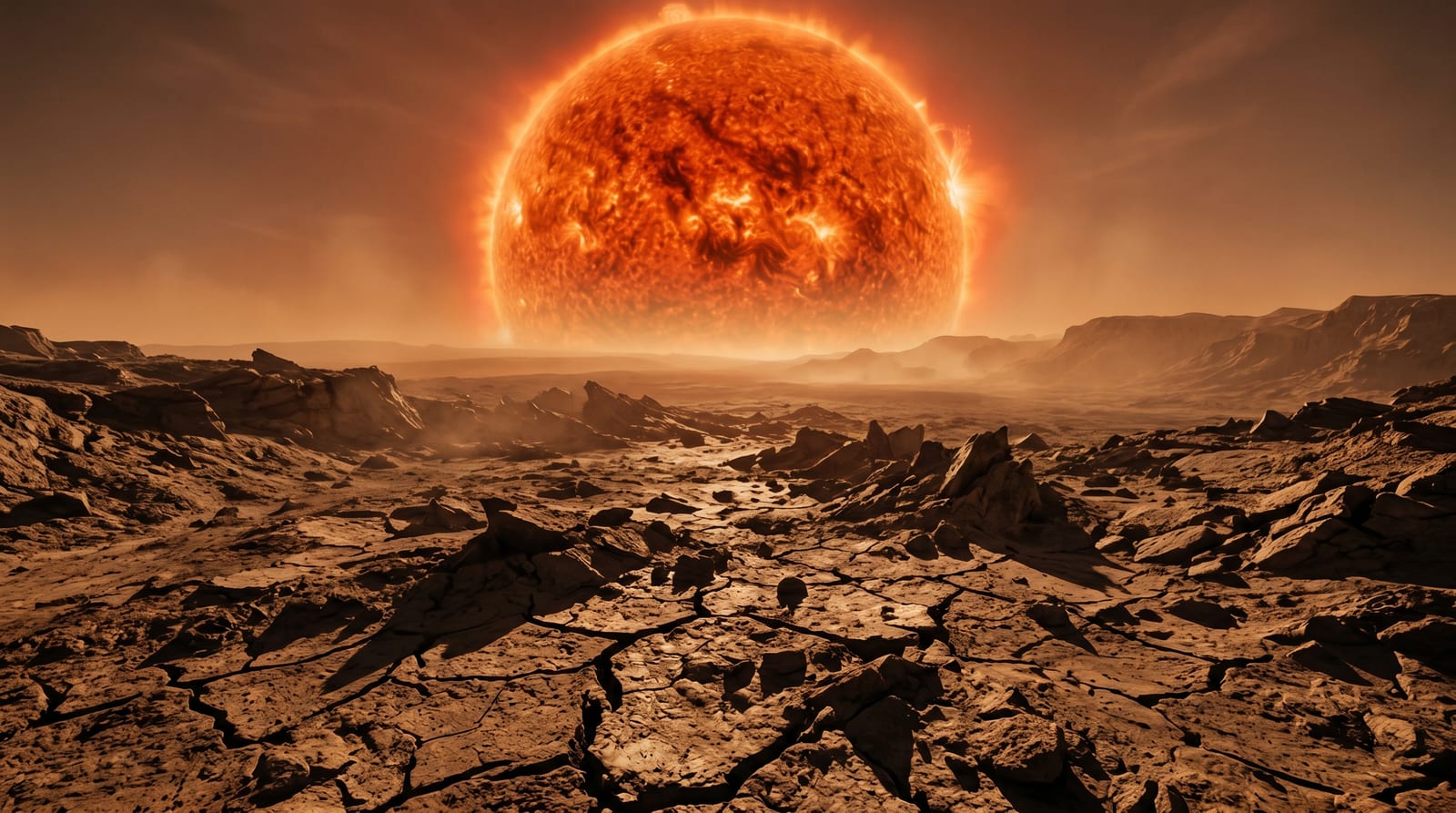
In about five billion years, the Sun will run out of hydrogen fuel in its core. When it does, it will swell into a red giant, growing so large that its outer layers would extend to roughly the current orbit of Earth. For decades, the standard assumption in astronomy textbooks has been simple: Earth gets swallowed. End of story for the home planet.
A new study published in Astronomy and Astrophysics on June 19, 2026 says the ending might need a rewrite.
Mats Esseldeurs, an astrophysicist at Belgium's KU Leuven, and colleagues revisited the question using two improvements that were not available to earlier researchers. The first is a more sophisticated treatment of tidal physics. The second is better data on how much mass aging stars actually lose to stellar winds.
"Earth's fate depends on a delicate balance between two effects," Esseldeurs explained. "If tidal interactions predominate, Earth is engulfed by the Sun. If the Sun's mass loss predominates, Earth escapes into an orbit larger than the radius of its star."
A contest between two forces
Here is how that balance works. As the Sun expands, its gravitational relationship with Earth changes. Tidal forces within the giant star produce drag that pulls Earth inward, toward destruction. At the same time, the Sun is shedding mass through a powerful stellar wind. Lose mass, lose gravitational grip, and the planet drifts outward. The question is which force wins.
Previous studies used simplified descriptions of how tides dissipate inside giant stars. Over the last 15 years, researchers have developed much better models based on the actual physics of stellar interiors, including something called dynamical tides, energy carried by internal gravity waves that ripple through the body of a giant star.
The new paper applies these updated prescriptions to the specific case of Earth's orbit. The result flips the old prediction. Under the new tidal model, Earth survives both the red giant branch (RGB) phase and the later asymptotic giant branch (AGB) phase, two separate expansion episodes when the Sun balloons outward before finally collapsing into a white dwarf.
The Sun's old cousin
The team also tested their model against a real star. L2 Puppis, located about 200 light-years away in the constellation Puppis, is a red giant with roughly the same mass the Sun will have at that stage. Think of it as a preview. L2 Puppis is already going through what our star will face, and astronomers have measured how much mass it is losing to its stellar wind.
Using the observed mass-loss rate of L2 Puppis as a stand-in for the Sun's future behavior, the model also favors survival. The Sun would need to lose mass at a rate closer to what astronomers actually observe in similar stars, and that is fast enough to let Earth drift clear.
"Advances made in modeling these tides over the last 15 years have enabled us to show that the dissipation is lower than previously expected," said Stephane Mathis, an astrophysicist at CEA Paris-Saclay and a co-author of the study.
Not a done deal
There is an important caveat. The paper is careful to say the conclusion is not definitive. The exact mass-loss rate during the Sun's AGB phase is still uncertain, and if it turns out to be lower than current estimates, Earth could still be pulled in. As the authors put it, "the ultimate fate of the Earth remains uncertain."
What the new work shows is that survival is at least as plausible as destruction, maybe more so. That is a reversal of the previous consensus, and it comes from better physics, not guesswork.
What the new model does not change: by the time any of this matters, Earth will have been uninhabitable for billions of years. The Sun is slowly brightening, and in roughly a billion years it will be about 10 percent more luminous than it is now. That is enough to trigger a runaway greenhouse effect, boiling away the oceans long before the red giant phase begins. The planet may survive. Life as we know it will not.
The unlucky ones
Mercury and Venus will not be so fortunate. Even under the most generous mass-loss assumptions, both planets sit too close to their star. They will be swallowed by the expanding Sun before Earth ever has to worry about its own escape.
Mars, interestingly, might also survive. According to the new modeling, the red planet's greater distance gives it a clearer path outward as the Sun loses mass.
After the red giant and AGB phases end, the Sun will shed its outer layers entirely, leaving behind a white dwarf, a dense stellar remnant about the size of Earth. It will produce no more fusion reactions and will slowly cool over trillions of years. If Earth survives, it will orbit that faint ember in permanent darkness, a frozen witness to the end of its star.
Beyond our solar system
The broader picture from this research goes beyond our own backyard. If Earth-sized planets can survive their star's giant phases, then some of the rocky planets observed around white dwarfs today may be original planets that made it through, rather than bodies that formed later from debris. Finding Earth-like planets orbiting white dwarfs at roughly the right distance would be one way to test this model against real data.
The study was published open access in Astronomy and Astrophysics under a Creative Commons license, with Esseldeurs and Mathis joined by authors from KU Leuven and Universite Paris-Saclay.
For now, it is a satisfying correction to something everyone thought they knew. The Sun may not get the last word on Earth after all.
Sources
Related on Impossible Universe
- A Dying Star Could Create a Tiny New Universe Instead of a Black Hole - what happens when theoretical physicists solve the same equations and get a stranger answer
- New Horizons Heads for the Solar System's Edge. Forecasts Predict When It Will Cross the Boundary. - another story about boundaries and what lies beyond them