Webb Peered Into the Cigar Galaxy and Found 16.5 Million Stars Hidden Behind the Dust
Scientists aimed NASA's James Webb Space Telescope at starburst galaxy M82 for 65 hours. The near-infrared view pierced through thick dust and resolved 16.5 million individual stars, revealing the Cigar Galaxy's hidden formation history.
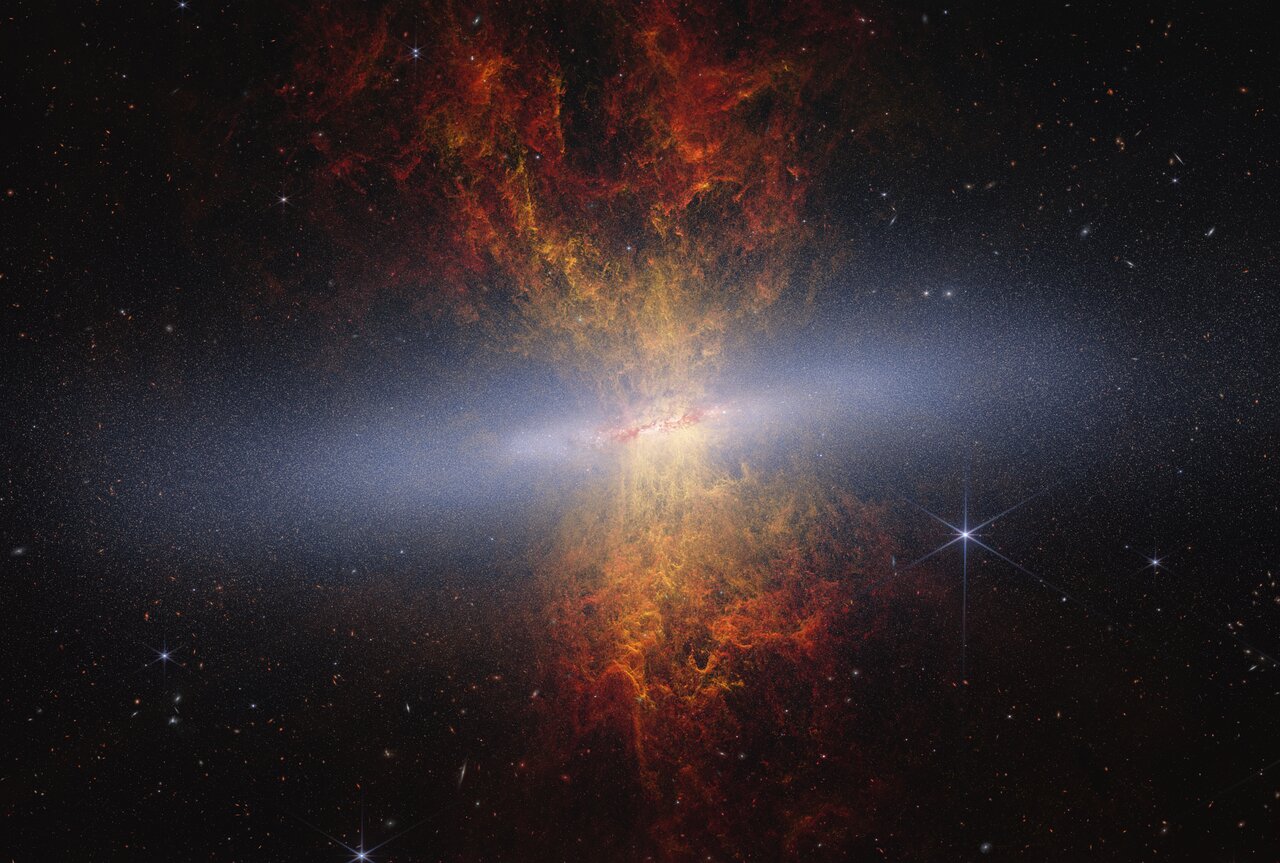
Twelve million light-years away, a small galaxy is burning through its fuel at a rate that makes the Milky Way look sluggish. Messier 82, better known as the Cigar Galaxy, is forming stars ten times faster than our own galaxy, a violent frenzy that astronomers have studied for decades but could never see clearly. Too much dust stood in the way.
Then Webb looked.
A team led by Adam Smercina of the Space Telescope Science Institute spent 65 hours with the James Webb Space Telescope's near-infrared camera pointed at M82. What came back was a view no telescope had ever delivered: 16.5 million individual stars resolved one by one through the dust that has hidden them from every other observatory.
"M82 is a mess, but it's a beautiful mess," Smercina said. "We don't fully understand what's going on, especially concerning its evolutionary history. What could have triggered such an elevated rate of star formation? How long has this galaxy been driving plumes of material away from its center?"
The results, published by the Space Telescope Science Institute and ESA on June 23, 2026, are a deep imaging survey of a galaxy that has been a laboratory for starburst physics for decades.
A galaxy on fire
M82 sits in the constellation Ursa Major, close to its larger spiral companion M81. The two galaxies had a close encounter about 200 million years ago, and the gravitational interaction compressed gas clouds inside M82 so violently that they began collapsing into stars at a furious rate. The starburst will eventually burn itself out, probably within a few hundred million years, a blink in galactic time. But right now, M82 is caught in the middle of it.
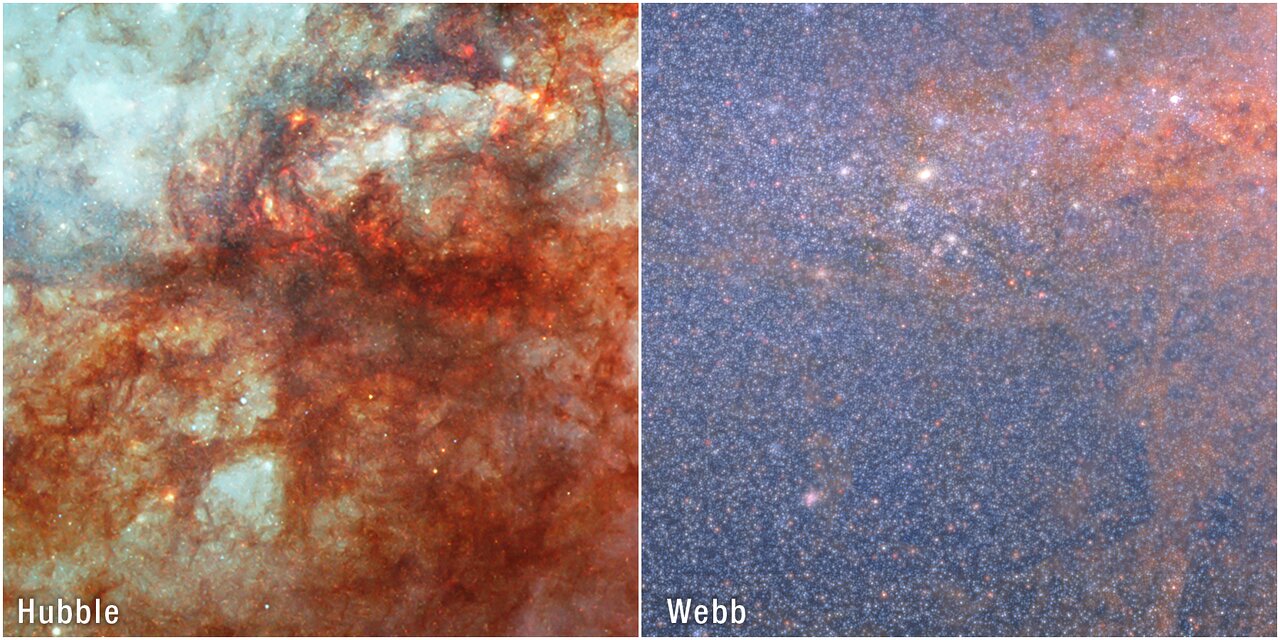
The problem for astronomers has always been the dust. M82 is packed with the same kind of thick interstellar dust that makes the center of the Milky Way invisible in visible light. Hubble could see the galaxy's overall structure, its glowing gas plumes, and its chaotic disk, but the stars themselves were hidden behind the haze. Webb's infrared eyes changed that.
"The sheer number of stars that we were able to resolve with Webb is incredible," said team member Benjamin Williams of the University of Washington. "It's a whole different world from what we've been able to see with other telescopes. All of these stars collectively provide a detailed fossil record of the formation and evolution of M82."
16.5 million specks of light
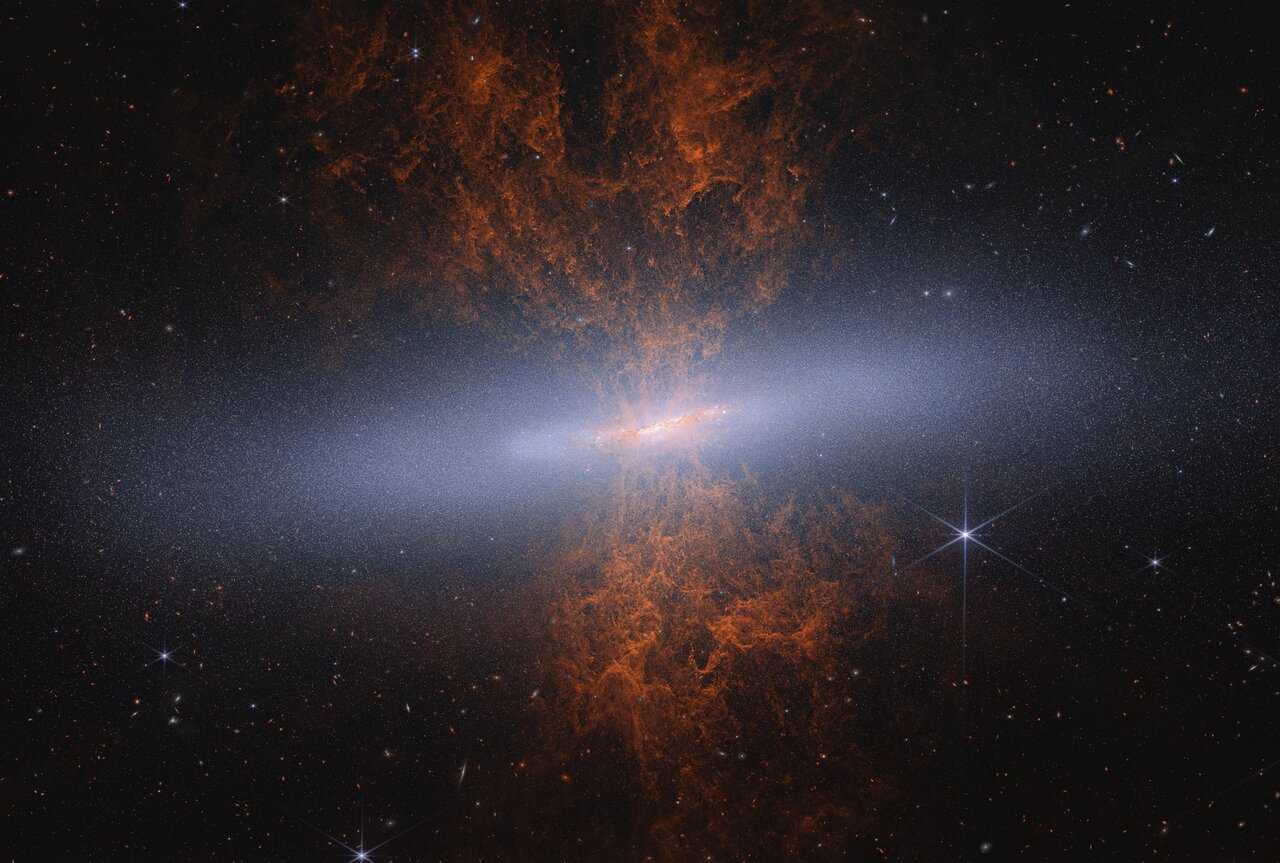
The Webb image contains roughly 16.5 million individually detectable stars. They appear as luminous blue granules spread across the galaxy's disk, and they are only the brightest ones. The total number of stars in a galaxy like M82 is much larger, but most are too faint even for Webb to see as separate points of light.
What the resolved stars can do, however, is act as history books. Their ages, colors, and distribution across the galaxy tell astronomers how star formation has moved through M82 over billions of years. Stellar populations near the center are different from those at the edges. The asymmetry of the disk, one side extending farther than the other, is a fossil of the gravitational interaction with M81.
"At first glance, the disk of the galaxy may seem less spectacular because Webb sees through the dust," said team member Eric Bell of the University of Michigan. "But M82 is a delightfully complex system. Webb's observations will help us address some ongoing mysteries, such as how star formation has moved within M82 over the last few billion years."
Plumes, outflows, and the hourglass
Above and below M82's disk, the galaxy is blowing material into space. The starburst is so intense that it drives bipolar outflows, hourglass-shaped plumes of gas and dust that stretch thousands of light-years away from the galactic plane.
The composite image from Webb and Hubble reveals these outflows in detail. Near the galaxy's bright center, the outflows appear yellow, representing ionized hydrogen gas detected by Hubble. As the material moves farther out, the color shifts to orange, then red, tracing small dust grains called polycyclic aromatic hydrocarbons, or PAHs. These molecules are common in interstellar space and serve as useful tracers of material flowing out of the galaxy.
The layered structure of the outflows suggests that the starburst is not a single event but a series of bursts spread over time. Each layer may correspond to a different episode of star formation, with the most recent material still close to the disk and older material pushed farther out.
Why M82 matters
Starburst galaxies like M82 are not just cosmic fireworks. They are laboratories for understanding how galaxies evolve. When a galaxy forms stars at 10 times the rate of the Milky Way, it is consuming its gas supply much faster than it can be replenished. The outflows are ejecting material that would otherwise form future generations of stars. In a few hundred million years, M82 will be a very different galaxy, and understanding how that process works helps astronomers predict the fate of other starburst galaxies across the universe.
M82 is also close, by cosmic standards. At 12 million light-years, it is one of the nearest starburst galaxies, which means Webb can resolve details that would be impossible to see at greater distances. What astronomers learn here can be applied to more distant galaxies that are harder to study.
"Galaxies are such intricate ecosystems that if you truly want to understand them, you have to pull datasets from different missions together," said team member Kristen McQuinn of the Space Telescope Science Institute. "One mission cannot fully answer all of the questions we have about M82. Combining the data collected by different telescopes, like Webb and Hubble, is powerful. When you marry the datasets, you expand what you can probe, and the questions that you can pose are even more complex."
The survey was program 5145 on Webb, a total of 65 hours of dedicated NIRCam time. The data is now public through the Mikulski Archive for Space Telescopes, and the team expects it will keep astronomers busy for years.
"M82 is an ideal galaxy evolution laboratory because it has properties that allow us to probe important physical processes," Smercina said. "It provides a simultaneous window onto many astrophysical questions, in a way that no other galaxy in the local universe can."
Sources
- NASA Science: "NASA's Webb Pinpoints Millions of Stars Within Cigar Galaxy" - primary NASA science release with full image details and researcher quotes
- ESA/Webb: "Webb pinpoints millions of stars within Cigar Galaxy" - ESA Webb science release, June 23, 2026, with image downloads
- STScI News Release 2026-115 - Space Telescope Science Institute press release
All images are from NASA, ESA, CSA, A. Smercina (STScI), T. Williams (University of Manchester). Image processing: A. Pagan (STScI). These images are publicly released under the standard Webb image use policy and may be used with proper credit. Research paper: JWST Program 5145 (PI: Smercina).
Related on Impossible Universe
- Euclid Just Captured 60 Million Stars at the Milky Way's Heart - another telescope resolving millions of stars in a single frame
- A Star Cluster That Refused to Die: Terzan 5 and the Bulge Fossil Fragments - another dense stellar region hiding in plain sight