Jupiter-Sized Planets Lighter Than Cotton Candy. The Puffiest Worlds Ever Found.
Two gas giants orbiting a star 1,110 light-years away are roughly the size of Jupiter but have densities lower than cotton candy. A global telescope network spent seven years confirming these are the puffiest planets ever detected.
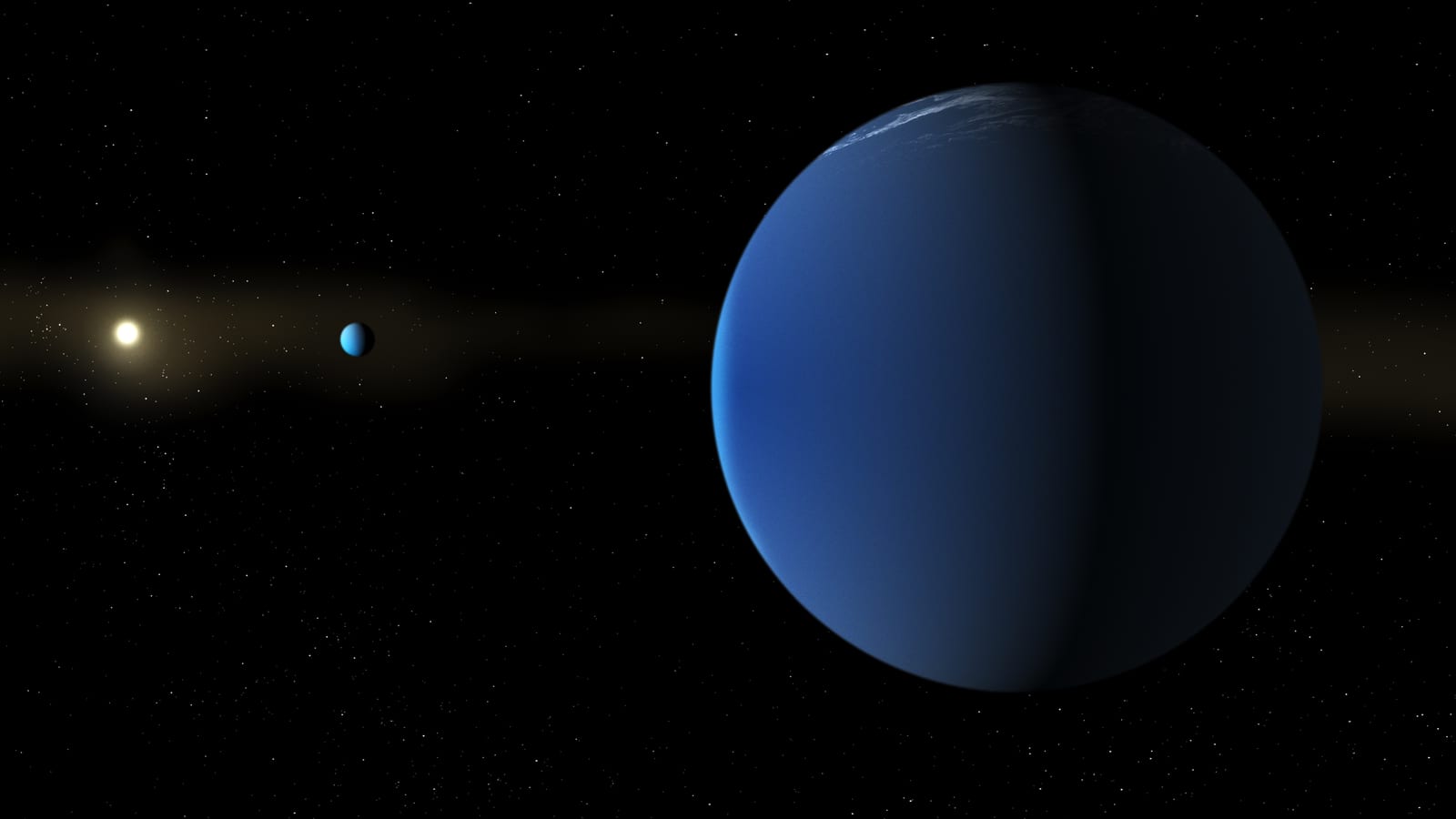
NASA's TESS satellite spent seven years watching a single Sun-like star 1,110 light-years away in the southern constellation Volans. It was looking for tiny dips in brightness that would signal a planet crossing the star's face. The dips it found were ordinary. The planets causing them were not.
Two worlds, each about the size of Jupiter but with so little mass that their density is lower than candy floss, emerged from the data. Named TOI-791 b and TOI-791 c, they are the puffiest planets ever found, and they lock the record for the lowest density exoplanets known to science.
The discovery, published June 25 in the Monthly Notices of the Royal Astronomical Society, was led by Oxford University astronomer George Dransfield and required observations from telescopes on four continents and one in Antarctica.
The numbers that broke the scale
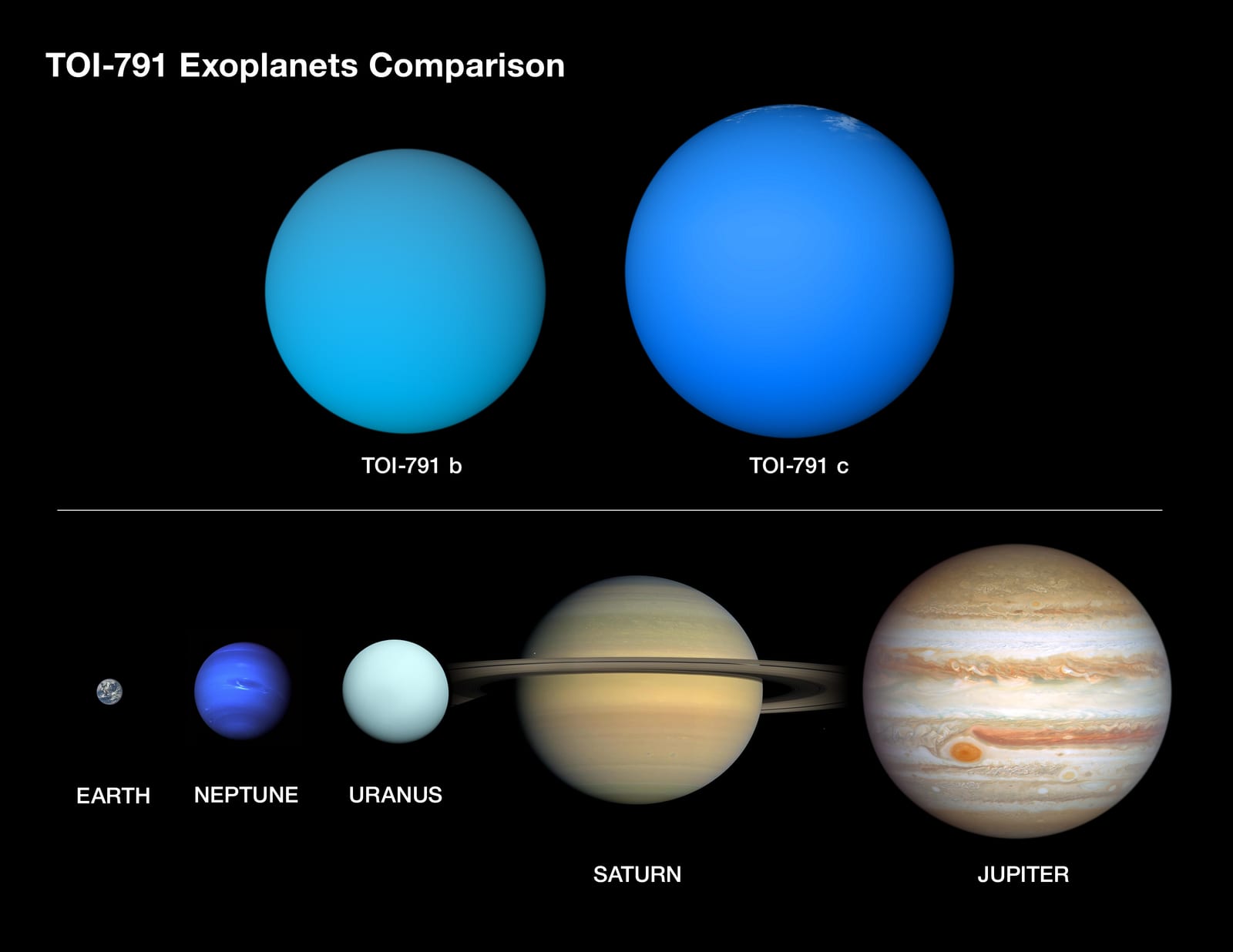
TOI-791 b is nearly the same size as Jupiter but contains just 3.0 percent of Jupiter's mass. Its density works out to 0.038 grams per cubic centimeter. TOI-791 c is slightly denser at 0.047 grams per cubic centimeter, but still more airy than the typical confectionery standard: candy floss has a density around 0.05 grams per cubic centimeter.
For comparison, Jupiter's average density is 1.33 grams per cubic centimeter, roughly 28 to 35 times denser than these super-puff planets. Earth, by contrast, sits at 5.5 grams per cubic centimeter, the densest planet in our solar system.
"The main reason these planets are interesting to study is that we didn't expect to see them at all," said Jon Jenkins, the science lead for the Science Processing Operations Center at NASA's Ames Research Center, which produced the TESS data used in the study. "They represent a puzzle for us to solve about how giant planets like Jupiter and the super-puffs form."
The two planets also have unusually long orbits. TOI-791 b takes 139 days to circle its host star, and TOI-791 c takes 232 days. Most discovered exoplanets orbit their stars in days or weeks, not months. Such long orbital periods are hard to confirm because TESS must watch the same star for multiple transits across many years.
A gravitational dance in a 5:3 rhythm
What makes TOI-791 especially rare is not just the presence of two super-puff planets, but the precision of their orbital relationship. The planets are locked in a 5:3 mean-motion resonance, meaning the inner planet completes five orbits for every three orbits of the outer planet. This ratio is stable but uncommon: only four other star systems are known to host multiple super-puff planets, and the 5:3 resonance in TOI-791 is among the cleanest examples.
The gravitational interaction between the two planets produces measurable timing variations in their transits. As they orbit, they tug on each other in a repeating pattern that slightly shifts when each transit occurs. The research team used this transit-timing variation, recorded over years of TESS data, to calculate the planets' masses with enough precision to confirm their extremely low density.
The volumes and masses came together through an international effort that included the ASTEP telescope at Concordia Station in Antarctica, operated by researchers from Universite Cote d'Azur and collaborators. The Antarctic winter provided months of continuous darkness, which allowed the team to capture each planet's transit, lasting more than 11 hours, in a single unbroken observation. These are the longest continuous planetary transits ever observed in their entirety from the ground.
The mystery of planetary cotton candy
Astronomers do not yet know how super-puff planets form. A gas giant the size of Jupiter with a fraction of its mass must be composed mostly of something extremely light, likely hydrogen and helium, but held in an enormously extended atmosphere that wraps a relatively small solid core.
One leading theory, proposed by MIT researcher Eve Lee and colleagues in 2014, suggests that super-puffs formed far from their host stars in the cold outer regions of the protoplanetary disk. In those cold zones, gas could condense and accumulate rapidly around a solid core, building an enormous puffy atmosphere before the planet migrated inward. The 5:3 resonance supports this picture: the resonance is a signature of gentle migration in which the planets moved inward together while maintaining their orbital lock.
"Only a handful of these super-puffy planets are known, and it is even rarer to find two in the same system," Dransfield said. "Their extremely low densities make them fascinating targets for understanding how planetary systems form and evolve."
What comes next
The team plans to follow up with the James Webb Space Telescope to examine the chemical composition of both planets' atmospheres. If JWST detects carbon-bearing and oxygen-bearing molecules in the extended atmospheres, it could confirm that these giant gas envelopes formed in the cold outer disk and have not been significantly stripped by the star's radiation over time.
"This system offers a unique laboratory for understanding how super-puff planets form and evolve," said Amaury Triaud, a professor at the University of Birmingham and co-author of the study. "We propose to carry out space-based observations using the James Webb Space Telescope to assess if the puffy atmosphere contains carbon-, nitrogen-, and oxygen-bearing species, revealing new insight into how these unusual planets formed."
Another open question is how much these planets spin and whether that spin deforms their shape. Jupiter rotates once every 10 hours and is visibly oblate, bulging at the equator. A super-puff rotating at a similar speed would be noticeably stretched, potentially detectable by high-precision photometry. The researchers also plan to measure the tilt of the host star's rotation axis relative to the planets' orbital plane, which could reveal whether the planets migrated through interactions with the disk or through more violent gravitational scattering.
For now, TOI-791 b and TOI-791 c stand as the lightest large planets known, a pair of siblings caught in a gravitational waltz that challenges what planetary formation models can explain. They will not stay at the top of the puffiest list forever. The combination of TESS data, the Roman Space Telescope launching in August 2026, and dedicated surveys will almost certainly find more. But being first in a category this strange is a rare thing.
Sources
- NASA Science: NASA's TESS Mission Reveals the Puffiest Planets Ever Found - primary NASA coverage with mission context and researcher quotes
- Dransfield et al., Monthly Notices of the Royal Astronomical Society (2026) - peer-reviewed paper: "ASTEP confirmation of a pair of long-period Jupiter-sized planets with extremely low densities transiting TOI-791"
- EurekAlert / University of Oxford press release - detailed announcement with international collaboration context and Antarctic telescope background
- Popular Science: Two super-puff planets are as wispy as cotton candy - accessible coverage with density comparison details
Hero image: NASA/Daniel Rutter artist illustration of the TOI-791 planetary system. Comparison graphic: NASA/Daniel Rutter. Both images are public domain NASA materials. The research described in this article is peer-reviewed and published in Monthly Notices of the Royal Astronomical Society (DOI: 10.1093/mnras/stag864).
Related on Impossible Universe
- JWST Saw Dawn and Dusk on a Hellish Exoplanet - another extreme world where JWST revealed atmospheric details
- JWST Found Salt Clouds on the Pink Planet - another exoplanet atmosphere decoded after years of waiting